
Chongfan Technology
News
04
2026
-
08
The Shanghai Institute of Optics and Fine Mechanics has made progress in the development of an intelligent distributed control system for laser-wakefield accelerators.
Author:
Recently, the National Key Laboratory of Ultra‑Intense Laser Science and Technology at the Shanghai Institute of Optics and Fine Mechanics, Chinese Academy of Sciences, in collaboration with the Institute of Modern Physics, Chinese Academy of Sciences, and Lanzhou University, has achieved a critical engineering breakthrough in the development of an end‑to‑end intelligent distributed control system for laser wakefield accelerators (LWFA). Leveraging the national major scientific instrument project “Next‑Generation Ultra‑Intense Ultra‑Short Laser Comprehensive Experimental Facility,” the research team has successfully built a complete distributed control system based on the EPICS (Experimental Physics and Industrial Control System) architecture and validated it through beam‑line experiments. The system supports a full suite of capabilities, including real‑time control of field‑deployed hardware, high‑speed image data streaming, and integrated storage and management of multidimensional experimental data, thereby enabling automated, intelligent closed‑loop control across the entire LWFA experimental workflow. The findings have been published in High Power Laser Science and Engineering under the title “Design and Implementation of a Control System for the Laser Wakefield Accelerator at the Shanghai Institute of Optics and Fine Mechanics.”
As LWFA technology undergoes rapid iteration, compact plasma accelerators are progressively advancing toward stable, automated experimental operations. However, current systems rely heavily on manual parameter tuning, and the transmission of massive multi‑camera beam‑diagnostic images faces bandwidth and latency bottlenecks. Moreover, supporting subsystems—such as timing synchronization, heterogeneous data storage, and remote collaborative monitoring—exhibit significant shortcomings, making it difficult to underpin fully automated, AI‑driven closed‑loop optimization experiments. To address these challenges, the research team leveraged the EPICS distributed control framework to develop an integrated hardware–software control system. They designed a hierarchical hardware architecture and a four‑layer modular software stack, innovatively incorporating RoCEv2 for high‑speed image transfer, a hybrid storage solution combining MySQL, InfluxDB, and MinIO, a dual‑mode visualization interface, and an end‑to‑end electronic experiment‑log module.
System test results show that our in-house RoCEv2 transport solution significantly reduces network jitter and CPU‑side protocol‑stack overhead, with a median latency only one‑tenth of that achieved by conventional TCP. The entire system enables unified control of 36 multi‑model subsystems, including diagnostic cameras, lasers, vacuum systems, gas targets, and beam‑profile detectors. Its hybrid storage architecture can stably archive 4 TB of image data per experiment while maintaining zero data loss over long‑term operation, supporting microsecond‑resolution time‑stamped storage of tens of thousands of EPICS process variables (PVs) and second‑level retrieval. A dual visualization approach—combining a local Phoebus client with remote web‑based visualization via Vue3—enables fine‑grained local equipment control and cross‑site real‑time monitoring, complemented by tiered alarm mechanisms and hardware safety interlocks to ensure the facility’s reliable long‑term operation. Customized electronic logs further enable end‑to‑end traceability and correlation of experimental parameters, images, and alarm information.
This system integrates the entire workflow of LWFA experimental equipment—control, signal acquisition, data storage, status monitoring, and experiment archiving—while also providing a standardized AI‑data interface to support unattended, intelligent closed‑loop operation of LWFA experiments. Compared with conventional discrete measurement and control solutions, this system offers distinct advantages in real-time responsiveness, platform scalability, and remote collaborative operation. Its comprehensive, generic architecture is highly portable and can be widely deployed across a range of large‑scale scientific facilities, including petawatt‑class ultra‑intense lasers and synchrotron radiation sources.
This research has been supported by multiple funding programs, including the Strategic Priority Program of the Chinese Academy of Sciences, the National Natural Science Foundation of China, the CAS Young Scientists Basic Research Program, and the New Cornerstone Science Foundation’s Scientific Exploration Award.
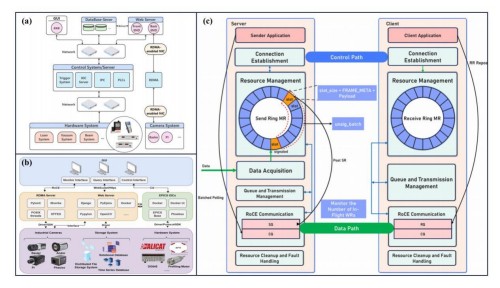
Figure 1. Design framework of a distributed control system: (a) Hardware hierarchical architecture; (b) Software hierarchical architecture; (c) User-space Remote Direct Memory Access (RDMA) transmission framework.
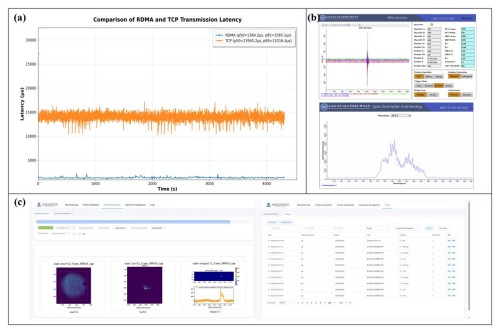
Figure 2 (a) Comparison of RDMA and TCP transmission latencies; (b) Partial view of the on-site equipment control interface; (c) Partial view of the web-based data storage visualization and electronic log interface.
Source: Shanghai Institute of Optics and Fine Mechanics
LATEST NEWS
Thank you for visiting the official website of Chongfan Technology. If you have cooperation intentions or suggestions, please contact us through the following methods, and we will reply as soon as possible, thank you!
Address: Room 403, Building 6, Phase III of R&D, No. 36 Xiyong Avenue, High tech Zone, Chongqing, China.
Telephone: +86-13658337211
E-mail: Sales@cfkeji.net
Website: www.cfkeji.net
Mobile Version