
Chongfan Technology
News
17
2026
-
11
The Changchun Institute of Optics and Fine Mechanics has made new progress in suppressing polarization aberrations in optical systems.
Author:
Like wavefront aberration and optical efficiency, polarization aberration is a fundamental property of optical systems that affects the amplitude, phase, and polarization of incident light. In applications demanding extremely high imaging quality or detection accuracy—such as lithographic imaging, polarization metrology, and astronomical remote sensing—polarization aberration represents a significant source of error. However, since polarization aberration is determined jointly by the system’s structural and coating parameters, its optimization and suppression typically require complex trade-offs among multiple critical performance metrics, including wavefront aberration and optical efficiency, posing challenges such as numerous constraints and limited degrees of freedom in control.
To address the aforementioned issues, the research team proposed a method for compensating polarization aberrations in optical systems. As an afocal optical element, the planar mirror offers an inherent advantage in decoupling wavefront aberrations from polarization aberrations. The team found that, in non‑parallel light paths, it can generate polarization aberrations with a specific spatial distribution, whose characteristics are dominated by low‑frequency components (Figure 1), and whose frequencies precisely match those of polarization aberrations in most optical systems. Building on this key finding, the research team developed a polarization aberration compensation scheme for optical systems based on planar mirrors.
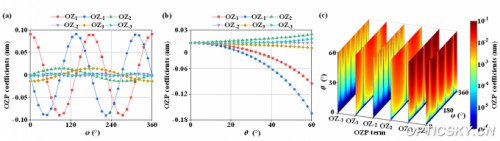
Figure 1. Relationship between Zernike coefficients in the Z direction and changes in the spatial orientation of the plane mirror
The aforementioned method was validated using optical design software. For a typical off-axis three-mirror anastigmat optical system, by adding a planar mirror and precisely adjusting its pose, the system’s polarization aberration was successfully reduced to 1/15 of its original level, and the average phase delay across the full field of view decreased significantly from 0.0759 rad to 0.0050 rad (Fig. 2), while key performance metrics such as wavefront error and optical efficiency remained essentially unaffected. A comparison of the polarization aberrations of the optical system before and after compensation is shown in Fig. 3. Furthermore, the polarization aberration compensation mechanism of the planar mirror and the influence of its quantity on the compensation effectiveness were systematically analyzed.
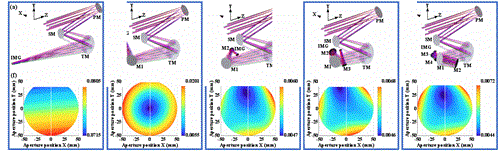
Figure 2. Structure of the optical system before and after polarization compensation, and the corresponding phase-delay pupil.
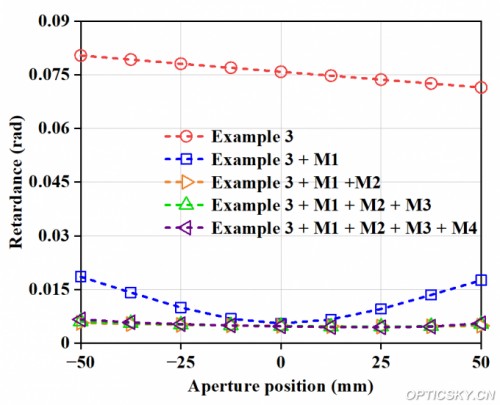
Figure 3. Comparison of polarization aberrations in the optical system before and after compensation (1–4 planar mirrors)
Because plane mirrors are extensively used in optical systems and are easy to operate, the proposed method is of great value for optimizing and controlling polarization aberrations in high-performance optical systems and holds significant potential for practical engineering applications. The relevant results were published under the title “Method to compensate for polarization aberrations in optical systems based on plane mirrors” in Optics and Lasers in Engineering 202, 109767 (2026).
The corresponding author of the paper is Associate Researcher Luo Jing from the Third Department of Space at the Changchun Institute of Optics and Precision Mechanics, Chinese Academy of Sciences, and the first author is doctoral student Chen Xingda. This work was supported by the Jilin Provincial Natural Science Foundation for Young Scientists (Category B), the National Natural Science Foundation of China, the National Key R&D Program, the Chinese Academy of Sciences Youth Innovation Promotion Association, and the Chinese Academy of Sciences Strategic Priority Program (Category B).
Source: Changchun Institute of Optics and Fine Mechanics
Previous
Previous
LATEST NEWS
Thank you for visiting the official website of Chongfan Technology. If you have cooperation intentions or suggestions, please contact us through the following methods, and we will reply as soon as possible, thank you!
Address: Room 403, Building 6, Phase III of R&D, No. 36 Xiyong Avenue, High tech Zone, Chongqing, China.
Telephone: +86-13658337211
E-mail: Sales@cfkeji.net
Website: www.cfkeji.net
Mobile Version
