
Chongfan Technology
News
04
2026
-
08
The Shanghai Institute of Optics and Fine Mechanics has proposed a configurational entropy engineering strategy to enable bismuth-doped glass optical fibers to achieve ultra-broadband luminescence.
Author:
Recently, the research team led by Researcher Huli Li at the Department of Advanced Laser and Optoelectronic Functional Materials of the Shanghai Institute of Optics and Fine Mechanics, Chinese Academy of Sciences, has proposed a configurational entropy engineering strategy tailored for bismuth-doped glasses and optical fibers. By modulating the glass-forming kinetics, the team froze the glass network in a high-energy, highly disordered structural state, effectively suppressing the aggregation of Ge and Bi elements and the associated nonradiative energy losses. This approach enabled the fabrication of bismuth-doped silica optical fibers with significantly reduced background and non-saturating losses, achieving broadband amplification spanning 1680–1750 nm, laser emission at 1650 nm and 1720 nm, and proof-of-concept methane sensing. The findings were published in Advanced Functional Materials under the title “Configurational Entropy Engineering of Bi-Doped Glass Fiber Enabling Ultrabroadband Emission.”
Near-infrared broadband amplifiers and lasers are critical light sources for next-generation high-capacity optical communications, molecular spectroscopy, and fiber‑optic sensing. Conventional erbium‑doped fiber amplifiers (EDFAs) offer a relatively narrow effective gain bandwidth, making it difficult for them to independently meet the ever‑increasing demand for transmission capacity. Bismuth‑doped silica fibers can generate broadband near‑infrared emission in the 1000–1800 nm range and are compatible with established silica fiber manufacturing technologies, thus emerging as promising candidates for expanding the communication wavelength band.
The core challenge lies in the gain–loss trade-off. The optical properties of bismuth active centers (BACs) are highly sensitive to the local coordination environment; while increasing the bismuth content enhances gain, it also promotes the aggregation of excess Bi ions in Ge‑rich regions, forming non‑emissive atomic clusters and quenching centers that elevate background losses and non‑saturation losses. Consequently, how to suppress elemental clustering while maintaining a high dopant concentration is a critical issue for advancing bismuth‑doped fibers toward high‑performance devices.
Unlike high-entropy alloys that rely on the mixing entropy of multiple components, the configurational entropy strategy treats the glass-forming pathway as a design variable: by employing ultrafast cooling, the disordered topological structure of the high‑temperature melt is frozen into a metastable state characterized by high energy and high configurational entropy. In Ge/Bi co‑doped quartz, the Si–O network freezes first, while the still‑mobile Ge–O units readily form Ge‑rich clusters, into which Bi tends to partition. Conventional cooling affords sufficient time for Ge migration and Bi clustering, leading to the formation of Ge‑ and Bi‑rich domains; in contrast, ultrafast quenching imposes kinetic arrest before these domains can grow. Phase diagrams and molecular dynamics simulations indicate that, despite the thermodynamic driving force for phase separation, increasing the cooling rate can compress diffusion and relaxation times, thereby suppressing clustering.
Spherical-aberration-corrected TEM reveals that the average size of Ge‑rich clusters decreases from 5.42 nm in the slow‑cooled sample to 1.66 nm in the quenched sample. Synchrotron‑based total X‑ray scattering and PDF/rPDF analyses indicate that the slow‑cooled sample exhibits stronger peaks corresponding to Bi–Bi atomic pairs and more pronounced medium‑range oscillations, suggesting more extensive Ge–Bi clustering; by contrast, the quenched sample displays a more disordered local structure, higher transmittance, and enhanced near‑infrared luminescence. DSC, in situ PDF, and in situ transmission spectroscopy further demonstrate that the high configurational entropy state is a kinetically frozen metastable phase: upon heating, the Bi‑related structural motifs and Ge‑rich clusters relax sequentially; after prolonged annealing at 500 °C, the optical properties irreversibly degrade to levels comparable to those of the slow‑cooled sample.
Using the same preform, the research team increased the drawing speed from 30 m/min to 100 m/min, subjecting the fiber core to more intense ultrafast cooling. With Ge/Bi concentrations remaining essentially unchanged, the background loss decreased from 400 dB/km to 210 dB/km, and the unsaturated loss dropped from 33.5% to 25.8%. The fiber achieved a net gain exceeding 20 dB in the 1680–1750 nm wavelength range, with an average net gain approximately 5 dB higher than that of the reference fiber, and it also delivered laser output at 1720 nm and 1650 nm. When the 1650‑nm laser was coupled with a hollow‑core fiber gas cell, the output power exhibited a systematic decrease as methane pressure increased, thereby validating its gas‑sensing capability.
The value of this work lies not only in the development of bismuth‑doped optical fibers with superior performance, but also in the proposal of a structural‑control paradigm for amorphous functional materials. While conventional design focuses on “what to add” and “how much to add,” configurational entropy engineering goes a step further by addressing “how to form”: by carefully tuning the cooling rate and relaxation pathway, it locks in non‑equilibrium structures before deleterious clustering can occur. This approach offers a new route to simultaneously achieve high doping levels, strong luminescence efficiency, and low energy dissipation, and it can be extended to other rare‑earth‑ or main‑group‑element‑doped glasses.
This study establishes a configurational entropy engineering approach for bismuth‑doped glass optical fibers: by employing ultrafast cooling to lock the glass network into a highly disordered, high‑energy metastable configuration and implementing kinetic trapping prior to the growth of Ge/Bi aggregation domains, it suppresses bismuth clustering, nonradiative energy transfer, and optical losses. The resulting fiber exhibits a reduction in background loss from 400 dB/km to 210 dB/km, a decrease in unsaturated loss from 33.5% to 25.8%, and achieves a net gain exceeding 20 dB across the 1680–1750 nm wavelength range, along with laser emission at 1650 and 1720 nm. Configurational entropy engineering elevates the “cooling history” from a fabrication parameter to a designable structural variable, providing a unified thermodynamic–kinetic framework for controlling local coordination, elemental distribution, and energy transport in amorphous materials.
In the future, this strategy is expected to be extended to rare-earth‑doped glasses, amorphous luminescent materials, and other functional glass systems, and integrated with multiscale simulations, in situ characterization, and advanced forming processes, thereby establishing quantitative correlations among “formation pathways—local structure—device performance.” This research has been supported by the Chinese Academy of Sciences’ Strategic Priority Science and Technology Program, the National Key R&D Program, projects funded by the Shanghai Municipal Science and Technology Commission, and the Advanced Glass R&D Platform, among others.

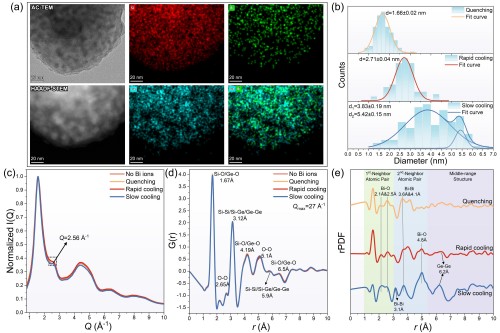
Figure 1. Multiscale structural evidence: Aberration-corrected TEM elemental mapping, synchrotron X-ray total scattering, and the radial pair distribution function (rPDF) collectively demonstrate that rapid quenching can reduce the size of Ge clusters and suppress the aggregation of Bi‑related structures.
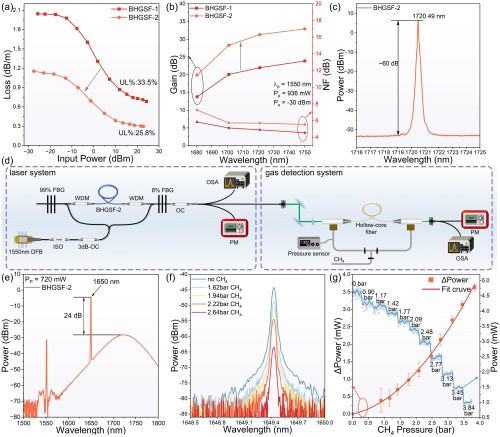
Figure 2: Device performance verification: Configuration entropy engineering enables optical fibers with reduced unsaturated loss, broadband amplification in the 1680–1750 nm range, laser output at 1650 and 1720 nm, and hollow-core fiber–based methane sensing.
Source: Shanghai Institute of Optics and Fine Mechanics
LATEST NEWS
Thank you for visiting the official website of Chongfan Technology. If you have cooperation intentions or suggestions, please contact us through the following methods, and we will reply as soon as possible, thank you!
Address: Room 403, Building 6, Phase III of R&D, No. 36 Xiyong Avenue, High tech Zone, Chongqing, China.
Telephone: +86-13658337211
E-mail: Sales@cfkeji.net
Website: www.cfkeji.net
Mobile Version