
Chongfan Technology
News
04
2026
-
08
The Haiguang Institute has achieved new progress in the field of high-resolution dual-comb spectroscopic detection technology.
Author:
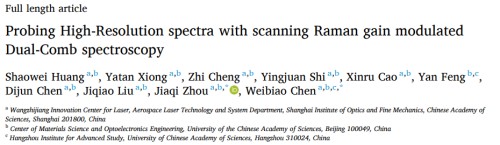
Recently, the research team led by Researcher Jiaqi Zhou at the Shanghai Institute of Optics and Fine Mechanics, Chinese Academy of Sciences, has achieved new advances in the field of high-resolution dual-comb spectroscopic detection. The related research findings were published in Optics and Laser Technology under the title “Probing High-Resolution Spectra with Scanning Raman Gain Modulated Dual-Comb Spectroscopy.”
Dual-comb spectroscopy has emerged as a highly promising precision spectroscopic technique, owing to its broad spectral coverage, high spectral resolution, exceptional sensitivity, and rapid data acquisition. However, the resolution of conventional dual-comb spectroscopy is inherently limited by the repetition rate of the optical frequency comb. The repetition rates of typical mode-locked laser combs typically range from tens to hundreds of megahertz, making it difficult to meet the stringent spectral‑resolution requirements in fields such as low‑pressure and cold‑atom spectroscopy, isotopic analysis, and fine‑structure probing. Moreover, reducing the repetition rate to achieve higher resolution would severely narrow the spectral coverage, complicate the system architecture, and degrade noise performance, thereby compromising the simultaneous attainment of wide spectral coverage and high resolution.
To address this issue, the research team employed a Raman‑gain‑modulated dual‑comb spectroscopy scheme based on single‑frequency seed injection. By applying stepwise frequency tuning to the single‑frequency laser, they drove all the comb teeth of the optical frequency comb to scan in synchrony, thereby progressively filling the spectral gaps between the teeth and lifting the limitation imposed by the original repetition rate on spectral resolution. Since an optical frequency comb comprises tens of thousands of longitudinal modes, precise control of the single‑frequency laser’s tuning is not required during the scanning process. The entire system utilizes all‑polarization‑maintaining fiber components, features a compact design, and exhibits robust environmental stability; the underlying principle is illustrated in Figure 1.
The team applied this system to the measurement of carbon dioxide absorption spectra. By performing 27 frequency sweeps, the system automatically completed the inversion and stitching of high‑resolution spectral data within a few minutes, achieving a spectral resolution of approximately 3.8 MHz over a bandwidth of ~776 GHz, with a signal‑to‑noise ratio of 36 dB. The resulting high‑precision absorption lines are in excellent agreement with theoretical predictions (Fig. 2). The entire measurement and inversion process requires no post‑processing correction algorithms, and the optical frequency comb does not necessitate any additional electrical locking.
This technical approach effectively decouples the trade-off between spectral coverage and resolution inherent in conventional dual-comb systems. While maintaining broad spectral coverage, it boosts resolution to the MHz level without relying on complex active stabilization or algorithmic compensation. With its compact architecture, tunable resolution on demand, and robust resistance to external perturbations, it offers a new technological pathway for cutting-edge applications that require exceptionally high spectral resolution. This work has been supported by projects including the National Key R&D Program, the National Natural Science Foundation of China, the Chinese Academy of Sciences’ International Partnership Program, and the Shanghai Municipal Science and Technology Innovation Action Plan.
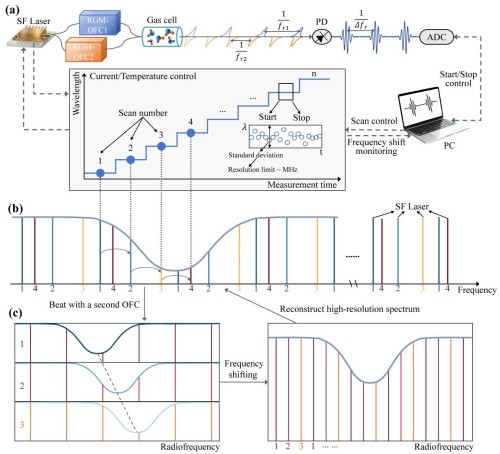
(Figure 1: Principle of scanning high-resolution Raman gain‑modulated dual-comb spectroscopy. (a) Time-domain plot of the system’s scanning sequence. (b) Principle of spectral scanning and detection. (c) RF spectrum signal and the process of reconstructing the high-resolution spectrum.)
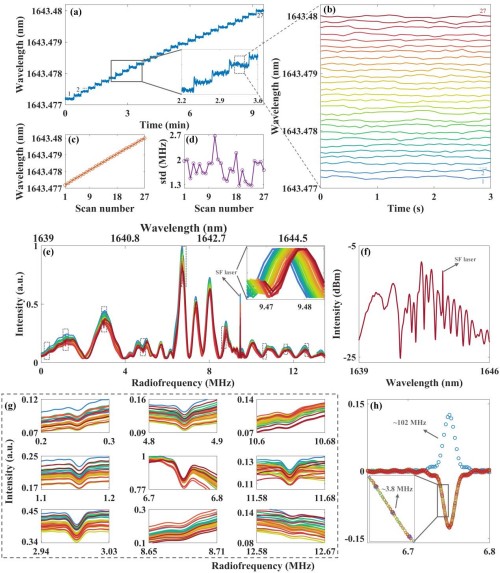
(Figure 2: Results of the 27‑group scan. (a) Stepwise scan data recorded by the wavelength meter. (b) Wavelength fluctuations during data acquisition for the 27 groups. (c) Wavelength variations across the 27 scans. (d) Standard deviation of the wavelengths for the 27 scans. (e) Dual-comb spectral data obtained from the 27 groups. (f) Spectral data. (g) Multiple gas absorption lines detected. (h) Comparison between a single dual‑comb spectral measurement and the results of the 27‑group scan.)
Source: Shanghai Institute of Optics and Fine Mechanics
LATEST NEWS
Thank you for visiting the official website of Chongfan Technology. If you have cooperation intentions or suggestions, please contact us through the following methods, and we will reply as soon as possible, thank you!
Address: Room 403, Building 6, Phase III of R&D, No. 36 Xiyong Avenue, High tech Zone, Chongqing, China.
Telephone: +86-13658337211
E-mail: Sales@cfkeji.net
Website: www.cfkeji.net
Mobile Version