
Chongfan Technology
News
30
2026
-
07
National University of Defense Technology: Spectral Shaping “Moves In” to Optical Fiber, Slimming the Spectrum of Cascaded Raman Lasers | HPLSE Article Recommendation
Author:
Spectral Broadening in Cascaded Raman Fiber Lasers
Cascaded Raman Fibre Laser (CRFL) generates higher-order Stokes light by exploiting stimulated Raman scattering in passive optical fibers, making it a key technological approach for achieving flexible wavelength tuning and power scaling. However, under high‑power operation, the temporal noise of the pump light propagates through successive stages; coupled with nonlinear effects such as four‑wave mixing, cross‑phase modulation, and self‑phase modulation, the higher-order Stokes light inevitably suffers from significant spectral broadening—initially “ Well-proportioned figure The spectrum gradually “ Chubby and plump ”, as shown in Figure 1. Although existing technologies have made significant advances in power enhancement and wavelength tuning, these improvements often come at the expense of spectral purity—particularly the difficulty in suppressing broadening of the spectral wings—which to some extent limits their applications in areas such as nonlinear frequency conversion and precision spectroscopy.
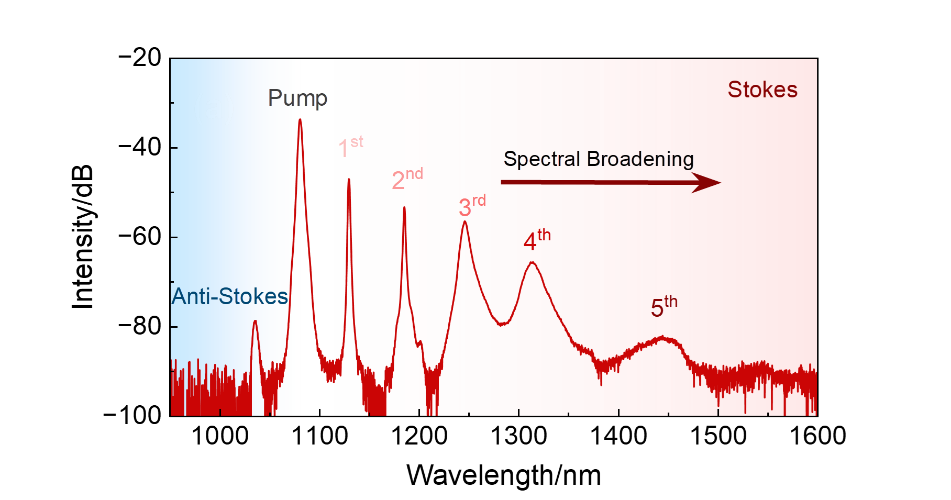
Figure 1. Spectral broadening in a cascaded Raman fiber laser.
In recent years, wavefront shaping techniques based on spatial light modulators (SLMs) have achieved remarkable success in the field of spatial light‑field manipulation. The underlying principle is to actively control the incident wavefront, thereby transforming disordered media from mere “scattering objects” into “controllable optical elements.” Inspired by this approach, researchers have begun exploring the application of similar concepts to fiber‑optic systems.
Passive Spectral Control: Enabling Spectral Shaping to “Reside” Within Optical Fibers
The research team led by Researcher Zhou Pu and Associate Researcher Yao Tianfu at the National University of Defense Technology has proposed a completely new approach: drawing on the conventional active modulation scheme that relies on external components such as SLMs, they leverage the intrinsic random spectral response of fiber Bragg gratings as a physical platform for spectral shaping, thereby implementing this concept in… Passive, built-in The approach “resides” within the fiber itself. The ingenuity of this concept lies in the fact that it requires no external active modulation hardware; instead, the function of “spectral shaping” is directly integrated into the fiber‑optic device, effecting a transition from “active control” to “passive on‑board implementation.”
Relevant results have been published in High Power Laser Science and Engineering Issue 3, 2026 ( Xiulu Hao, Tianfu Yao, Bing Lei, Bangwen Yin, Shanmin Huang, Chenchen Fan, Jinyong Leng, Pu Zhou, Ilya N. Nemov, Alexander V. Dostovalov, Sergey A. Babin, "Passive spectral tailoring via random fibre gratings for linewidth management in a kilowatt cascaded Raman fibre oscillator," High Power Laser Sci. Eng. 14, 03000e45 (2026) )
Specifically, when such a fiber Bragg grating with random refractive-index fluctuations is placed inside a cascaded Raman oscillator, a wavelength-selective feedback mechanism emerges: the wavelength components aligned with the high-reflection regions experience stronger feedback and longer photon lifetimes, thereby gaining an advantage in mode competition, while noise components deviating from the central wavelength are effectively suppressed. A schematic illustration of this operating principle is shown in Figure 2. This process is analogous to a… Passive Self-Optimizing Spectral Shaping System , purify and select the most coherent optical modes from the broadband noise background.
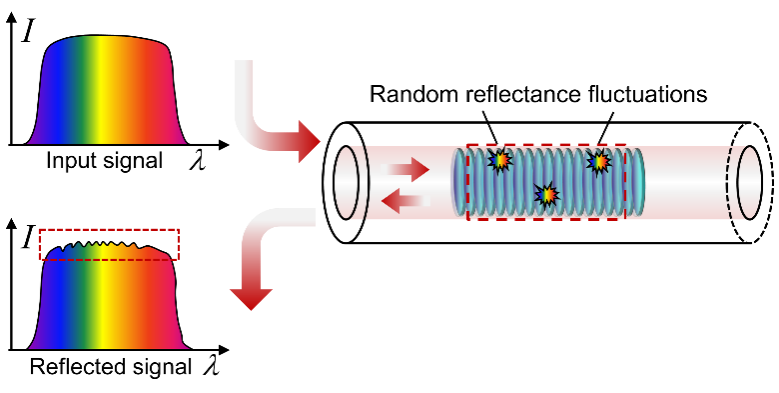
Figure 2 Schematic diagram of the operating principle of grating-based random feedback
“Slimming” the Spectrum: Experimental Validation
Based on the aforementioned control strategy, the research team constructed an experimental two-stage cascaded Raman oscillator system operating at 1080 nm → 1130 nm → 1185 nm. By employing a fiber Bragg grating with intrinsic random reflectivity fluctuations, they enabled spectral shaping to be seamlessly integrated within the fiber, thereby facilitating linewidth management in the cascaded Raman laser.
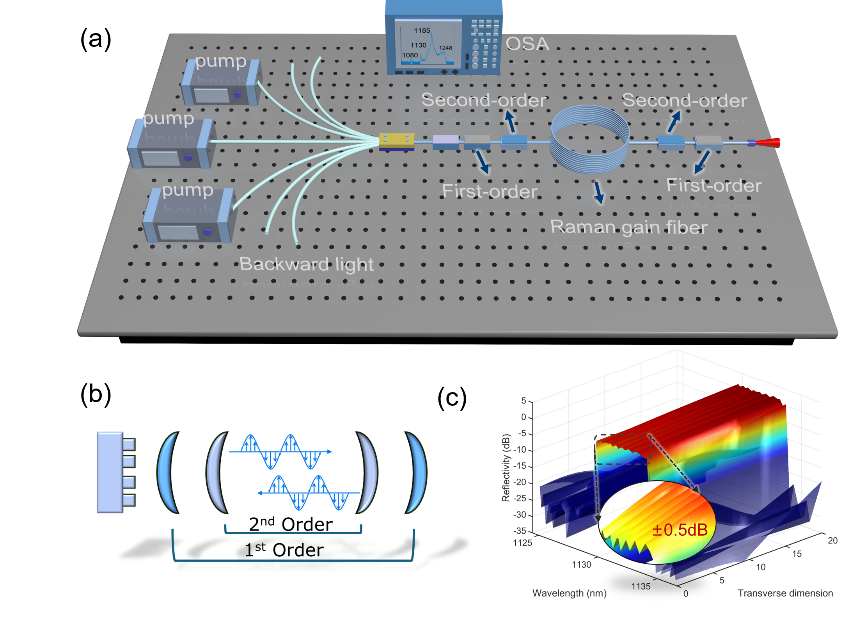
Figure 3 (a) Schematic diagram of the experimental setup for a cascaded Raman fiber laser; (b) Schematic illustration of the principle of passive spectral modulation; (c) Random refractive index distribution of the grating.
Experimental results show that, at the optimal fiber length, the system achieved a 1185‑nm laser output of 1031 W. More importantly, the spectral quality was significantly improved: the “narrowing” effect was pronounced. Compared with the feedback‑free control group, the 3‑dB linewidth narrowed from 1.3 nm to 1.1 nm, the 10‑dB linewidth decreased from 3.6 nm to 2.9 nm, and the 30‑dB linewidth—characterizing the spectral wing broadening—was substantially compressed from 14.2 nm to 9.5 nm. These findings provide preliminary validation of the effectiveness of the passive spectral‑control mechanism. In terms of temporal stability, passive spectral control also demonstrated favorable performance. At full power of 1031 W, the normalized intensity standard deviation remained below 0.03, and the RF spectrum was flat with no significant peaks, enabling stable continuous-wave operation.
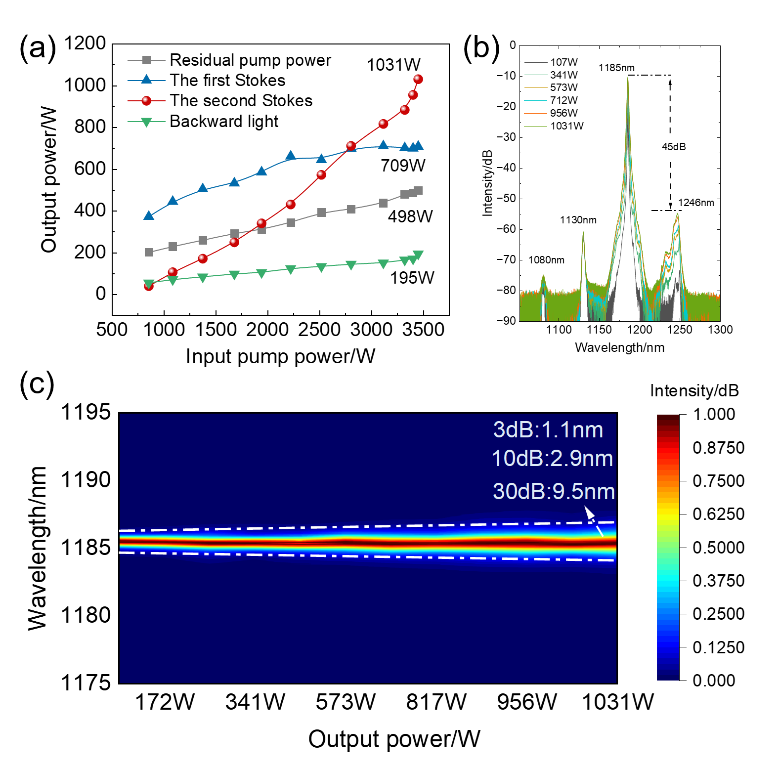
Figure 4. Experimental results: (a) Output power of the signal light; (b) Evolution of the output spectrum with increasing output power; (c) Linewidth characteristics of the output spectrum.
Original article link: https://mp.weixin.qq.com/s/SNUiK2mtXEmxCLmi1ACysw
LATEST NEWS
Thank you for visiting the official website of Chongfan Technology. If you have cooperation intentions or suggestions, please contact us through the following methods, and we will reply as soon as possible, thank you!
Address: Room 403, Building 6, Phase III of R&D, No. 36 Xiyong Avenue, High tech Zone, Chongqing, China.
Telephone: +86-13658337211
E-mail: Sales@cfkeji.net
Website: www.cfkeji.net
Mobile Version