
Chongfan Technology
News
15
2026
-
06
Snapshot 3D Image Projection System Based on a Diffractive Optical Decoder
Author:
A research team from the Samueli School of Engineering at UCLA and the California NanoSystems Institute (CNSI), led by Professor Aydogan Ozcan, has developed a snapshot‑style 3D imaging projection system that integrates a digital encoder with a passive diffractive optical decoder, enabling end‑to‑end joint optimization via deep learning. This hybrid architecture can project multiple distinct images onto closely spaced axial planes in a single shot, marking a significant step toward compact, high‑fidelity volumetric 3D display technology. The findings have been published in the journal Light: Science & Applications.

Conceptual diagram of a snapshot-based 3D image projection system
3D imaging technologies are essential for next-generation holography, immersive visualization, and augmented reality/virtual reality (AR/VR) interfaces, where precise depth‑dependent focusing cues are critical for natural depth perception and visual comfort. However, dense depth multiplexing in conventional holographic displays remains a significant challenge: as axial image planes become increasingly close within the output volume, diffraction‑induced crosstalk rapidly degrades depth selectivity and image fidelity.
System Operating Principle
The UCLA team’s approach addresses this challenge by pairing a learned digital encoder with a passive multilayer diffractive decoder composed of structurally optimized surfaces. The encoder, built on a Fourier neural network, extracts multiscale spatial and frequency-domain features from a stack of target images, integrates axial‑position information, and generates a single phase pattern that simultaneously encodes all 3D images to be projected.
The encoded wavefront is then propagated through structurally optimized diffractive surfaces, which physically implement depth‑dependent field programming during light propagation, optically routing the image content to its designated axial depth while inherently suppressing interlayer crosstalk.
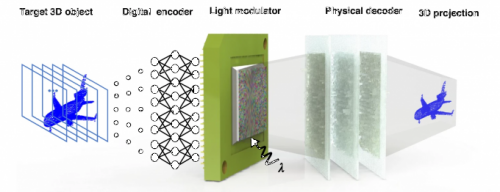
Schematic Diagram of a Snapshot-Based 3D Image Projection System
Simulation and Experimental Results
Through numerical simulations, the researchers demonstrated multi‑plane snapshot imaging with axial plane spacing on the order of a single wavelength, and showed that the system can be scaled to volumetric scenes comprising 28 axial slices, all encoded within a single phase pattern. The work also characterizes key design parameters—including the depth of the diffractive decoder, output diffraction efficiency, spatial light modulator resolution, and axial encoding density—providing practical design guidelines for future diffractive 3D displays.
The research team further experimentally validated this framework by employing a single-layer physical decoding device operating in the visible spectrum, implemented as a two‑plane optical prototype. The measured intensity patterns closely matched both the numerical simulations and the target image, significantly outperforming the diffraction‑free free‑space baseline, thereby demonstrating the feasibility of a hybrid digital–optical architecture for snapshot 3D imaging.
Potential Applications and Prospects
This work establishes a compact, scalable platform for snapshot 3D imaging with high axial resolution, with potential applications including holographic and near-eye AR/VR displays, multi-depth volumetric microscopes, real-time 3D visualization, and volumetric optical computing. Looking ahead, the framework can be extended to multispectral operation, multi-view holography, and physically fabricated multilayer passive decoders, enabling the construction of compact, energy-efficient 3D display systems.
Source: phys
LATEST NEWS
Thank you for visiting the official website of Chongfan Technology. If you have cooperation intentions or suggestions, please contact us through the following methods, and we will reply as soon as possible, thank you!
Address: Room 403, Building 6, Phase III of R&D, No. 36 Xiyong Avenue, High tech Zone, Chongqing, China.
Telephone: +86-13658337211
E-mail: Sales@cfkeji.net
Website: www.cfkeji.net
Mobile Version