
Chongfan Technology
News
15
2026
-
06
A team from Jinan University has, for the first time, discovered free-space optical skyrmions exhibiting a dual texture of spin–energy flow.
Author:
Recently, Associate Researcher Wang Sicong and Professor Qin Fei from the School of Physics and Optoelectronic Engineering (School of Science and Engineering) at Jinan University, in collaboration with the team led by Ren Xifeng at the University of Science and Technology of China, published their latest research findings titled “Unveiling Spin and Poynting Dual Textures of an Optical Skyrmionic Tube in Free Space” in the internationally renowned journal Physical Review Letters. Skyrmions, owing to their distinctive topological structure, have long attracted extensive attention from the global academic community.
Skyrmions originated in particle physics research. Their distinctive feature is their robust topological protection, which makes them resistant to external perturbations, rendering them promising candidates for next‑generation high‑density information storage, data transmission, and intelligent optical devices.
In 2018, the concept of skyrmions was introduced into the field of optics for the first time, giving rise to the notion of “optical skyrmions” and opening up a new research direction in topological optics. Since then, researchers have successively discovered a variety of optical skyrmion structures arising from different physical quantities—such as light‑field polarization, spin, Stokes parameters, and energy flow—and have demonstrated their significant application potential in areas including optical communication, information processing, and precision metrology. Owing to their dual appeal—both fundamental scientific significance and practical prospects—optical skyrmions have become one of the cutting‑edge research hotspots in international optics.
In 2024, the team, building on a 4π focusing system, theoretically predicted for the first time energy‑flow optical skyrmions—topological quasiparticles formed by the trajectories of light’s energy flow (the Poynting vector)—as reported in Phys. Rev. Lett., 2024, 133, 073802. However, 4π focusing systems require the precise coherent superposition of multiple laser beams, imposing extremely stringent demands on experimental precision and posing substantial challenges to both the experimental observation and practical applications of such energy‑flow skyrmions. Meanwhile, existing free‑space optical skyrmions typically involve only a single physical quantity and are largely confined to two‑dimensional planar structures, which significantly limits their ability to interact with matter and their potential for real‑world applications.
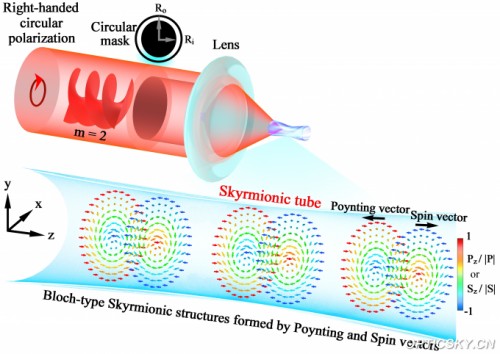
Generating tubular distributions of spin–orbit dual‑texture optical skyrmions in free space by means of a ring‑shaped, second‑order circularly polarized vortex beam tightly focused.
To address this challenge, the research team has proposed a novel solution. Their findings reveal that, by tightly focusing an annular second‑order circularly polarized vortex beam using only a conventional single‑lens focusing system, it is possible to generate in free space a “spin–angular momentum double‑texture optical skyrmion.” In this configuration, the spin and angular momentum—two distinct physical degrees of freedom—share the same skyrmionic topological texture, enabling the coexistence of a “dual topological structure” within a single light beam. Experimental results further confirm that this structure can form a stable tubular topological distribution extending nearly ten wavelengths along the direction of light propagation. This demonstrates that optical skyrmions are no longer confined to two dimensions; instead, they have attained three‑dimensional topological architectures with substantial depth, offering a new pathway for extending topological light fields into three‑dimensional space.
This work further refines the research framework for optical skyrmions, offering an effective approach to harness their interactions with matter. It will help advance applied research in the fields of spin dynamics and energy transport, with broad prospects for applications in precision metrology, optical tweezers, particle manipulation, and related areas.
Source: Jinan University
LATEST NEWS
Thank you for visiting the official website of Chongfan Technology. If you have cooperation intentions or suggestions, please contact us through the following methods, and we will reply as soon as possible, thank you!
Address: Room 403, Building 6, Phase III of R&D, No. 36 Xiyong Avenue, High tech Zone, Chongqing, China.
Telephone: +86-13658337211
E-mail: Sales@cfkeji.net
Website: www.cfkeji.net
Mobile Version