
Chongfan Technology
News
09
2026
-
06
Shanghai Tech University undergraduates have published a research paper in the journal Optica.
Author:
Recently, Ying Zhuochao and Tan Bangxin, undergraduate students from the Gezhi Innovation Class of the School of Intelligent Science and Technology at Shanghai Tech University, published their latest research findings in Optica as co‑first authors. The paper is titled “On-demand holographic VCSELs with integrated nanoprinted diffractive neural networks.”
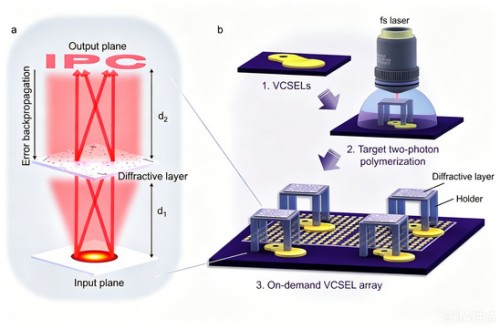
Schematic diagram of the holographic VCSEL principle
Holographic technology can precisely control the direction, intensity, and optical state of light, enabling functions such as three-dimensional imaging and beam shaping, and holds great promise for applications in cutting-edge fields like optical displays, optical communications, and optical computing. A VCSEL is a compact, low‑power, high‑speed, and easily integrable micro‑laser, making it an ideal core component for fabricating chip‑scale holographic light‑emitting devices. However, conventional theoretical designs of holographic VCSELs often diverge from their actual performance; these designs typically rely on assumptions about idealized light sources, neglecting the intrinsic emission characteristics of real VCSELs, which in turn hinders practical implementation.
To address this challenge, the research team innovatively proposed an inverse design approach for diffractive neural networks (DNNs) that incorporates the device’s real‑world physical characteristics. First, they experimentally measured the actual optical field distribution of the VCSEL under operating current and constructed a weak waveguide–fiber model for calibration and fitting. By integrating these real‑world emission data into the neural network training process, they ensured that the holographic structure design accurately reflects the device’s actual operating conditions. Simultaneously, leveraging high‑precision two‑photon nanolithography, they directly fabricated a holographic functional layer on the VCSEL surface, successfully developing an integrated miniature holographic laser array. In experiments, this device reliably projected high‑quality holographic images, enabling functions such as display and data distribution.
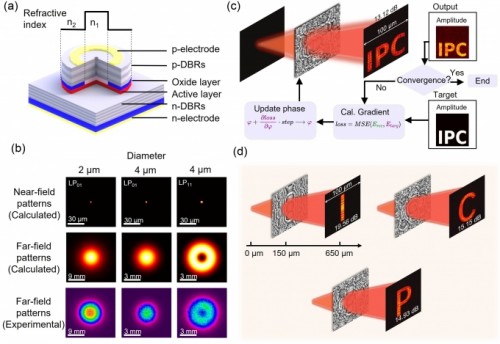
Design of a VCSEL holographic diffractive layer supporting Diffractive Neural Networks (DNN)
The innovation of this study lies in its integration of the VCSEL’s real-world light-emitting characteristics into the design model, the development of a universal holographic VCSEL design algorithm based on diffractive neural networks, and the monolithic integration of the holographic diffraction layer with the VCSEL device. This approach offers a novel design paradigm and fabrication strategy for chip-scale active holographic emitters, demonstrating promising applications in on-chip ultrashort‑range optical communication, micro‑display technologies, and integrated optical systems.
This achievement stems from the groundbreaking “Large‑Project‑Based Course” established by the Gezhi Innovation Class. It represents a vivid implementation of the college’s initiative to cultivate talent in the field of industrial intelligence, exploring the educational philosophy of “early team integration, early involvement in research projects, and early access to research platforms.” The work underscores the Gezhi Innovation Class’s success in developing innovative curricula and fostering students’ deep engagement in scientific research. The paper was supervised by Associate Researcher Dong Yibo, an academic mentor for undergraduate students at the School of Intelligent Science and Technology, with additional, in‑depth guidance provided by Associate Researcher Luan Haitao.
Source: University of Shanghai for Science and Technology
LATEST NEWS
Thank you for visiting the official website of Chongfan Technology. If you have cooperation intentions or suggestions, please contact us through the following methods, and we will reply as soon as possible, thank you!
Address: Room 403, Building 6, Phase III of R&D, No. 36 Xiyong Avenue, High tech Zone, Chongqing, China.
Telephone: +86-13658337211
E-mail: Sales@cfkeji.net
Website: www.cfkeji.net
Mobile Version