
Chongfan Technology
News
09
2026
-
06
An Guang has achieved a breakthrough in the research and development of light sources for non-Doppler wind‑profiling lidar.
Author:
Recently, the research team led by Researcher Zhang Tianshu at the Anhui Institute of Optics and Fine Mechanics, Chinese Academy of Sciences, has achieved a breakthrough in the development of light sources for non‑Doppler wind‑profiling lidar. They have designed a lightweight, passively Q‑switched Nd:YAG master oscillator power amplifier (MOPA) laser based on dual single‑emitter diode pumping, with key performance metrics surpassing those of comparable commercial products from abroad. The related findings were published under the title “Dual single-emitter diode-pumped passively Q-switched Nd:YAG MOPA laser for wind lidar” in Optics Express, a journal of the Optical Society of America.
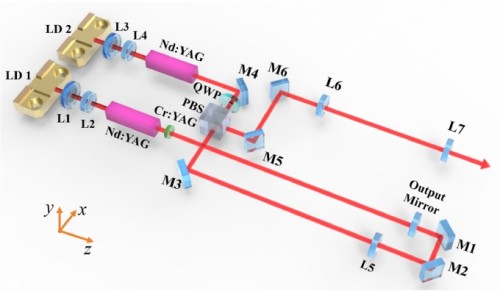
Nd:YAG MOPA laser system setup
High‑resolution wind‑field sensing in the near‑surface layer—spanning vertical heights from 0 to several hundred meters—is critical for emerging applications such as the low‑altitude economy, wind‑energy optimization, and aviation safety. The team at the Anhui Institute of Optics and Fine Mechanics has overcome the longstanding challenges of high cost and poor environmental robustness associated with conventional Doppler wind‑lidar systems in complex near‑surface deployments, providing core technological support for high‑resolution near‑surface wind‑field sensing within a range of several hundred meters. This miniaturized, highly stable, and environmentally resilient passively Q‑switched Nd:YAG master‑oscillator power‑amplifier (MOPA) laser, pumped by a dual‑monolithic diode, makes wind measurement simpler, more affordable, and more accurate.
Traditional Doppler lidar systems face two major technical challenges: first, they rely on complex frequency‑shift demodulation techniques; second, they demand extremely high precision and stringent control over optical‑system imperfections, requiring rigorous suppression of optical aberrations. To overcome these bottlenecks, the team pioneered a compact, highly stable passively Q‑switched MOPA architecture and adopted a dual‑single‑diode pumping scheme, in which a single diode independently pumps both the oscillator and the amplifier. At the same time, this system integrates a two‑stage temperature‑control design and a polarization‑coupled, bidirectional amplification configuration, enabling superior thermal management and efficient energy extraction while eliminating the size constraints imposed by conventional cooling systems.
The R&D team conducted comprehensive performance tests on this independently developed, integrated laser system, which demonstrated outstanding performance across key parameters: at a repetition rate of 3.96 kHz, the device stably delivers pulses with a pulse width of 5.012 nanoseconds and a single-pulse energy of 442.9 microjoules. Meanwhile, the beam quality approaches the diffraction limit. Notably, the system exhibits exceptional thermal robustness: within an ambient temperature range of 30–50°C, its laser power fluctuation is kept within ±3%, and the maximum beam pointing drift does not exceed 50 micro-radians. In several critical core performance metrics, this laser outperforms comparable commercial products from overseas.
In addition to breakthroughs in core light-source technologies, the team has also achieved significant innovations in the application of the complete LiDAR system. They successfully integrated this high‑energy microchip laser into a multi‑beam, scan‑free, non‑Doppler LiDAR architecture, employing advanced algorithms to track aerosol motion. This enabled continuous 24‑hour near‑surface wind‑profiling measurements. Empirical data demonstrate that the temporal trends of wind speed and direction captured by the device closely match those from in situ meteorological sensors, confirming the precision and reliability of the measurements.
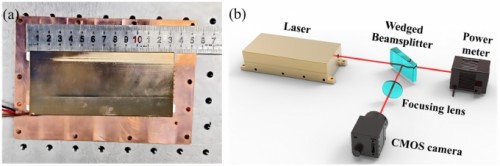
In terms of practicality, this laser weighs only 400 grams, significantly enhancing the compactness of the LiDAR system and enabling seamless integration with various mobile platforms, such as medium-sized unmanned aerial vehicles (UAVs), making it suitable for a wide range of applications.
This achievement not only provides a highly feasible, low-cost, and easily deployable new solution for remote sensing of near-surface wind fields in complex environments, but also lays the core technological foundation for future urban microclimate monitoring and three-dimensional dynamic wind-field mapping in challenging terrains, thereby helping to ensure the safe operation of the low‑altitude economy and drive its industrial upgrading.
Dr. Chen Jinxin is the first author of the paper, Master’s student Wang Yuyang is a co-author, and Researcher Zhang Tianshu is the corresponding author. This research was supported by the National Key R&D Program.
Source: Anhui Institute of Optics and Fine Mechanics
LATEST NEWS
Thank you for visiting the official website of Chongfan Technology. If you have cooperation intentions or suggestions, please contact us through the following methods, and we will reply as soon as possible, thank you!
Address: Room 403, Building 6, Phase III of R&D, No. 36 Xiyong Avenue, High tech Zone, Chongqing, China.
Telephone: +86-13658337211
E-mail: Sales@cfkeji.net
Website: www.cfkeji.net
Mobile Version