
Chongfan Technology
News
22
2026
-
10
The Purple Mountain Observatory has jointly unveiled a new mechanism for planetesimal formation in disk winds and turbulent environments.
Author:
Recently, the Purple Mountain Observatory of the Chinese Academy of Sciences, in collaboration with the Institute for Advanced Study at Tsinghua University, used high-resolution numerical simulations to demonstrate that, in a complex protoplanetary disk environment governed by the combined effects of magnetic fields, turbulence, and disk winds, dust can still undergo substantial aggregation, thereby creating favorable conditions for planetesimal formation. The relevant findings were published in The Astrophysical Journal Letters on October 15, 2026.
Planetesimals are a crucial link in the evolutionary process by which dust in protoplanetary disks coalesces into planetary embryos, and elucidating their formation mechanisms is of great significance for understanding the origins of planets, particularly exoplanets. However, during growth, dust particles can fragment through mutual collisions or rapidly drift inward toward the central star and accrete onto it via gas–dust interactions, posing the well-known “meter‑size barrier” to planetesimal formation. Moreover, gas–dust interactions can trigger streaming instabilities, driving localized dust concentrations that provide an important pathway for overcoming this barrier and facilitating planetesimal formation. Nevertheless, in the complex environment of a protoplanetary disk—where magnetic fields, turbulence, and disk winds all play concurrent roles—whether this mechanism can persist and operate effectively remains an open question requiring further investigation.
The research team, using the magnetohydrodynamic code Athena++ and a custom‑developed dust multi‑fluid module, identified both large‑scale disk winds and intra‑disk turbulence within a single model (Figure 1), and elucidated the small‑scale dust‑aggregation processes underlying these phenomena. The results show that, under varying magnetic field strengths, cooling conditions, and dust grain sizes, the streaming instability can still drive the formation of high‑density clumps, leading to local dust densities that exceed the threshold for gravitational collapse and thus exhibiting the potential to give rise to planetesimals (Figure 2). Further analysis reveals that disk winds, by stripping gas from the disk surface, increase the relative abundance of dust within the disk, thereby creating favorable conditions for planetesimal formation. Moreover, in regions with stronger magnetic fields, localized magnetic field concentrations can generate ring‑like gas structures capable of trapping dust, slowing its radial drift and further promoting dust aggregation. These findings provide new physical insights into the mechanisms of planetesimal formation in real protoplanetary disks.
Associate Researcher Huang Pinghui of the Purple Mountain Observatory is the first author and the corresponding author of the paper, with Professor Bai Xueneng of Tsinghua University serving as a co-corresponding author. This research was supported by the National Natural Science Foundation of China’s Key Project and Youth Science Fund, among others, and the computational work was carried out on the Purple Mountain Observatory’s high-performance computing platform, “Zimo.”
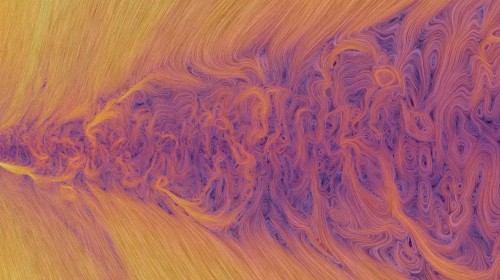
Figure 1: Vertical-plane gas flows in a protoplanetary disk, illustrating the complex turbulence within the disk and the magnetized disk-wind structure at the disk surface.
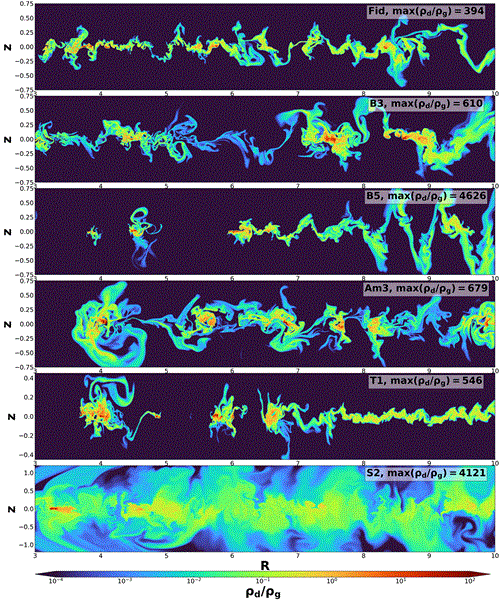
Figure 2: Dust aggregation under different simulation conditions. The red regions correspond to high-density dust clumps, within which planetesimals can form efficiently.
Source: Purple Mountain Observatory
Previous
Previous
LATEST NEWS
Thank you for visiting the official website of Chongfan Technology. If you have cooperation intentions or suggestions, please contact us through the following methods, and we will reply as soon as possible, thank you!
Address: Room 403, Building 6, Phase III of R&D, No. 36 Xiyong Avenue, High tech Zone, Chongqing, China.
Telephone: +86-13658337211
E-mail: Sales@cfkeji.net
Website: www.cfkeji.net
Mobile Version
