
Chongfan Technology
News
09
2026
-
06
A research team at the National Astronomical Observatories has uncovered new clues to the formation history of globular clusters in the Andromeda Galaxy’s halo.
Author:
Recently, the team led by Academician Zhao Gang at the National Astronomical Observatories of the Chinese Academy of Sciences conducted a joint analysis of 29 star clusters in the halo of the Andromeda Galaxy (M31), using spectroscopic data from the Xinglong 2.16-meter telescope and multi-wavelength photometric data. The results were published in The Astronomical Journal under the title “The Spectroscopic and Photometric Study of a Star Cluster Sample in Andromeda Halo.”
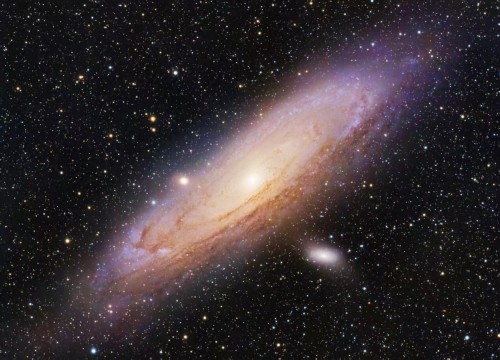
Figure 1: An astrophotograph of the Andromeda Galaxy (M31), showing its two satellite galaxies, M32 and NGC 205. (Image source: Gu Hongrui)
M31 lies approximately 2.5 million light-years from the Milky Way, and its halo globular clusters preserve a record of its early merger and accretion history. Precise measurements of these clusters’ ages and metallicities enable us to trace M31’s assembly process. Previous studies have struggled to obtain high‑precision parameters simultaneously; this work presents, for the first time, a multi‑band photometric–spectroscopic analysis spanning the ultraviolet to the near‑infrared for 29 halo globular clusters, providing more robust constraints on the assembly history of M31’s halo.

Figure 2: The black dots show the spatial distribution of 29 star clusters across the sky, while the three hollow ellipses represent the morphology of the M31 galaxy and its two satellite galaxies (M32 and NGC 205).
The team obtained low-resolution optical spectra for 29 star clusters using the BFOSC spectrograph on the 2.16-meter telescope. For photometry, they integrated u- and v-band data from the SAGES survey, along with publicly available datasets from GALEX, PAN-STARRS, and 2MASS, covering a total of 12 bands spanning the ultraviolet to the near-infrared. The analysis employed two approaches: spectral‑photometric joint fitting based on the BC03 model to derive precise age constraints, and full-spectrum fitting using the ULySS package to determine metal abundances. The final results combine the strengths of both methods.
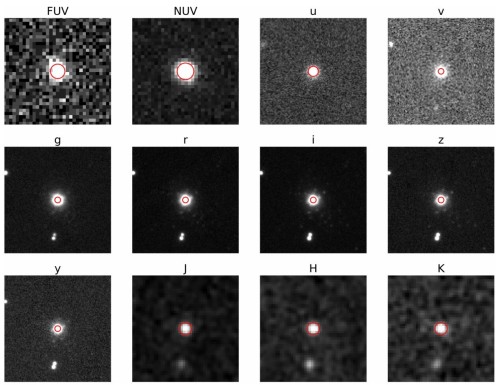
Figure 3: Shows the 48×48 square arcsecond image data for each of the 12 bands used in this study for a particular star cluster (G002).

Figure 4 shows the spatial distribution of 29 sample star clusters on the M31 stellar substructure map. The M31 substructures labeled in the figure include: streams A–D, the Giant Stream G, the Northeast Structure NE, the Northwest Stream NW, and the Southwest Cloud SW. The left and right panels partition the sample according to metallicity: metal-rich ([Fe/H] > −1.5, left panel) and metal-poor ([Fe/H] ≤ −1.5, right panel). The color of each point indicates age: red (<10 billion years), green (10–15 billion years), and blue (>15 billion years). The star clusters marked with names in the figure are discussed in detail in the paper.
The study determined the ages and metallicities of 29 star clusters, three of which were analyzed jointly for the first time. The results show that the vast majority of these clusters are very old (>10 billion years) and metal-poor ([Fe/H] < −1.5), in agreement with previous high-resolution studies and LAMOST findings. Notably, no clear radial gradient in metallicities was detected in the M31 halo, suggesting that these clusters may have originated in different satellite galaxies rather than forming in situ. Furthermore, the young cluster B517 lies along the D stellar stream and exhibits a consistent metallicity, confirming a physical association; by contrast, H26, although projected to overlap with the C stellar stream, displays a significant metallicity difference, indicating that this is merely a projection effect.
This study demonstrates the capability of combined spectroscopic–photometric analysis. In the future, the Chinese Space Station Survey Telescope (CSST) will deliver near-ultraviolet data at higher spatial resolution, enabling more in-depth investigations of ultraviolet excess phenomena. Meanwhile, the complementary nature of LAMOST and SAGES survey data will lay the groundwork for studies involving larger samples. This approach will also serve as an important reference for future galactic archaeology.
With funding from the National Natural Science Foundation of China’s Outstanding Research Group Project, “Galactic and Nearby Universe Studies Based on LAMOST and FAST,” Gu Hongrui, a doctoral student at the National Astronomical Observatories, served as the first author, while Academician Zhao Gang, Associate Researcher Fan Zhou, and other researchers co-authored this study.
Source: National Astronomical Observatories
LATEST NEWS
Thank you for visiting the official website of Chongfan Technology. If you have cooperation intentions or suggestions, please contact us through the following methods, and we will reply as soon as possible, thank you!
Address: Room 403, Building 6, Phase III of R&D, No. 36 Xiyong Avenue, High tech Zone, Chongqing, China.
Telephone: +86-13658337211
E-mail: Sales@cfkeji.net
Website: www.cfkeji.net
Mobile Version