
Chongfan Technology
News
09
2026
-
06
Significant progress has been made in the study of the distant activity of long-period comets.
Author:
Recently, the Shanghai Astronomical Observatory of the Chinese Academy of Sciences, in collaboration with the Purple Mountain Observatory, has made significant progress in the study of the long-period comet’s activity at large heliocentric distances. Leveraging the high-precision Yunnan–Hainan–Puerto Rico Telescope (YHPT) at the Yao’an Station of the Purple Mountain Observatory, the research team conducted systematic observations of the long-period comet C/2023 A3 (Tsuchinshan–ATLAS). This study is the first to reveal the comet’s enhanced activity at relatively large heliocentric distances—between 7.2 and 5.9 astronomical units—and to characterize the evolution of its distant‑distance activity. These findings provide empirical evidence for understanding the mechanisms underlying cometary activity at great distances and the patterns governing its evolutionary behavior. The results were published online on May 25, 2026, in the international astronomical journal The Astrophysical Journal.
Long-period comets originate in the Oort Cloud, where they have preserved vast quantities of highly volatile primordial material in extremely low-temperature conditions, serving as natural probes for studying the early evolution of the Solar System and the origins of the building blocks of life. C/2023 A3 (Tsuchinshan–ATLAS) is a long-period retrograde comet from the Oort Cloud that became visible to the naked eye in 2024; it has also been dubbed the “Great Comet of 2024” and has been one of the most closely watched cometary objects in both the global astronomical community and the public eye in recent years. C/2023 A3 (Tsuchinshan–ATLAS) was jointly discovered by the Purple Mountain Observatory and South Africa’s Asteroid Terrestrial Impact Last Alert System. The comet reached perihelion on September 27, 2024, at a heliocentric distance of 0.39 astronomical units.

Figure 1. Morphological evolution of comet C/2023 A3 (Tsuchinshan–ATLAS) in the R band over time, with each image covering a field of view of 31.8″ × 31.8″.
The conventional view holds that cometary activity driven by the sublimation of water ice typically occurs within 3 au, whereas in the distant region beyond 5 au, cometary activity is very weak, the underlying mechanisms remain unclear, and the available observational samples are scarce. To address this critical scientific question, the research team conducted continuous monitoring of C/2023 A3 from March to July 2023, obtaining high‑quality data over 21 effective observing nights, spanning a continuous range of heliocentric distances from 7.2 au down to 5.9 au.
The study finds that the comet’s dust production rate and effective scattering cross-section both increase steadily as its heliocentric distance decreases, while its activity index exhibits a distinct two-stage evolution, with activity levels at large distances far exceeding those of typical comets. The coma’s color displays a unique evolutionary pattern, suggesting the combined influence of gas emission and changes in dust particle size.
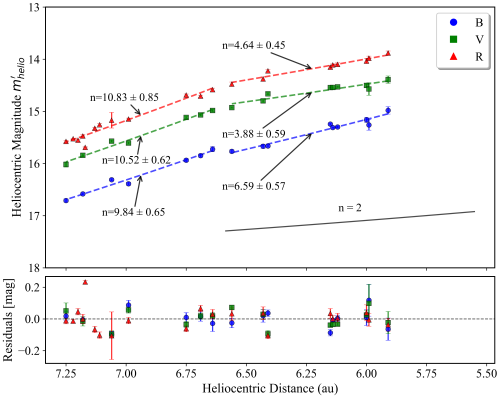
Figure 2. Variation of the activity index of comet C/2023 A3 (Tsuchinshan–ATLAS) with heliocentric distance.
This study successfully filled the observational data gap for comet C/2023 A3 in the distant region between 5 and 7 astronomical units, while also providing a highly valuable representative observational sample and empirical support for establishing a comprehensive classification framework for the long-period comets’ activity at large heliocentric distances.
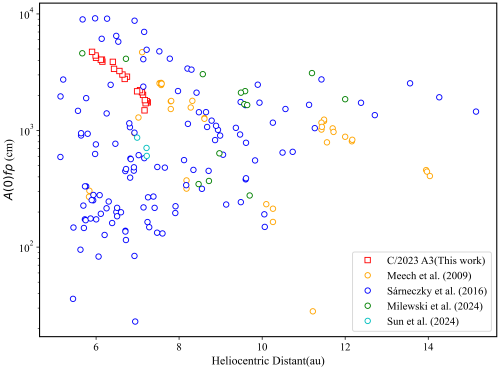
Figure 3. Variation of the A(0)fρ value of comet C/2023 A3 (Tsuchinshan–ATLAS) with heliocentric distance, compared with other distant long-period comets.
The first author of the paper is Wu Yingqi, a master’s student at the Shanghai Astronomical Observatory, and the corresponding author is Shi Jianchun. This research was supported by the National Natural Science Foundation of China, funding for the operation, maintenance, and upgrade of astronomical telescopes from the Chinese Academy of Sciences, and the China Manned Space Program, among other projects.
Source: Shanghai Astronomical Observatory
LATEST NEWS
Thank you for visiting the official website of Chongfan Technology. If you have cooperation intentions or suggestions, please contact us through the following methods, and we will reply as soon as possible, thank you!
Address: Room 403, Building 6, Phase III of R&D, No. 36 Xiyong Avenue, High tech Zone, Chongqing, China.
Telephone: +86-13658337211
E-mail: Sales@cfkeji.net
Website: www.cfkeji.net
Mobile Version