
Chongfan Technology
News
05
2026
-
06
The TianGuan satellite has obtained the most complete X-ray image to date of the supernova remnant W28.
Author:
Supernova remnants are structures formed when the gas and dust ejected by a massive star during its final explosive phase collide with the interstellar medium and expand—essentially the remnants left behind after the “cosmic fireworks” have faded. Supernova remnant W28 is one of the prototypical “thermal‑composite” supernova remnants in the eyes of astronomers, yet its full X-ray morphology has long remained elusive. During the early in-orbit testing phase following its launch, the FXT (Fast X-ray Telescope), an instrument aboard the Einstein Probe (EP) satellite developed under the leadership of the Chinese Academy of Sciences, observed W28, yielding the most complete X-ray spectral imaging to date. The resulting research, titled “A complete X-ray view of supernova remnant W28 with the Einstein Probe: Spatial distribution of parameters, and the origin of the thermal-composite morphology,” was published in May 2026 in the astronomical journal Astronomy & Astrophysics. Based on the multi-wavelength images of W28 obtained by FXT, the image was selected as the featured image for that issue.
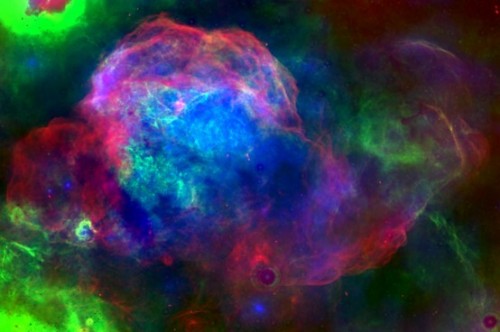
Figure 1: In this figure, red denotes the 1.3 GHz emission from the MeerKAT radio telescope, green represents the optical Hα emission line observed by SuperCOSMOS, and blue shows the X-ray emission in the 0.4–2.3 keV energy range detected by EP-FXT. North is toward the top, and west is to the right. (Image source: Chi Yiheng et al.)
A supernova is the most spectacular way a star can die. Following the explosive flash, the shock wave generated by the explosion sweeps through and heats the ejected material as well as the surrounding interstellar gas, forming a bright nebula known as a supernova remnant, which continues to expand over tens of thousands of years, stretching out to hundreds of light-years. Typically, the gas is compressed into a thin shell that emits bright X-rays; however, a distinct class of supernova remnants behaves differently, with bright, hot gas persisting even in their central regions, where gas would normally be scarce. These are called thermally mixed supernova remnants. For a long time, W28—located about 6,000 light-years from Earth—has been regarded as one of the prototypical examples of such remnants. Observations of W28 conducted by the Fengxing Tian satellite have, for the first time, yielded the most complete X-ray image of this object, revealing its intricate and unique morphological features as well as the physical origins of the bright X-ray-emitting gas within.
The most striking discovery of “Feng Xing Tian” is a faint, shell‑like structure on the western side of W28. It is visible simultaneously in X-ray, optical, and radio images—exactly the hallmark of a typical supernova remnant. Although previous studies at other wavelengths had identified certain localized features in the western shell as potential SNR candidates, the wide‑field observations of “Feng Xing Tian” reveal that the shell’s north–south extent and its pronounced curvature both point to a common origin: a supernova explosion at the heart of W28. In the past, W28 was thought to have a radius of roughly 40 light-years; however, the newly detected western shell suggests that the shock wave from this supernova has swept through a much larger region of the interstellar medium, extending to about 80 light-years. Moreover, based on the shock front traced by the shell, spectral observations from “Feng Xing Tian” indicate that W28 is approximately 8,000 years old—considerably younger than the previously estimated ~40,000 years.
The achievement of complete X-ray imaging of W28 is made possible by two core capabilities of the “Fengxing Tian” instrument: first, its wide 1° × 1° field of view, which allows a single observation to encompass the entire structure of W28, thereby greatly simplifying the previously cumbersome process of stitching together multiple overlapping exposures; second, its exceptional ability to detect low‑surface‑brightness signals—thanks to the instrument’s extremely low background noise, faint shell structures and diffuse emission can be clearly resolved against the background.
Based on the spectral data of “Fengxing Tian,” the research team conducted a comprehensive diagnostic analysis of the hot gas in W28. The gas in the western shell is both hot and tenuous, whereas the gas filling the central region is relatively cooler but more dense; however, these two structures exhibit nearly identical pressures, providing more direct evidence that the western shell is an integral part of W28.
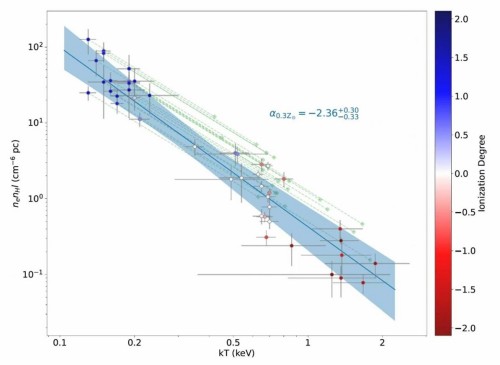
Figure 2: Distribution of the electron temperature (horizontal axis) and radiative measure (proportional to the square of the density) of the warm gas in W28, based on “Fengxingtian” data. The blue points indicate gas undergoing rapid cooling. These data points can be fitted by a power-law function with an exponent of approximately −2, reflecting that the warm gas within W28 follows an isobaric distribution. The green dashed line marks the isobar corresponding to the rapidly cooling data points, while its other end indicates the likely location of the warm gas in these regions prior to rapid cooling. (Image source: Chi Yiheng et al.)
More detailed analysis reveals that in the central region of W28, a portion of the hot gas is undergoing rapid cooling: the electron temperature has dropped sharply over a short timescale, while the recombination of ions and electrons to lower ionization states will require a much longer period. We have precisely observed this intermediate state—“electrons have cooled, but recombination remains incomplete.” The “Wind in Heaven” observations not only detect signatures of rapid cooling in the spectrum but also spatially delineate the regions where this cooling is taking place. By combining data from multiple wavelength bands, we find that these rapidly cooling hot gas clumps are spatially highly coincident with the warm gas clouds emitting optical Hα emission lines. This suggests that heat exchange between them may be responsible for the recent rapid cooling of the hot gas; at the same time, the thermal evaporation of the cooler cloudlets provides a mass source for the hot gas filling the center of W28.
In the traditional morphological classification of supernova remnants, shell-type and thermal‑mixed types are regarded as distinct categories. However, in W28, the western shell exhibits typical shell‑type characteristics, while the central region displays a thermal‑mixed morphology—both coexisting within the same remnant. This suggests that the observed differences in morphology and ionization signatures are, in fact, merely the outcomes of a single physical process evolving under varying density conditions.
The core scientific objective of the TianGuan satellite is to monitor transient sources—such as supernova explosions and black-hole tidal disruption events—and to conduct rapid follow-up observations. However, the W28 observations have demonstrated that, thanks to its wide field of view and low background noise, “Fengxing Tian” also delivers outstanding performance in studying diffuse X-ray sources. We have good reason to expect that the TianGuan satellite will continue to yield exciting discoveries in the study of diffuse celestial objects.
The “Fengxingtian” telescope is an internationally collaborative space-based X-ray observatory developed under China’s leadership. It is one of the two scientific payloads aboard the TianGuan satellite, spearheaded by the Institute of High Energy Physics of the Chinese Academy of Sciences and jointly built with the Institute of Physical Chemistry of the Chinese Academy of Sciences, the European Space Agency (ESA), and the Max Planck Institute for Extraterrestrial Physics (MPE) in Germany. Yi-Heng Chi, a doctoral student at Nanjing University, is the first author of the paper, while Associate Professor Ping Zhou serves as the corresponding author.
Professor Yang Chen of Nanjing University, Dr. Lei Sun of Tsinghua University, Researchers Chengkui Li, Shumei Jia, and Yong Chen of the Institute of High Energy Physics, Chinese Academy of Sciences, Professor Chong Ge of Xiamen University, and Researcher Weimin Yuan of the National Astronomical Observatories, Chinese Academy of Sciences, are co-authors of the paper.
Source: National Astronomical Observatories
LATEST NEWS
Thank you for visiting the official website of Chongfan Technology. If you have cooperation intentions or suggestions, please contact us through the following methods, and we will reply as soon as possible, thank you!
Address: Room 403, Building 6, Phase III of R&D, No. 36 Xiyong Avenue, High tech Zone, Chongqing, China.
Telephone: +86-13658337211
E-mail: Sales@cfkeji.net
Website: www.cfkeji.net
Mobile Version