
Chongfan Technology
News
03
2026
-
06
Researchers have developed a novel composite mesoporous nanoenzyme probe.
Author:
Recently, the Hefei Institutes of Physical Science of the Chinese Academy of Sciences has made progress in research on environmental hazardous‑substance detection technologies. The research team has developed a novel composite mesoporous nanozyme probe composed of palladium, platinum, and iridium, enabling the simultaneous, high‑precision detection of bacterial macromolecular pollutants and hormone‑type small‑molecule contaminants.
The sources of environmental and food contamination are primarily categorized into two types: biological hazards and chemical hazards. In contexts such as environmental monitoring, public health protection, and food production, precise detection and traceability of these contaminants are of critical importance. However, due to the substantial differences in molecular weight between these two categories, simultaneous detection often requires separate analytical platforms, leading to cumbersome procedures and relatively slow turnaround times.
To address the aforementioned challenges, the team developed a sandwich–competitive dual‑mode immunoassay system using a palladium–platinum–iridium ternary mesoporous nanozyme as a signal label, enabling the integrated and simultaneous detection of harmful substances with different molecular weights. This technology offers two key advantages: the ternary mesoporous framework provides abundant catalytic sites, enhancing peroxidase‑mimicking activity, sensitivity, and the signal’s dynamic range; meanwhile, the highly rough mesoporous surface increases the loading capacity of detection antibodies, improving target‑capture efficiency. An immunochromatographic sensor based on this approach demonstrated excellent analytical performance in the simultaneous detection of Escherichia coli and clenbuterol in environmental water samples, with a limit of detection of 35 cells/mL for E. coli and 7.15 picograms/mL for clenbuterol, a repeatability error below 7%, and a total assay time of only 10 minutes.
The relevant research findings were published in Biosensors and Bioelectronics. This work was supported by the National Natural Science Foundation of China and the National Key R&D Program, among others.
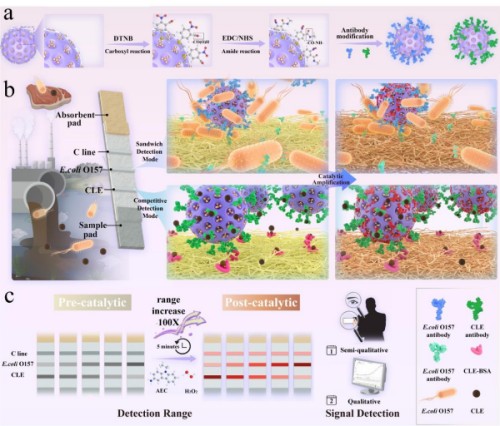
A Novel Nanoscale Detection Technology Capable of Simultaneous Detection of Bacteria and Hormones: Material Preparation, Dual-Mode Detection Principle, and Quantitative Analysis Workflow
Source: Hefei Institute of Physical Science
LATEST NEWS
Thank you for visiting the official website of Chongfan Technology. If you have cooperation intentions or suggestions, please contact us through the following methods, and we will reply as soon as possible, thank you!
Address: Room 403, Building 6, Phase III of R&D, No. 36 Xiyong Avenue, High tech Zone, Chongqing, China.
Telephone: +86-13658337211
E-mail: Sales@cfkeji.net
Website: www.cfkeji.net
Mobile Version