
Chongfan Technology
News
05
2026
-
06
Hot Topics Such as Holographic Keys, Ultra-Stable Lasers, and Multi-Beam Optical Phased Arrays | Photonics Research, Volume 14, Issue 4: Editors’ Pick Collection
Author:
Photonics Research Volume 14, Issue 4 features a total of 67 high‑quality papers spanning several cutting‑edge research areas, including fiber optics and optical communications, image processing and analysis, integrated optics, and instrumentation and measurement. Among these, seven papers have been selected as Editors’ Picks, covering such hot topics as information security and encryption, Brillouin lasers in gas‑filled hollow‑core fibers, dual‑beam manipulation in two‑dimensional optical phased arrays, polarization control in thin‑film lithium niobate, and precision six‑degree‑of‑freedom measurement of non‑cooperative targets. These contributions highlight the latest advances in photonics across fundamental mechanisms, device innovation, and system applications. Below are brief summaries of the seven Editors’ Pick papers; we invite readers to explore, read, and share them.
• Holography, Gratings, and Diffraction

Paper Information: Tong Shen, Fangfang Chen, Jia Cai, Jihong Zheng, "Secret hologram key with angular multiplexing based on PDLC photonic crystals using Morse code matrices," Photonics Res. 14, 989 (2026)
Morse code, a highly recognizable classic coding paradigm in the field of digital communication, possesses both historical significance and contemporary practical value. By deeply integrating this unique coding scheme with modern holographic technology, its distinctive technical advantages can be precisely leveraged to achieve highly secure information encryption. To this end, Professor Zheng Jihong’s research group at Shanghai Tech University—affiliated with Academician Zhuang Songlin’s team—has proposed a holographic key based on polymer‑dispersed liquid crystal photonic crystals (PDLC‑PC). At its core, this approach establishes a multi‑channel holographic interference‑based encryption system grounded in PDLC photonic crystals, enabling the precise mapping of Morse code to holographic diffraction patterns. The key principle underlying this work lies in the interference recording of multi‑channel light fields and angle‑dependent diffraction reconstruction: by reconstructing a series of diffraction orders at different angles, multiple conjugate digital combinations are formed. These distinct digital combinations, following the rules of holographic reconstruction, are further used to derive a Morse‑code matrix, allowing the corresponding Morse code to be identified from the ciphertext and thereby decoding the plaintext. This method effectively embeds the physical elements required for encryption within the holographic key itself and, as needed, enables dynamic recombination of confidential information.
• Fiber Optics and Optical Communications

Paper Information: Hao Liang, Weixiang Zhang, Zhiqi Wang, Qingqing Chen, Yinghui Zhang, Yizhi Sun, Shoufei Gao, Yingying Wang, Xiaojie Guo, Ran Wang, Linghao Cheng, Bai-Ou Guan, Wei Ding, "Brillouin scattering and single-longitudinal-mode lasing in long-length, SF6-filled anti-resonant hollow-core fibers," Photonics Res. 14, 1022 (2026)
The research team of Researcher Ding Wei at Jinan University, in collaboration with Professor Guan Bai’ou’s team, has proposed and experimentally validated a method based on sulfur hexafluoride (SF₆)… 6 ) A gas‑filled, anti‑resonant hollow‑core fiber (DNANF) Brillouin photonics platform enables continuous tunability from linear to strongly nonlinear interactions. Using distributed Brillouin optical time‑domain reflectometry (BOTDR), the researchers directly observed the complete evolution of spontaneous Brillouin scattering into stimulated Brillouin scattering (SpBS→SBS) over a 2.4‑km fiber, with the Brillouin gain coefficient spanning four orders of magnitude (~10). -5 Up to 0.14 m -1 W -1 Furthermore, molecular diffusion at the gas–fiber interface induces a pronounced evolution of the Brillouin spectrum, providing a unique diagnostic tool for studying acousto‑optic interactions under varying gas‑component pressure conditions. This system not only demonstrates that an actual drawn hollow‑core fiber exhibits a SBS threshold exceeding 1 kW—50 dB higher than that of conventional fibers—but also achieves tunable single‑longitudinal‑mode Brillouin laser emission in the C‑band, delivering a laser with a linewidth of 1.1 kHz and an output power of 188 mW. Building on this work, the gas‑mediated Brillouin effect holds promise for applications in spectral analysis, nonlinear optics, narrow‑linewidth lasers, and other areas, leveraging hollow‑core fibers as the transmission medium.
• Silicon Photonics
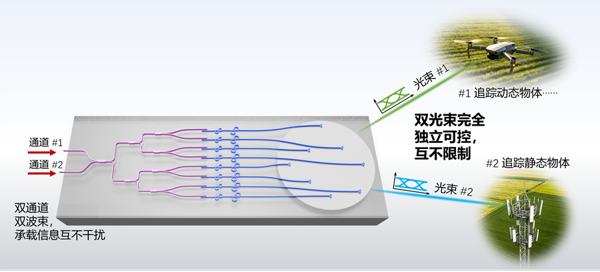
Paper Information: Jingyu Zhao, Jingye Chen, Daixin Lian, Shi Zhao, Wenke Jiao, Daoxin Dai, Yaocheng Shi, "Independent and power efficient dual-beam steering based on a two-dimensional circular optical phased array," Photonics Res. 14, 1078 (2026)
Multi-beam optical phased arrays can achieve simultaneous beamforming on a single chip, enabling high‑frame‑rate sensing, multi‑target tracking, and parallel communication for multiple users. A team led by Professor Shi Yaoceng at Zhejiang University has proposed a novel architecture that, for the first time, integrates multi‑beam design into two‑dimensional optical phased arrays, endowing them with entirely new degrees of freedom. The team has developed a low‑power, scalable microring phase‑shifter module capable of precisely controlling the phase of a carrier at a specific wavelength. By cascading microring structures with different parameters, they realized independent phase tuning across multiple target frequency channels, while reducing phase‑shifting power consumption to just one‑ninth of that in conventional designs. Building on this architecture, the team successfully demonstrated two‑dimensional, wide‑field‑of‑view beam scanning with independently controlled dual beams on a standard passive silicon‑on‑silicon nitride platform, and further showcased parallel, high‑speed free‑space optical communication for two users. This work presents a low‑power, scalable on‑chip multi‑beam optical phased‑array architecture, which holds promise as a key technological enabler for all‑solid‑state, parallel LiDAR systems and multi‑user wireless optical interconnects.
Dual-mode microscopic imaging enabled by a single liquid crystal lens

Paper Information: Xinyi Zhou, Haoxu Guo, Meihua Zhuang, Jingjing Wang, Xiaoxue Zhang, Xiangsheng Xie, Yaqin Zhou, "Dual-mode microscopic imaging enabled by a single liquid crystal lens," Photonics Res. 14, 1085 (2026)
Microscopy plays a foundational role in modern biomedical research, with different imaging modalities providing multidimensional insights into the structural features of biological samples. However, a single imaging mode often falls short of fully characterizing complex specimens, making multimodal imaging an important frontier in the field of biological imaging. A team led by Associate Professor Xie Xiangsheng, Associate Professor Guo Haoxu, and Lecturer Zhou Yaqin at Shantou University has innovatively designed and fabricated a low-cost, electrically tunable, multi-wavelength, dual‑mode, dual‑channel liquid crystal (MD²LC) lens that integrates vortex phase modulation, focusing, and beam splitting into a single liquid crystal device. Within a unified optical‑path architecture, this device generates two spatially separated imaging channels, enabling simultaneous acquisition of bright-field and phase‑contrast images on a single camera frame—without the need for conventional 4f Fourier filtering systems. This approach significantly reduces system complexity and effectively eliminates the temporal delays associated with mode switching, offering a new technological pathway toward compact, multifunctional microscopic imaging systems.
• Integrated Optics
Polarization rotator and switch on thin-film lithium niobate
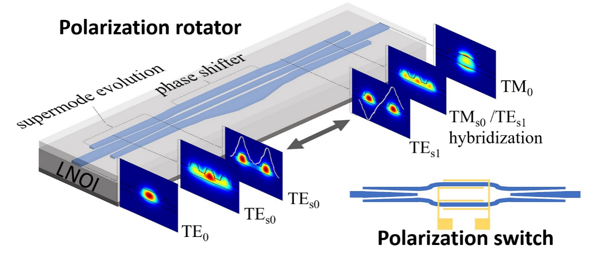
Paper Information: Fansu Zhao, Ao Cui, Weilong Ma, Haohua Wang, Youkang Gao, Changjian Guo, Kaixuan Chen, Liu Liu, "Polarization rotator and switch on thin-film lithium niobate," Photonics Res. 14, 1197 (2026)
High‑performance polarization‑control devices based on the thin‑film lithium niobate (TFLN) platform are essential building blocks for on‑chip optical communication, quantum communication, and optical sensing systems. A team led by Associate Researcher Chen Kaixuan of South China Normal University and Associate Professor Liu Liu of Zhejiang University has achieved an efficient, broadband, low‑power on‑chip polarization rotator and polarization switch by cascading a novel supermode converter with an asymmetric phase modulator. The polarization rotator exhibits an insertion loss of less than 1 dB over a 100 nm bandwidth, a polarization extinction ratio exceeding 20 dB, and losses as low as 0.37 dB (TE) and 0.41 dB (TM) at 1550 nm. The electro‑optic‑based polarization switch delivers an extinction ratio greater than 20 dB and a loss below 2.2 dB across the 1490–1630 nm range, with a response time of approximately 13 ns and a power consumption of only 0.008 mW—outperforming conventional silicon‑based solutions. This work represents the first demonstration of high‑performance polarization rotation and high‑speed electro‑optic polarization switching on an etched TFLN waveguide platform, requiring no additional materials, while featuring a simple structure, ease of fabrication, and robust process tolerance. It provides critical technological support for polarization control in future on‑chip optical communication, quantum communication, and optical sensing systems.
• Instrumentation and Measurements
Simultaneous six-degree-of-freedom measurement using low-coherence spatial interferograms

Paper Information: Runkun Zhao, Liheng Shi, Yuetang Yang, Yuhan Li, Guanhao Wu, "Simultaneous six-degree-of-freedom measurement using low-coherence spatial interferograms," Photonics Res. 14, 1247 (2026)
High‑precision six‑degree‑of‑freedom measurement is essential in fields such as intelligent manufacturing and precision assembly. Addressing the limitations of conventional optical multi‑DOF measurement methods, which rely on cooperative targets, Associate Professor Wu Guanhao’s team at Tsinghua University has proposed a novel approach for directly performing absolute six‑DOF measurements on non‑cooperative targets. This method first employs time‑phase‑shift interferometry to separate the low‑coherence interference envelope from the speckle background; it then extracts the geometric information of the coherent envelope to determine pitch, yaw, and axial displacement. Simultaneously, a registration technique is applied to the speckle background to obtain roll and lateral displacement, thereby achieving simultaneous and absolute six‑DOF measurement. Based on this approach, the study yields highly accurate results, with unaveraged Allan deviations of less than 6.0 arcseconds for angular measurements and 50.0 nanometers for displacement, and post‑averaging values of less than 2.0 arcseconds and 7.7 nanometers, respectively. By using only a single beam of light, this work realizes high‑accuracy absolute six‑DOF measurement of non‑cooperative targets, opening new avenues for enhancing the precision and adaptability of multi‑DOF measurements in scientific research and engineering applications.
• Optical Devices
Hertz-integral-linewidth lasers based on portable solid-state microresonators
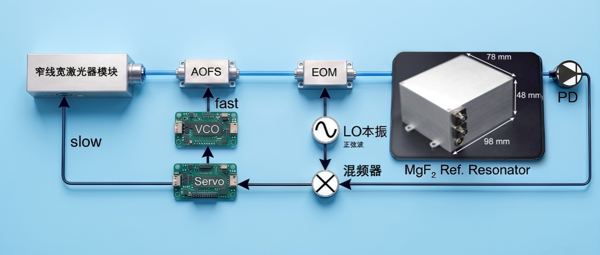
Paper Information: Xing Jin, Xuanyi Zhang, Fangxing Zhang, Zhenyu Xie, Shui-Jing Tang, Qi-Fan Yang, "Hertz-integral-linewidth lasers based on portable solid-state microresonators," Photonics Res. 14, 1455 (2026)
Ultra‑stable lasers are essential tools for precision measurements such as optical atomic clocks and gravitational‑wave detection. However, conventional Fabry–Perot‑based designs are bulky, require ultra‑high vacuum and sophisticated vibration isolation, and remain confined to laboratory settings. With the growing demand for portable optical atomic clocks, navigation systems, remote sensing, and other applications, there is an urgent need for an ultra‑stable laser architecture that combines high stability, compact size, and robust performance. To address this challenge, the research group of Researcher Qi‑fan Yang at Peking University’s School of Physics, in collaboration with partners, has proposed and demonstrated a compact ultra‑stable reference cavity based on a whispering-gallery-mode microcavity made of MgF₂ crystal. For the first time, they have achieved laser output with a hertz‑level integrated linewidth under ambient temperature and pressure, using solid‑state components. The innovation of this work lies in shrinking the core elements of an ultra‑stable laser—traditionally requiring large laboratory setups—to a palm‑sized footprint, while operating entirely at room temperature and atmospheric pressure without the need for vacuum or active vibration isolation. Its exceptional robustness makes it well suited for portable optical atomic clocks, high‑precision navigation, geodesy, remote sensing, and miniaturized microwave photonic oscillators, providing a critical device foundation that could translate laboratory‑grade precision measurement capabilities into deployable field‑ready systems.
LATEST NEWS
Thank you for visiting the official website of Chongfan Technology. If you have cooperation intentions or suggestions, please contact us through the following methods, and we will reply as soon as possible, thank you!
Address: Room 403, Building 6, Phase III of R&D, No. 36 Xiyong Avenue, High tech Zone, Chongqing, China.
Telephone: +86-13658337211
E-mail: Sales@cfkeji.net
Website: www.cfkeji.net
Mobile Version