
Chongfan Technology
News
03
2026
-
06
An Guang has made progress in broadband, high-resolution vertical profiling of atmospheric water vapor.
Author:
Recently, the team at the Center for Basic Sciences of the Institute of Optics and Fine Mechanics, Chinese Academy of Sciences, has made progress in research on broadband, high‑resolution solar spectral remote sensing. The team developed a broadband, high‑resolution spectroradiometer based on a virtually imaged phased array (VIPA) and, for the first time, applied it to retrieve vertical profiles of atmospheric water vapor. The related findings were published in the optics journal Optics Letters under the title “Broadband high‑resolution spectroradiometer based on a virtually imaged phased array.” Vertical profiles of key atmospheric constituents refer to the altitude‑dependent distributions of oxygen (O₂), nitrogen (N₂), water vapor (H₂O), ozone (O₃), carbon dioxide (CO₂), and trace gases such as methane (CH₄) and nitrous oxide (N₂O). These profiles typically span from the surface through the stratosphere and beyond (0–100 km), with their structure governed by a combination of physical processes, chemical reactions, and transport mechanisms.
Accurate retrieval of vertical profiles of key atmospheric constituents is of great significance for studies in atmospheric physics and chemistry, as well as for environmental and climate change assessments. Ground-based high-resolution Fourier-transform spectrometers offer high measurement accuracy, but their large size and high cost typically limit their widespread deployment in multi-site observation networks. While existing portable solar spectrometers provide the advantage of flexible deployment, they often struggle to simultaneously achieve broad spectral coverage and high spectral resolution, thereby hindering the high‑precision retrieval of atmospheric composition profiles.
Based on a novel VIPA spectrometer and in conjunction with a solar tracker, the team at the Anhui Institute of Optics and Fine Mechanics has developed a new type of solar spectral radiometer. This system achieves a transient spectral coverage of 145 cm⁻¹ within the 7535–7680 cm⁻¹ wavenumber range, with a spectral resolution of 0.023 cm⁻¹, enabling both broad‑range spectral data acquisition and highly detailed measurement results. The core component, the VIPA spectrometer, measures approximately 40 cm × 28 cm × 12 cm and weighs about 8.5 kg, making it compact and lightweight while offering a wide spectral detection range, high spectral accuracy, and rapid response. Using this system, the team successfully acquired high‑resolution atmospheric transmittance spectra and, by selecting the water vapor absorption window at 7618.6–7619.5 cm⁻¹, employed an optimal estimation algorithm to retrieve vertical profiles of atmospheric water vapor, yielding distribution data for water vapor concentrations across different altitude layers from the lower troposphere to the upper atmosphere. These results validate the feasibility of using this system for the quantitative retrieval of vertical profiles of atmospheric constituents. The experimental findings clearly demonstrate that this miniaturized, next‑generation solar spectral radiometer can meet the demands of precise, quantitative measurements of various atmospheric components at different altitudes, underscoring its reliable value for practical operational applications.
The aforementioned research findings have opened up new technological avenues for rapid, high‑resolution, wide‑band spectral remote sensing of key atmospheric constituents and are expected to provide crucial support for the development of low‑cost, lightweight, multi‑site atmospheric observation networks.
Master’s student Qiu Guojun is the first author of the paper, while Researcher Zhao Weixiong and Associate Researcher Tan Tu serve as the corresponding authors. This study was supported by projects funded by the National Natural Science Foundation of China, the President’s Fund of the Hefei Institutes of Physical Science, and the Anhui Provincial Natural Science Foundation, among others.
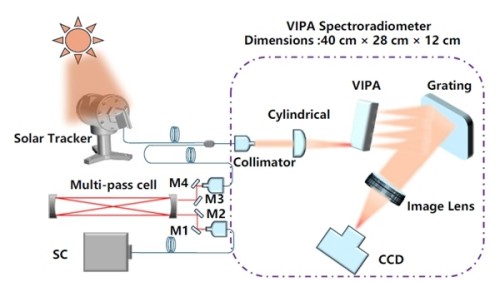
Schematic diagram of the principle underlying water vapor profile measurements using a VIPA spectrometer.
Source: Anhui Institute of Optics and Fine Mechanics
LATEST NEWS
Thank you for visiting the official website of Chongfan Technology. If you have cooperation intentions or suggestions, please contact us through the following methods, and we will reply as soon as possible, thank you!
Address: Room 403, Building 6, Phase III of R&D, No. 36 Xiyong Avenue, High tech Zone, Chongqing, China.
Telephone: +86-13658337211
E-mail: Sales@cfkeji.net
Website: www.cfkeji.net
Mobile Version