
Chongfan Technology
News
01
2026
-
06
Ultrafast Holographic-Feel Optical Microscope
Author:
A high-speed microscopy method for studying light–matter interactions makes it possible to observe optical processes on extremely short timescales. To this end, a joint German–Italian research team has innovatively combined holographic imaging with ultrafast spectroscopy. In this way, even transient electronic and magnetic phenomena—key players in the development and application of next-generation energy materials—can be directly observed.
This research was jointly conducted by scientists from the Institute of Physical Chemistry at Heidelberg University, the Polytechnic University of Milan, and the Institute of Photonics and Nanotechnologies in Milan. The findings have been published in the journal Nature Photonics.
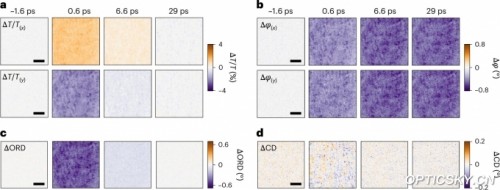
At the heart of this study is a pump–probe microscope, which is used to perform so‑called pump–probe experiments. In these experiments, a short optical pulse first excites the material under investigation, while a second pulse subsequently records its time‑dependent response. By comparing measurements taken with the pump on and off, these processes can be reconstructed with high precision.
Dr. Julia Anthea Gessner explained: “By combining holographic imaging with ultrafast spectroscopy, we can observe and track electronic and magnetic dynamical processes with spatial resolution across timescales ranging from femtoseconds to picoseconds.” She is the project leader of Collaborative Research Center 1249, “N‑Heterocyclic Polycycles as Functional Materials,” and also heads a research group at the Institute of Physical Chemistry.
Dr. Martin Hörmann of the Polytechnic University of Milan explained: “This innovative method developed by the German–Italian research team enables simultaneous imaging of ultrafast electromagnetic phenomena across a wide field of view. Unlike other microscopy techniques, it makes it possible to image regions at the micrometer scale and to generate time-resolved movies of electron charge and spin dynamics.”
Furthermore, light‑induced changes in the optical properties of materials can also be visualized using this approach. “Our chiral optical method thus opens up entirely new possibilities for directly observing dynamic processes in complex materials,” said Dr. Hörmann, who, together with Dr. Gessner and doctoral student Federico Visentin, played a pivotal role in this research.
This high-resolution, ultrafast imaging technique is primarily designed for use in energy materials—materials that are integral to sustainable technologies such as solar cells, LEDs, spin‑LEDs, and innovative electronic components. Professor Felix Deschler of the Institute of Physical Chemistry at Heidelberg University emphasizes: “This microscopy method offers new insights into ultrafast optical processes, particularly how these processes evolve with changes in a material’s composition and structure.”
According to Professor Franco V. A. Camargo, a scientist at the Milan Institute of Photonics and Nanotechnology, research on light–matter interactions can provide crucial insights for the development of high‑efficiency, durable optoelectronic and spintronic devices.
Source: phys.org
LATEST NEWS
Thank you for visiting the official website of Chongfan Technology. If you have cooperation intentions or suggestions, please contact us through the following methods, and we will reply as soon as possible, thank you!
Address: Room 403, Building 6, Phase III of R&D, No. 36 Xiyong Avenue, High tech Zone, Chongqing, China.
Telephone: +86-13658337211
E-mail: Sales@cfkeji.net
Website: www.cfkeji.net
Mobile Version