
Chongfan Technology
News
09
2026
-
03
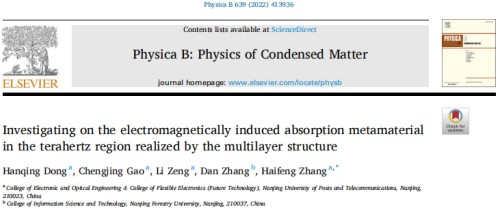
Research on Terahertz Electromagnetically Induced Absorption Metamaterials Realized Through Multilayer Structures
Author:
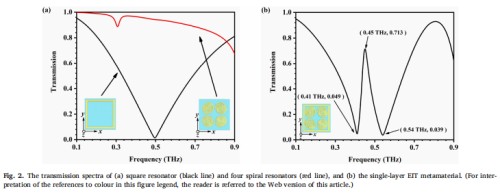
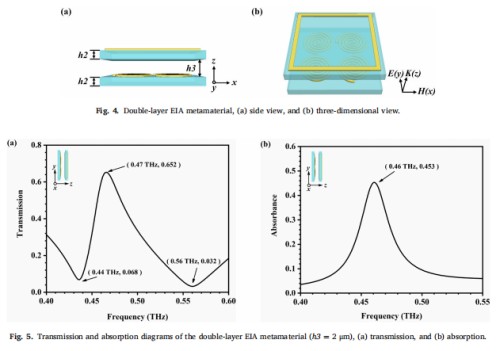
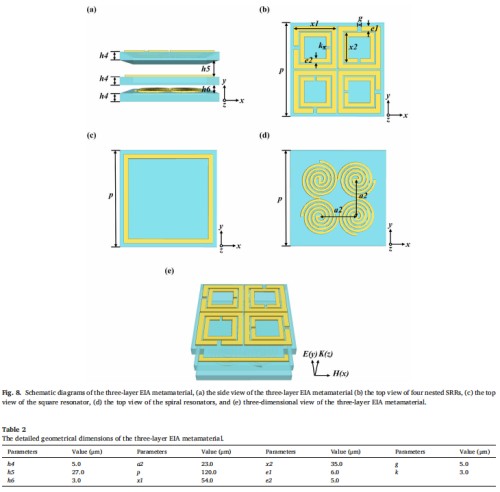
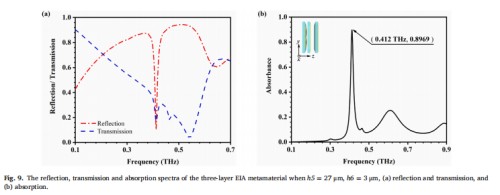
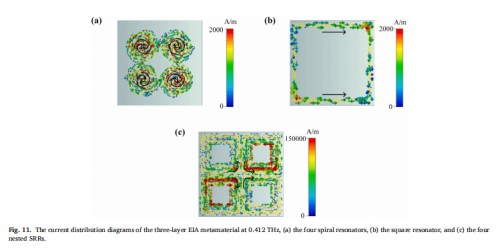
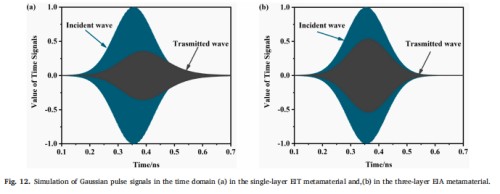
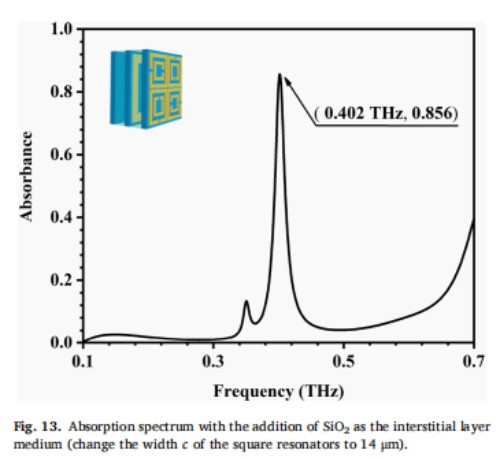
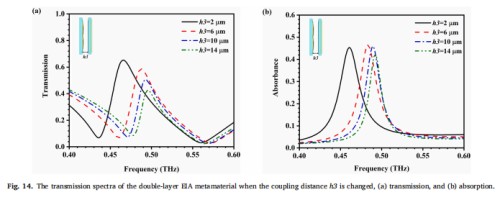
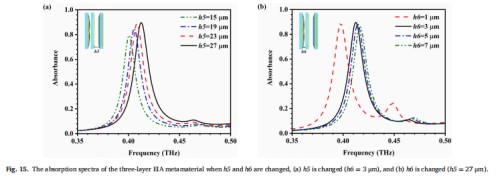
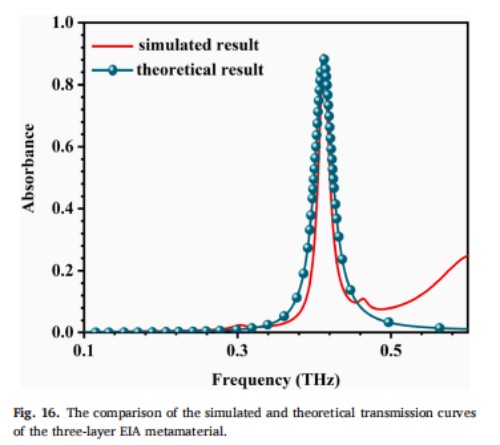
In recent years, electromagnetic induced absorption (EIA) has demonstrated broad application prospects in fields such as nonlinear optics, and this research direction has been attracting sustained attention from the academic community. Building on the bright–dark–quasi‑dark theory, researchers have proposed an electromagnetic induced transparency (EIT) metamaterial that can transition from EIT to EIA by adjusting the coupling distance. By sequentially rotating the first nested split-ring resonator by 90 degrees and introducing four nested split-ring resonators (SRRs) as quasi‑dark modes, they successfully achieved a significant enhancement in absorption performance, with the absorption peak reaching 0.8969 at 0.412 THz. Studies show that the magnetic resonance effect induced by interlayer coupling can effectively boost absorption performance, and this structure also exhibits polarization insensitivity. This paper further explores the impact of various structural parameters on absorption performance, confirming that this enhancement method is universally applicable and can be widely used in areas such as optical signal processing, optical storage, quantum switching, and optical sensing—and can even be extended to the microwave and infrared bands.
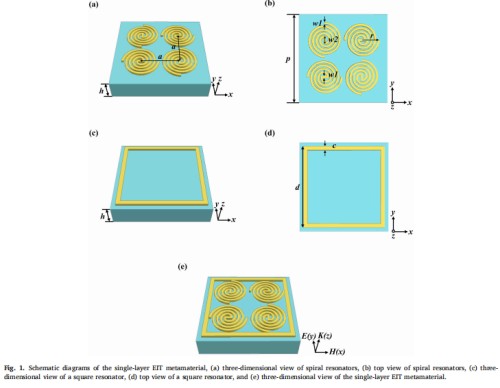
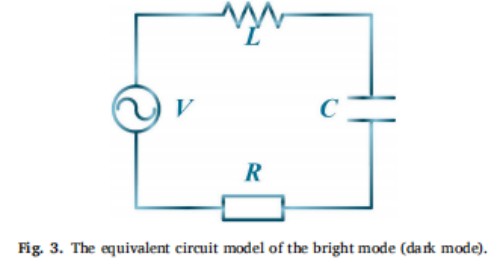
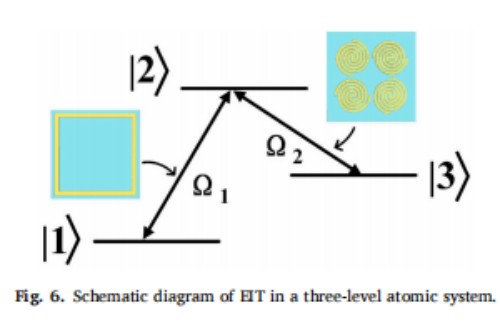
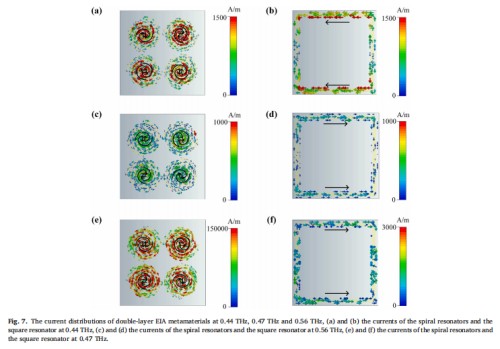
Based on the bright–quasi‑dark theory, this paper proposes an EIT metamaterial composed of a square resonator and four spiral resonators. The excitation field directly induces the bright mode to generate a magnetic field, which ultimately couples with the four dark modes. This coupling mechanism gives rise to a transparency window in EIT metamaterials and an absorption window in EIA metamaterials. To further enhance the absorption rate, we introduce four nested SRRs as quasi‑dark modes; by adjusting the coupling distance between the quasi‑dark modes and the bright mode, we can precisely control the coupling strength. After optimization and upgrading, the absorption rate of this metamaterial reaches 0.8969 at 0.412 THz. The proposed model holds broad application prospects in the fields of absorbers, optical filtering, and sensing technologies.
Source: Optical Metamaterials
LATEST NEWS
Thank you for visiting the official website of Chongfan Technology. If you have cooperation intentions or suggestions, please contact us through the following methods, and we will reply as soon as possible, thank you!
Address: Room 403, Building 6, Phase III of R&D, No. 36 Xiyong Avenue, High tech Zone, Chongqing, China.
Telephone: +86-13658337211
E-mail: Sales@cfkeji.net
Website: www.cfkeji.net
Mobile Version