
Chongfan Technology
News
23
2026
-
03
Significant Progress Achieved in the Development of a Novel Liquid-Helium-Free Optically Coupled Scanning Probe Microscopy System
Author:
In recent years, scanning probe microscopy (SPM), with its atomic-scale spatial resolution, has emerged as a crucial tool for micro- and nanoscale research. However, conventional SPM is often limited in probing molecular chemical bonds and resolving structurally similar topographies due to its lack of chemical specificity. To address this challenge, researchers have integrated SPM with near-field plasmonic enhancement techniques, thereby developing optically coupled scanning probe microscopy (OC-SPM) capable of single-molecule spectroscopic detection. Nevertheless, achieving angstrom-level spectroscopic imaging typically requires cooling the sample to liquid-helium temperatures to enhance signal-to-noise ratio and signal stability. For a long time, the high cost of liquid helium and its unreliable supply have been key bottlenecks hindering the widespread adoption of such technologies. More importantly, OC-SPM experiments usually demand prolonged tip modification and precise optical alignment, both of which place extremely stringent requirements on the sustained stability of cryogenic environments. Wet-based approaches that rely on liquid-helium replenishment are ill-suited for long-term continuous operation; experiments are often forced to halt at critical moments when the liquid-helium supply is exhausted, severely limiting the experimental efficiency and scientific output of OC-SPM.
Recently, a team led by Qing Hu from the Institute of Physics of the Chinese Academy of Sciences and the Beijing National Research Center for Condensed Matter Physics, in collaboration with a team led by Shijin Tan from the University of Science and Technology of China and with the support of CAS Aikemi (Beijing) Technology Co., Ltd., successfully developed a novel liquid-helium-free closed-loop optically coupled scanning tunneling microscope system, achieving spectroscopic imaging at the angstrom scale. The core innovation of this system lies in the successful integration of the “remote liquefaction, liquid-helium-free closed-loop” concept (Rev. Sci. Instrum. 94, 093701 (2023)) into the OC-SPM design. By placing the compressor in a separate helium circulation loop and using flexible liquid-transfer rods to deliver liquid helium to the scanning probe, the system not only effectively isolates vibration-induced noise and significantly reduces its overall footprint but, more importantly, completely eliminates the need for liquid-helium replenishment. Test results demonstrate that the system operates at a base temperature below 3 K, with temperature stability approaching ±1 mK and vibration levels below 1 pm, enabling several months of continuous operation; its overall performance is comparable to that of conventional Dewar-based OC-SPM systems. Furthermore, the system incorporates two movable lens modules on the scanning probe, each with a numerical aperture of 0.46, delivering a maximum photon-collection efficiency of 22.8% and providing a robust foundation for angstrom-scale spectroscopic imaging.
Building on this foundation, the research team conducted multi-modal characterization experiments on individual silver phthalocyanine (AgPc) molecules. By coupling scanning tunneling microscopy (STM) with non-contact atomic force microscopy (nc-AFM), they successfully localized the molecular structure and clearly resolved the central silver atom; scanning tunneling spectroscopy (STS) imaging revealed the spatial distribution of the molecule’s highest occupied molecular orbital (HOMO) and lowest unoccupied molecular orbital (LUMO); and, in combination with tip-enhanced Raman spectroscopy (TERS), they further identified the fine details and assignments of molecular vibrations—for example, the 718 cm⁻¹ Raman peak corresponds to in-plane twisting of the central ring, the 756 cm⁻¹ peak arises from out-of-plane bending of the C–H bonds in the phenyl ring, and the 856 cm⁻¹ peak is associated with out-of-plane torsional motion of the phenyl ring. These results fully demonstrate the system’s capability for comprehensive, multi-dimensional characterization at the sub-nanometer scale, spanning morphological observation, electronic-state analysis, vibrational fingerprint identification, and localized chemical-information probing.
The remote-liquefaction, liquid-helium-free closed-cycle ultra-low-vibration cryogenic cooling scheme is an original technology developed by the team led by Xun Qing at the Institute of Physics. The successful development of this system not only marks a profound leap for China in the field of high-end precision instrumentation—from “principle innovation” to “independent control over critical core technologies”—but also provides cutting-edge scientific instrumentation support characterized by “high signal-to-noise ratio and multi-parameter coupling,” thereby enabling state-of-the-art research in quantum materials, surface catalysis, single-molecule science, and other frontier areas. Its technical advantages—namely, being liquid-helium-free, highly integrated, and capable of multi-modal operation—significantly reduce both research operating costs and the barriers to instrument operation, laying a solid foundation for conducting high-precision, long-duration, multi-modal microscopic characterization experiments.
This research was co-first-authored by Associate Researcher Ma Ruisong and Postdoctoral Fellow Liu Dairong from the Institute of Physics, Chinese Academy of Sciences, along with Ph.D. student Liu Zhiwei from the University of Science and Technology of China. Researcher Huan Qing from the Institute of Physics and Professor Tan Shijing from the University of Science and Technology of China served as the co-corresponding authors. The findings were published under the title “A Cryogen-free Low Temperature Scanning Probe Microscope System for Ångström resolved Spectroscopic Imaging” in the journal Advanced Scientific Instruments (https://doi.org/10.1016/j.asi.2026.100011). This work was supported by the National Natural Science Foundation of China, the National Key R&D Program, the Chinese Academy of Sciences’ Scientific Instrument Development Project, the Beijing Municipal Natural Science Foundation, the Chinese Academy of Sciences’ Young Scientists Basic Research Program, and the National Major Science and Technology Special Project, among others.
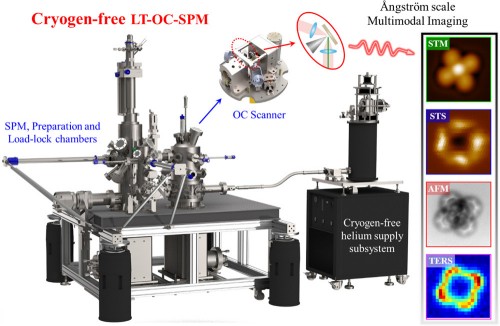
Figure: Design schematic and multimodal imaging results of a novel liquid-helium-free closed-loop optically coupled scanning tunneling microscope system.
Source: Institute of Physics, Chinese Academy of Sciences
LATEST NEWS
Thank you for visiting the official website of Chongfan Technology. If you have cooperation intentions or suggestions, please contact us through the following methods, and we will reply as soon as possible, thank you!
Address: Room 403, Building 6, Phase III of R&D, No. 36 Xiyong Avenue, High tech Zone, Chongqing, China.
Telephone: +86-13658337211
E-mail: Sales@cfkeji.net
Website: www.cfkeji.net
Mobile Version