
Chongfan Technology
News
23
2026
-
03
Research Progress on High-Brightness, High-Order Harmonic Extreme Ultraviolet Light Sources
Author:
Extreme ultraviolet high-harmonic sources are coherent photon-emitting light sources generated through the strong nonlinear interaction of high-power femtosecond lasers with inert gases. Owing to their exceptional coherence and ultrashort pulse duration, they find critical applications in attosecond laser science, attosecond physics, time-resolved photoelectron spectroscopy, lithography, and semiconductor wafer inspection. However, the relatively low conversion efficiency of gas-based high-harmonic generation results in comparatively weak output intensities, thereby limiting their practical use. Consequently, enhancing the conversion efficiency to achieve high-brightness extreme ultraviolet sources has long been a central focus in ultrafast laser research.
To enhance the brightness of high-order harmonics, the HX-07 research group at the Institute of Physics, Chinese Academy of Sciences and the Beijing National Research Center for Condensed Matter Physics has leveraged the Comprehensive Facility for Extreme Conditions to address the challenge from two key aspects: the design of the driving laser source and the gas target. By employing a high-power femtosecond laser and optimizing phase matching in the interaction region, they have achieved improved conversion efficiency and higher harmonic brightness. Regarding the driver, they have independently developed a femtosecond laser with a repetition rate of 1 MHz and an average power of 200 W. Furthermore, by utilizing a multi-pass cavity spectral broadening and compression scheme based on fused silica plates, the pulse duration has been compressed by a factor of eight, boosting the peak power to 5.35 GW—conditions that are highly favorable for generating high-brightness high-order harmonics. As for the gas target, the group conducted a detailed investigation into the relationship between gas density distribution and nozzle size and position, and designed a differentially structured gas target that increases the gas density in the interaction region while reducing the background pressure. This optimization of phase matching further enhances the conversion efficiency.
Based on the aforementioned two lines of research, a high-harmonic XUV light source with photon energies spanning 20.47 eV to 46.95 eV has been successfully developed, achieving a single-stage harmonic brightness of 1.07 × 10¹¹ phs/s. This light source is entirely domestically developed, from the driving laser through high-harmonic generation, single-stage harmonic selection, beam delivery, and focusing. Not only do its performance metrics reach the international advanced level, but it also represents a successful domestic substitution.
This light source will be integrated with end-user instruments such as angle-resolved photoemission spectrometers and photoelectron microscopes to enable time-resolved studies of condensed matter, superconducting materials, low-dimensional quantum materials, and other systems. The relevant findings have been published in Optics Letters, volume 49, pages 6992–6995 (2026), under the title “Sub-30-fs High-Power Laser Based on a Solid-State Multipass Unit and Its Application in High-Flux High-Harmonic Generation” (original article link: https://doi.org/10.1364/OL.584257). Du Chao, a graduate student, is the first author, while Researchers Teng Hao and Wei Zhiyi serve as co-corresponding authors. This research was supported by the National Key R&D Program, the National Natural Science Foundation of China’s Key Project, and the Chinese Academy of Sciences, among others. In the acknowledgments section at the end of the paper, the authors specifically thank the Comprehensive Experimental Facility for Extreme Conditions (SECUF).
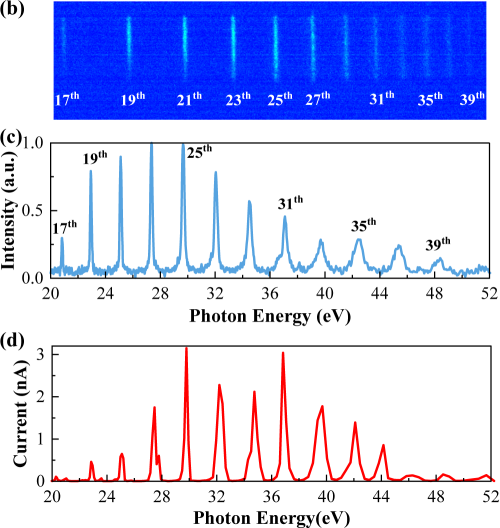
Figure. Measurement results of high-brightness high-order harmonics
Source: Institute of Physics
LATEST NEWS
Thank you for visiting the official website of Chongfan Technology. If you have cooperation intentions or suggestions, please contact us through the following methods, and we will reply as soon as possible, thank you!
Address: Room 403, Building 6, Phase III of R&D, No. 36 Xiyong Avenue, High tech Zone, Chongqing, China.
Telephone: +86-13658337211
E-mail: Sales@cfkeji.net
Website: www.cfkeji.net
Mobile Version