
Chongfan Technology
News
25
2026
-
03
Control of the Topological Antiskyrmion Lattice Transition at Room Temperature
Author:
Magnetic (anti-)skyrmions are topologically protected magnetic domain structures whose nanoscale, topologically stable quasiparticle nature holds great promise for serving as a new generation of high-density, low-power magnetic information units in information processing and neuromorphic computing. This capability is poised to meet the pressing demands of the big-data, cloud-computing, and intelligent-information eras, making magnetic skyrmions a current research hotspot and a critical frontier in spintronics and condensed-matter physics. Novel information-processing paradigms based on magnetic skyrmions—such as reservoir computing—leverage the nonlinear response, short-term memory, and dynamical complexity of topological magnetic quasiparticles to perform complex computational tasks under low-power conditions, representing an important direction for future low-power, high-performance information processing.
Under the overall coordination and guidance of Academician Shen Baogen, Researcher Zhang Ying’s team in Group M07 of the Magnetism Laboratory at the Institute of Physics, Chinese Academy of Sciences and the Beijing National Research Center for Condensed Matter Physics has leveraged a specialized research platform that integrates high-resolution magnetic-domain characterization, in-situ multi-field control, and micromagnetic simulations to conduct systematic studies on topological magnetic skyrmions in a variety of magnetic material systems. Through these efforts, the team has amassed extensive research experience in the generation, manipulation, and underlying physical mechanisms of topological magnetic units. Antiskyrmions, as the antiparticles of skyrmions, exhibit superior thermal stability and additional degrees of freedom, thereby further enriching emerging paradigms for information processing. Recently, the research team has undertaken in-depth investigations into reservoir computing based on antiskyrmions, focusing on the collective dynamical evolution of antiskyrmion lattice transitions and the multi-degree-of-freedom control of such systems.
Using in situ Lorentz transmission electron microscopy, the research team has, for the first time, directly observed the field-dependent dynamic evolution of antiskyrmions in the room-temperature chiral magnet Mn1.4PtSn, demonstrating a continuous transformation of antiskyrmions from a triangular lattice to a square lattice. The experimental results reveal that as the applied magnetic field is gradually reduced, the shape, size, and spatial position of the antiskyrmions undergo concerted changes, giving rise to a field-dependent, multi-degree-of-freedom, tunable collective evolution. Further micromagnetic simulations elucidate the microscopic mechanism underlying the antiskyrmion lattice transition: the interplay among the external magnetic field, anisotropic Dzyaloshinskii–Moriya interaction, and dipolar interactions collectively drives the evolution of antiskyrmions from a circular to a square morphology and the reconfiguration of lattice symmetry. This work provides, for the first time, direct real-space resolution of the continuous evolution of room-temperature topological spin structures, establishing an antiskyrmion information-unit system characterized by a rich array of intermediate states and multidimensional degrees of freedom. It thus furnishes crucial experimental evidence for multilevel information encoding and reservoir-computing functionalities based on topological information units. Importantly, the intermediate states encountered during the antiskyrmion lattice transition are, in principle, compatible with existing schemes for detecting and reading out skyrmion information, underscoring the feasibility of realizing future low-power, high-performance information-processing devices based on topological (anti)skyrmions.
The research findings experimentally and intuitively reveal the field-dependent transition characteristics of topological antiskyrmion lattices, and were published in the journal Advanced Functional Materials under the title “Manipulation of topological antiskyrmion lattice transition at room temperature” (http://doi.org/10.1002/adfm.202531037). Dr. He Zhidong, a postdoctoral researcher in Group M07 of the Magnetism Laboratory at the Institute of Physics, Chinese Academy of Sciences, is the first author of the paper, with Researcher Zhang Ying serving as the corresponding author. This work received strong support from the Institute of Physics, Chinese Academy of Sciences; University of Science and Technology Beijing; Beijing Institute of Technology; and Anhui University, and was funded by the National Key R&D Program, the National Natural Science Foundation of China’s Young Scientists Fund—Category A, the Science Center Project, the Chinese Academy of Sciences’ Program for Supporting Young Research Teams in Basic Research, and the Bo Xin Program—Category A, among others. Original article link: http://doi.org/10.1002/adfm.202531037
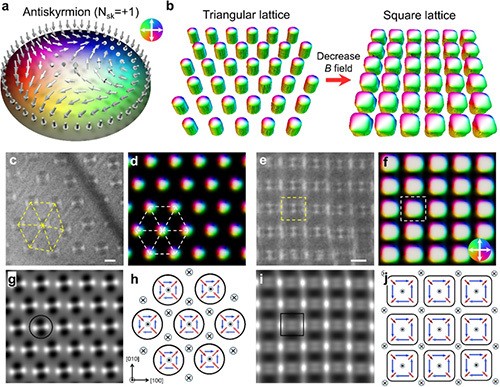
Figure 1. Room-temperature manipulation of the real-space multi-degree-of-freedom transformation of antiskyrmions from a triangular to a square lattice.
Source: Institute of Physics, Chinese Academy of Sciences
LATEST NEWS
Thank you for visiting the official website of Chongfan Technology. If you have cooperation intentions or suggestions, please contact us through the following methods, and we will reply as soon as possible, thank you!
Address: Room 403, Building 6, Phase III of R&D, No. 36 Xiyong Avenue, High tech Zone, Chongqing, China.
Telephone: +86-13658337211
E-mail: Sales@cfkeji.net
Website: www.cfkeji.net
Mobile Version