
Chongfan Technology
News
07
2026
-
09
Shanghai Astronomical Observatory Reveals New Observational Evidence of Cosmic Filaments “Transporting” Galaxies
Author:
Recently, a research team led by Researcher Wang Peng of the Shanghai Astronomical Observatory, Chinese Academy of Sciences, used large‑scale spectroscopic data from the Sloan Digital Sky Survey (SDSS) to reveal a significant directional correlation between the orbital motions of satellite galaxies and the cosmic filaments in which they reside. For the first time, this study provides observational evidence—based on the orbital dynamics of satellite galaxies—of a two‑stage accretion process: matter first converges toward cosmic filaments and then flows along these filaments into galaxy groups and clusters. This finding offers new dynamical support for understanding how the cosmic web regulates the formation and evolution of galactic systems. The results were published in The Astrophysical Journal Letters under the title “Observational Evidence for the Kinematic Memory of Cosmic Filaments from Satellite Orbital Orientations.”

Figure 1: A two-stage accretion process around cosmic filaments. Matter and galaxies first converge from the surrounding environment, such as cosmic walls, along directions approximately perpendicular to the filament; once inside the filament, satellite galaxies are transported toward galaxy groups or clusters via longitudinal flow along the filament axis and spiral motions. Blue arrows indicate transverse infall, while gold arrows denote transport along the filament.
Matter in the universe is not distributed uniformly; instead, it forms a vast network of filaments, nodes, and walls—known as the “cosmic web.” Within this structure, cosmic filaments act like “highways,” linking galaxy groups and clusters and continuously delivering matter to these systems. Numerical simulations suggest that material may first converge from the surrounding environment toward the filament axes and then flow along the filaments into galaxy groups and clusters. However, this “two‑stage accretion” scenario has thus far been based primarily on theoretical models and numerical simulations, with few direct, systematic observational tests to validate it.
Satellite galaxies orbit their central host galaxy, and their orbits preserve dynamical information acquired upon entering the host system. The research team analyzed multiple galactic systems and, using the projected positions and line-of-sight velocities of satellite galaxies, measured the relationship between the orientations of their orbits and the directions of nearby cosmic filaments. They found that the orbital orientations of satellite galaxies are significantly biased away from a random distribution, with statistical significance reaching approximately 12.8 standard deviations. Overall, satellite galaxies tend to move within planes that contain the axis of the cosmic filament. This suggests that cosmic filaments not only influence the spatial orientation of galaxies as they fall into groups but also imprint an observable “kinematic memory” on the orbital motions of satellite galaxies. More importantly, this orbital alignment undergoes a “flip” as a function of the distance between the galactic system and the filament axis: in the filament’s outskirts, matter and galaxies primarily converge inward along directions roughly perpendicular to the filament; once inside the filament, the flow direction gradually transitions to transport along the filament axis. These observations are consistent with the “two‑stage accretion” model, according to which matter first flows laterally from the surrounding environment into the filament and then follows the filament toward galaxy groups and clusters.
Wang Peng stated: “If we liken cosmic filaments to highways that transport matter, then the orbits of satellite galaxies are like the ‘tire tracks’ left by that flow. We have not only observed evidence of satellite galaxies being transported along these filaments, but also captured the transition process by which they shift from transverse infall into the filaments to motion aligned with the filament’s axis. This discovery provides new observational support for testing the two‑stage accretion model of cosmic filaments, and it also offers fresh dynamical clues for investigating the formation and evolution of angular momentum within the filamentary structure itself, as well as for understanding the physical origin of its characteristic radius.”
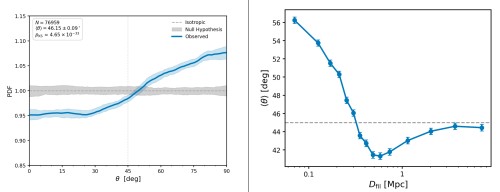
Figure 2: Left panel: Statistical correlation between the orbital planes of satellite galaxies and the orientation of cosmic filaments. The observed distribution deviates significantly from a random configuration, indicating that satellite galaxies tend to move within planes that contain the filament axis. Right panel: Variation of satellite galaxy orbital orientations as a function of their distance from the filament axis. As one moves from the filament’s outskirts toward its center, the orbital orientations undergo a “flip,” transitioning from perpendicular to the filament to aligned along it—corresponding to two distinct accretion phases: transverse infall and filament‑aligned transport.
This study was jointly conducted by the Shanghai Astronomical Observatory of the Chinese Academy of Sciences, together with Shanghai Jiao Tong University, Zhejiang University, and Nanjing Normal University. Researcher Wang Peng of the Shanghai Astronomical Observatory served as both the first author and the corresponding author of the paper.
This research was supported by the National Natural Science Foundation of China’s Major Project and General Program, the Special Scientific Research Fund for the Survey Space Telescope under the Space Application System of China’s Manned Space Program, as well as the Shanghai Qimingxing Program, among other projects.
Source: Shanghai Astronomical Observatory
LATEST NEWS
Thank you for visiting the official website of Chongfan Technology. If you have cooperation intentions or suggestions, please contact us through the following methods, and we will reply as soon as possible, thank you!
Address: Room 403, Building 6, Phase III of R&D, No. 36 Xiyong Avenue, High tech Zone, Chongqing, China.
Telephone: +86-13658337211
E-mail: Sales@cfkeji.net
Website: www.cfkeji.net
Mobile Version