
Chongfan Technology
News
23
2026
-
07
The Shanghai Institute of Optics and Fine Mechanics has made new progress in research on high‑power laser protection mechanisms.
Author:
Recently, the research team led by Researcher Jun Wang at the Department of Frontier Interdisciplinary Photonics of the Shanghai Institute of Optics and Fine Mechanics, Chinese Academy of Sciences, has made new progress in studying the mechanisms of high‑intensity laser protection. The relevant findings, titled “Periodic explosive boiling and hopping vapor-bubble dynamics during nanosecond laser irradiation of a nanoparticle in water,” have been published in Optical Materials Express.
When nanosecond pulsed lasers irradiate carbon nanoparticles in water, they trigger transient processes involving the coupled action of multiple physical fields—optical, thermal, and phase‑transition phenomena. This process underpins the operational principles of relevant optical materials; however, simultaneously capturing its transient dynamics and optical responses, both experimentally and theoretically, has long remained a challenging problem in this field.
The research team irradiated an aqueous suspension of carbon nanoparticles with a 4‑nanosecond short‑pulse laser, measured the temporal evolution of the transmittance in real time, and developed a corresponding thermodynamic model to elucidate the physical response mechanisms of such carbon‑based optical materials under nanosecond laser excitation. Both the model and experimental results reveal a previously unreported dynamic behavior: when carbon nanoparticles are heated by a nanosecond laser, the vapor layer that forms around them does not expand continuously and smoothly, but instead undergoes a series of discrete, explosive, stepwise expansions. The team terms this phenomenon “jumping bubble dynamics.” Further modeling identifies the physical conditions underlying this effect: when the temperature of the superheated liquid surrounding the nanoparticles reaches approximately 588 K (315 °C), the liquid phase undergoes explosive boiling, causing the vapor shell to expand abruptly. As long as the nanoparticle temperature remains above this threshold, the jumping process repeats cyclically.
This hopping mechanism provides a physical explanation for why carbon nanoparticle suspensions can efficiently limit high‑power laser radiation. Each jump is accompanied by a sudden change in the size of the vapor shell, leading to a stepwise increase in the scattering cross section and a substantial attenuation of the transmitted light. This physical property is precisely what enables optical limiters to protect sensitive detectors, night‑vision devices, and the human eye from damage caused by intense lasers. Furthermore, the model predicts that each boiling‑induced jump generates acoustic waves in the medium at gigahertz frequencies—essentially ultrasonic waves. This mechanism for generating ultrasound on the picosecond timescale holds promise for new applications in biophysics, materials science, and other fields.
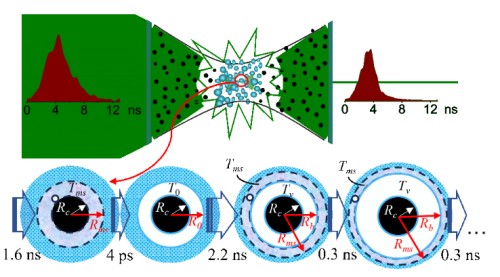
Figure 1. Experimental setup and model. A laser pulse heats carbon nanoparticles suspended in water, generating a vapor shell around them. This vapor shell does not expand smoothly but instead expands in explosive, “jumping‑bubble” bursts. Each burst corresponds to a microexplosion of superheated water, occurring repeatedly within a single laser pulse. This mechanism accounts for the record‑breaking effectiveness of laser‑induced radiation shielding. The time intervals shown in the figure represent the calculated durations of the successive processes.
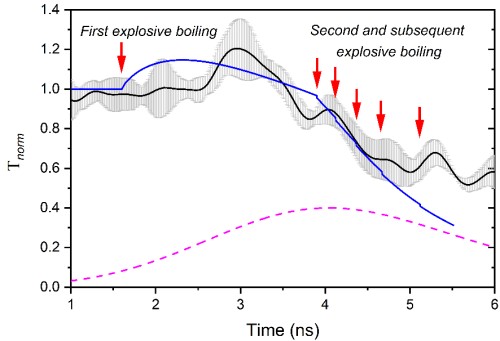
Figure 2: The experimentally measured transmittance curve (black line) is accurately reproduced by our model (blue line). The sharp peak corresponds to the emergence of a thin vapor shell, while the abrupt drop marks the onset of a series of explosive jumps (“jumping bubbles”), which dramatically enhance light scattering. As a result, the suspension effectively begins to attenuate high‑power laser pulses (dashed line).
This work was supported by the Chinese Academy of Sciences’ Pioneer Program, the National Natural Science Foundation of China, and the Shanghai Municipal Natural Science Foundation.
Source: Shanghai Institute of Optics and Fine Mechanics
LATEST NEWS
Thank you for visiting the official website of Chongfan Technology. If you have cooperation intentions or suggestions, please contact us through the following methods, and we will reply as soon as possible, thank you!
Address: Room 403, Building 6, Phase III of R&D, No. 36 Xiyong Avenue, High tech Zone, Chongqing, China.
Telephone: +86-13658337211
E-mail: Sales@cfkeji.net
Website: www.cfkeji.net
Mobile Version