
Chongfan Technology
News
11
2026
-
06
East China University of Science and Technology: Perovskite Photovoltaic Interface Materials | Nature Materials
Author:
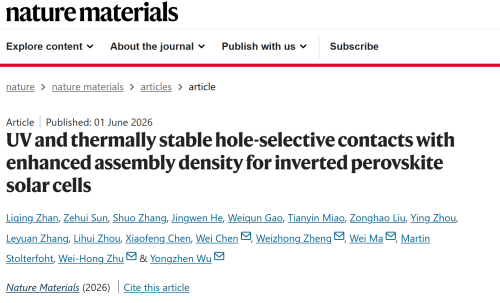
Recently, the internationally renowned academic journal Nature Materials published online the latest collaborative research成果 of a team led by Academician Weihong Zhu, Professor Yongzhen Wu, and Professor Wei Ma from the School of Chemistry and Molecular Engineering at East China University of Science and Technology, along with Associate Professor Weizhong Zheng from the School of Chemical Engineering and Professor Wei Chen from Huazhong University of Science and Technology, in the fields of organic hole-transport materials and perovskite solar cells. The study, titled “UV and thermally stable hole-selective contacts with enhanced assembly density for inverted perovskite solar cells,” offers a molecular‑rational design strategy to address the longstanding challenges of ultraviolet‑induced degradation and thermal instability in perovskite photovoltaic devices.
Perovskite solar cells have attracted considerable attention due to their high efficiency and low cost, with self-assembled monolayers (SAMs) serving as hole-selective contacts—a key technology driving the development of inverted‑structure devices. However, mainstream carbazole‑based SAM materials—such as MeO‑2PACz shown in Figure 1—face severe stability challenges that significantly limit the outdoor operational lifetime of the devices. At the molecular level, the electron‑rich nature of the carbazole unit makes it prone to oxidative degradation under UV irradiation, particularly in the presence of oxygen. Although introducing phenyl‑based conjugated linkages can enhance photostability, our team has found that aromatic phosphonic acids exhibit poor thermal stability and readily undergo intermolecular dehydration reactions. Degradation of the hole‑transport material compromises its dual functions of charge extraction and interface passivation.
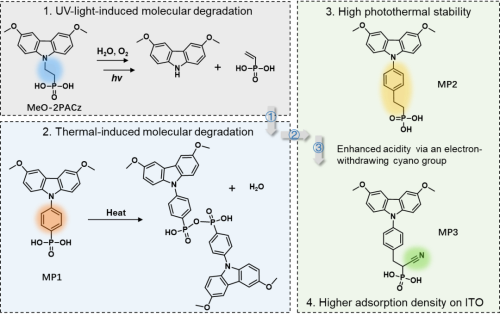
Figure A1. Photothermal degradation mechanisms of organic hole-transport materials and rational molecular design strategies.
In response to the aforementioned challenges, the research team used the prototypical molecule MeO‑2PACz as a model and, through systematic molecular engineering of the linker groups, for the first time elucidated two distinct degradation pathways: an ultraviolet‑induced N‑dealkylation of the nonconjugated segment and a thermally driven acidification side reaction of the conjugated structure. Building on this profound mechanistic understanding, the team rationally designed and synthesized a novel molecule, MP3. This molecule ingeniously integrates both conjugated and nonconjugated linker moieties and incorporates electron‑withdrawing substituents, thereby effectively suppressing both UV‑induced degradation and thermal decomposition. Moreover, by tuning the pKa of the phosphonic acid anchoring group, the team significantly enhanced the molecular assembly density and binding strength on the substrate.
Experimental results show that perovskite solar cells based on the MP3 molecule have achieved a certified power conversion efficiency of 27.1%, placing them at an internationally leading level. Notably, these devices exhibit significantly improved operational stability compared to the benchmark MeO‑2PACz: after 1,000 hours of continuous UV irradiation, they retain 93.2% of their initial efficiency; following 1,000 hours of thermal aging at 100 °C, the efficiency retention rate remains as high as 91.1%; and during 2,200 hours of maximum power point tracking at 65 °C, the efficiency retention rate is 94.8%.
This achievement marks a significant theoretical breakthrough by East China University of Science and Technology in the field of perovskite photovoltaic interface materials, opening up new avenues for designing next-generation charge-selective contact materials that combine high efficiency with exceptional long-term stability, and holding substantial value for advancing the commercialization of perovskite solar cells.
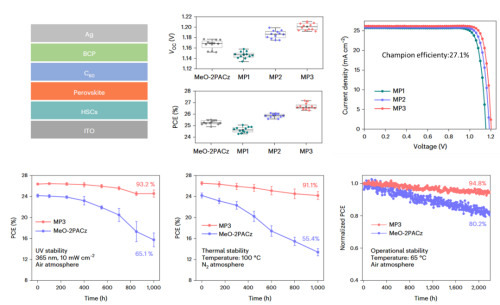
Figure A2. Performance and stability of perovskite solar cells based on a newly designed organic hole-transport material.
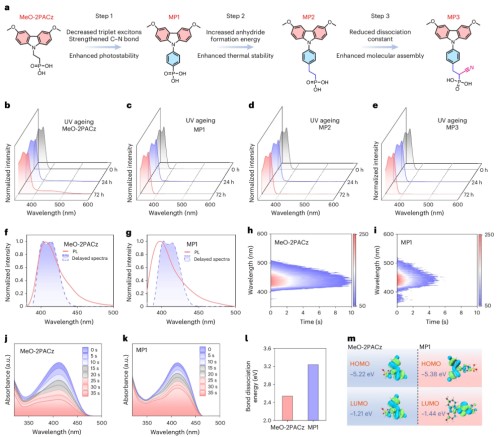
Figure 1 Molecular Design and UV Stability
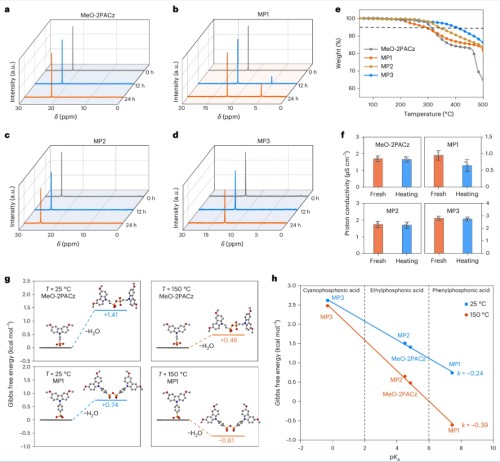
Figure 2 Molecular Thermal Stability
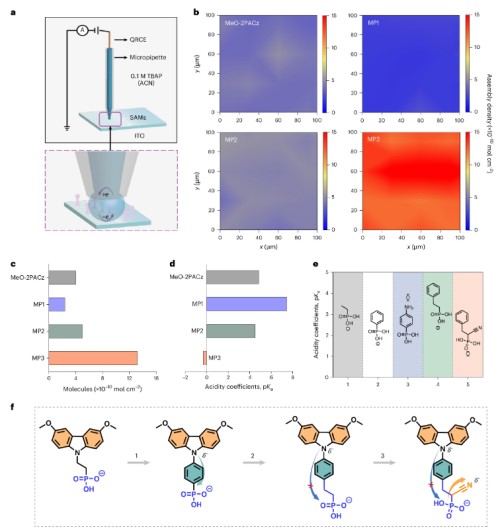
Figure 3. Characterization of Molecular Assembly Behavior
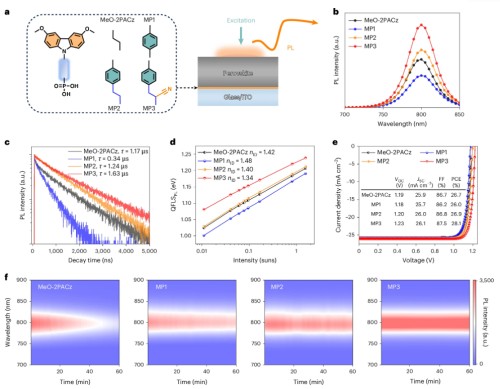
Figure 4. Optoelectronic Properties and Stability of Perovskite Thin Films
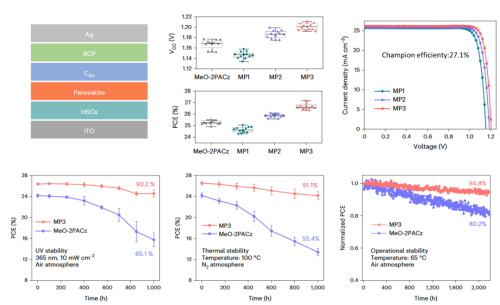
Figure 5: Photovoltaic Performance and Long-Term Stability of the Device
Zhan Liqing, a doctoral student; Sun Zehui and Zhang Shuo, postdoctoral fellows; and He Jingwen, a doctoral student, are the co-first authors of the paper. Professor Chen Wei of Huazhong University of Science and Technology, along with Associate Professor Zheng Weizhong, Professor Ma Wei, Academician Zhu Weihong, and Professor Wu Yongzhen of East China University of Science and Technology, serve as the corresponding authors. The research was carried out on platforms including the Center for Frontier Sciences in Materials Biology and Dynamic Chemistry, the Feringa Nobel Laureate Joint Research Center, and the Analytical Testing Center at East China University of Science and Technology, under the meticulous guidance and support of Academician Tian He. It was also supported by funding from the National Natural Science Foundation’s Basic Science Center Program, the National Outstanding Youth Science Fund, and key projects of the Shanghai Municipal Science and Technology Commission.
Source: School of Chemistry and Molecular Engineering, East China University of Science and Technology
LATEST NEWS
Thank you for visiting the official website of Chongfan Technology. If you have cooperation intentions or suggestions, please contact us through the following methods, and we will reply as soon as possible, thank you!
Address: Room 403, Building 6, Phase III of R&D, No. 36 Xiyong Avenue, High tech Zone, Chongqing, China.
Telephone: +86-13658337211
E-mail: Sales@cfkeji.net
Website: www.cfkeji.net
Mobile Version