
Chongfan Technology
News
05
2026
-
06
Spacetime Plasma Hologram
Author:
The teams led by Dongxia Hu and Yanlei Zuo at the China Academy of Engineering Physics, Stefan Weber at the Extreme Light Infrastructure (ERIC), and Hao Peng at Shenzhen Technology University have experimentally demonstrated spatiotemporal volumetric holography based on plasma gratings generated by spatially varying ionization. This approach enables the recording, storage, and retrieval of both spatial and temporal information of object pulses with femtosecond‑level resolution. The authors employed two complementary detection schemes—multi‑pulse scanning with a focused probe and single‑pulse imaging with an extended probe—to reliably reconstruct complex spatiotemporal structures, including Gaussian beams and Laguerre‑Gaussian beams. By investigating the operational intensity range of object pulses and the lifetime of the holograms, they thoroughly characterized the robustness of this method. These advances pave the way for ultrafast optical memory devices and real‑time signal processors, with potential applications in high‑speed optical communications and analog computing.
The research findings were published in Optica on May 22, 2026, under the title “Spatiotemporal plasma hologram.”
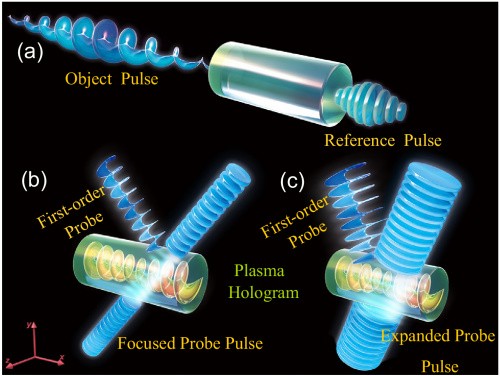
Figure 1: Schematic diagram of a spatiotemporal plasma hologram.
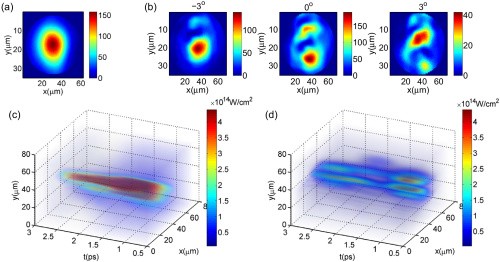
Figure 2: Transverse intensity profiles of a Gaussian pulse and a Laguerre–Gaussian pulse.
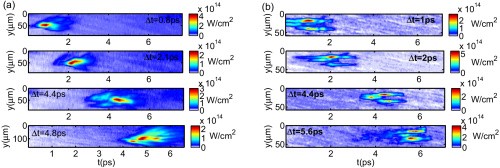
Figure 3: Investigation of the propagation of Gaussian and Laguerre–Gaussian pulses in a plasma using single-shot measurements.
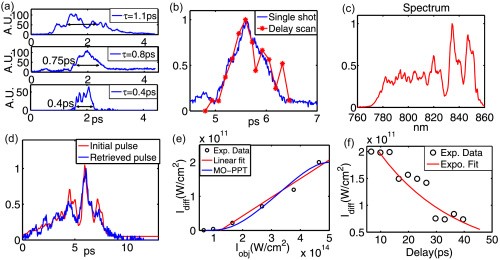
Figure 4: (a) Temporal waveform of the object’s pulse under different pulse durations.
Source: Optics World
LATEST NEWS
Thank you for visiting the official website of Chongfan Technology. If you have cooperation intentions or suggestions, please contact us through the following methods, and we will reply as soon as possible, thank you!
Address: Room 403, Building 6, Phase III of R&D, No. 36 Xiyong Avenue, High tech Zone, Chongqing, China.
Telephone: +86-13658337211
E-mail: Sales@cfkeji.net
Website: www.cfkeji.net
Mobile Version