
Chongfan Technology
News
03
2026
-
06
A new microscopy technique enables light-field imaging to surpass the diffraction limit in resolution.
Author:
Recently, a research team at the Institute for Molecular Science of Japan’s National Institutes of Natural Sciences has developed a novel microscopy technique called the “atom camera.” By using a single ultracold atom as a probe, they have achieved nanoscale imaging of light fields. This technology not only measures the intensity distribution of light but also, for the first time, directly visualizes its polarization structure, with a spatial resolution better than 100 nanometers—surpassing the diffraction limit of conventional optical microscopes. The method holds promise for applications in quantum computing and other emerging quantum technologies. The related findings, titled “Atom camera: super-resolution scanning microscope of a light pattern with a single ultracold atom,” were published in the latest issue of Nature Communications.
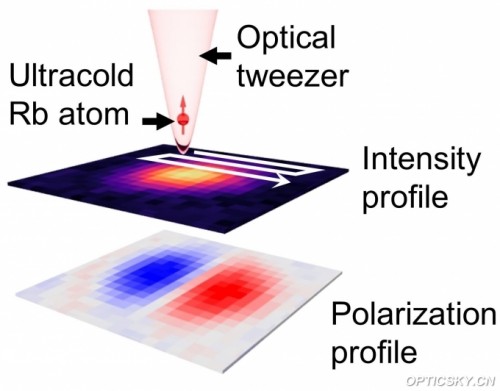
Conceptual diagram of the atomic camera. A single ultracold rubidium (Rb) atom is trapped in an optical tweezer, and by scanning the light spatially, the intensity and polarization distribution of the light are rendered as a visual pattern.
In quantum technologies, precise control of light fields with fine structures is essential. Laser beams are frequently employed to manipulate the quantum states of matter; for instance, in neutral-atom quantum computers, tiny arrays of laser‑generated spots and optical lattice structures play a central role in controlling qubits. However, many fundamental aspects of these systems have long remained difficult to observe directly. This is because such light fields typically reside in closed environments like vacuum cavities, where detectors cannot easily access them, while remote imaging through lenses often suffers from aberrations that distort the resulting images.
In this study, the research team trapped a single rubidium atom in an optical tweezer and used laser cooling to bring it down to a temperature close to absolute zero, reducing its thermal motion to an extremely low level. Subsequently, the researchers manipulated the atom’s position with nanometer‑scale precision, enabling it to “sense” changes in the light field point by point as it moved through space.
When an atom is in a different spatial position, the energy of its internal spin state varies with the local light‑field intensity and polarization. By measuring this energy shift, researchers can reconstruct an image of the light field’s spatial distribution. In other words, the atom acts as a “quantum sensor that scans the light field point by point,” converting otherwise invisible optical information into measurable data.
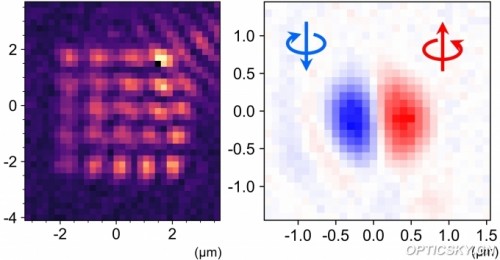
Images of light patterns captured using an atomic camera
Furthermore, this method has, for the first time, enabled direct imaging of light’s polarization structure. The team discovered that a seemingly simple linearly polarized laser beam, when subjected to intense focusing, develops a complex polarization pattern in the vicinity of the focal point—microscopic changes that were previously difficult to observe directly can now be clearly captured by the “atomic camera.”
This technology offers a novel approach to measuring optical fields at the nanoscale and holds promise for broad applications in quantum technologies. In particular, in neutral-atom quantum computers and quantum simulators, it can be used to precisely characterize and control the laser fields driving qubits, as qubits are highly sensitive not only to light intensity but also to polarization states.
Source: Nature Communications
Previous
Previous
LATEST NEWS
Thank you for visiting the official website of Chongfan Technology. If you have cooperation intentions or suggestions, please contact us through the following methods, and we will reply as soon as possible, thank you!
Address: Room 403, Building 6, Phase III of R&D, No. 36 Xiyong Avenue, High tech Zone, Chongqing, China.
Telephone: +86-13658337211
E-mail: Sales@cfkeji.net
Website: www.cfkeji.net
Mobile Version