
Chongfan Technology
News
11
2026
-
05
Chinese Research Team Achieves All-Optical Logic Operations and Multispectral Image Recognition
Author:
In nature, eagle eyes can detect prey tracks under ultraviolet light, and snake eyes can perceive infrared heat sources, whereas the human eye is limited to the narrow band of visible light. If machines could be endowed with a broad-spectrum vision akin to that of both eagles and snakes, they would be able to capture far more hidden information in fields such as remote-sensing monitoring.
To realize this capability, key devices must accurately sense and identify light across different spectral bands while simultaneously performing sensing, storage, and computation—much like the human brain. Optoelectronic memristors precisely possess this “integrated sensing–storage–computing” property and are regarded as a crucial foundation for neuromorphic vision systems.
Recently, a research team at the Shenzhen Institute of Advanced Technology, Chinese Academy of Sciences, has developed a novel optoelectronic memristor by encapsulating black phosphorus (BP) with lead oxide (PbOx). This device not only exhibits significantly enhanced stability but also boasts nonvolatile memory characteristics, making it suitable for constructing light-controlled artificial neural networks. Moreover, the device demonstrates broad-spectrum optical responsiveness spanning from the ultraviolet to the near-infrared region. Under illumination at different wavelengths, the device displays completely opposite responses; by simply adjusting the wavelength and intensity of the light, its on–off state can be flexibly tuned.
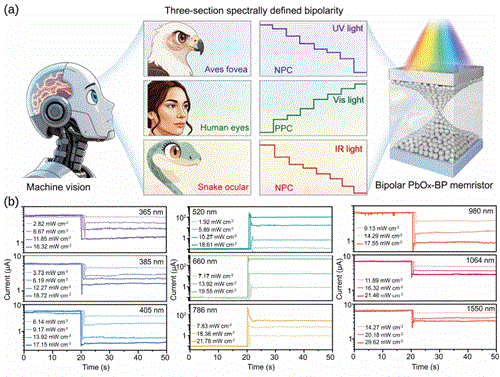
Bipolar All-Optical Response of PbOX-BP Memristors and Their Applications in Logic Operations and Multispectral Recognition
Building on this spectrally tunable bipolar response, the research team further demonstrated 14 all-optical Boolean logic operations and successfully performed multi-spectral remote-sensing image classification and recognition. Among 16 crop-classification tasks, the system achieved a maximum accuracy of 98.6%, highlighting the device’s promising applications in all-optical neuromorphic vision and intelligent recognition.
The relevant research findings have been published in Advanced Materials, and the research was supported by the National Key R&D Program and the National Natural Science Foundation of China, among others.
Source: Shenzhen Institute of Advanced Technology
LATEST NEWS
Thank you for visiting the official website of Chongfan Technology. If you have cooperation intentions or suggestions, please contact us through the following methods, and we will reply as soon as possible, thank you!
Address: Room 403, Building 6, Phase III of R&D, No. 36 Xiyong Avenue, High tech Zone, Chongqing, China.
Telephone: +86-13658337211
E-mail: Sales@cfkeji.net
Website: www.cfkeji.net
Mobile Version