
Chongfan Technology
News
11
2026
-
05
AI-Enhanced Optical Micro-Manipulation Technology Empowers Precise Microparticle Transport
Author:
Recently, the Xi’an Institute of Optics and Precision Mechanics of the Chinese Academy of Sciences, in collaboration with Northwest A&F University, has achieved a significant breakthrough in the field of optical microparticle transport. The findings have been published in Light: Advanced Manufacturing. The paper’s co-first authors are Yun Yuxiang, a master’s student at Northwest A&F University (jointly trained by the Xi’an Institute of Optics and Precision Mechanics), Gao Wenyu, a doctoral student at the institute, and Zhou Yuan, a special research assistant. Researcher Bai Chen and Researcher Yao Baoli from the Xi’an Institute of Optics and Precision Mechanics, along with Associate Professor Cai Yanan from Northwest A&F University, serve as the co-corresponding authors.
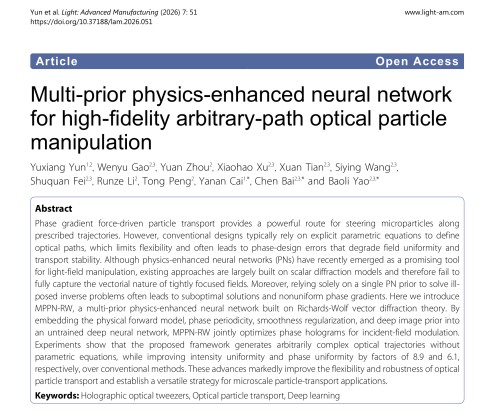
Optical transport belts based on holographic optical tweezers offer significant advantages, including non-contact operation, high precision, and minimal sample damage, making them highly valuable for applications in micro- and nanoassembly, biological manipulation, targeted drug delivery, and other fields. They are also one of the key technologies underpinning major national strategic priorities such as advanced manufacturing and life sciences and health. However, conventional designs of optical transport belts rely on explicit trajectory equations, which struggle to meet the demands of complex path generation; scalar diffraction models fail to accurately characterize light-field properties under tightly focused conditions; and existing deep-learning approaches suffer from strong data dependency, limited generalization capability, and susceptibility to speckle noise and phase discontinuities—issues that hinder further advancement of optical microparticle transport technology.
To address the aforementioned challenges, our team has innovatively proposed a Multi-Prior Physical Enhancement Neural Network (MPPN-RW) based on Richards–Wolf vector diffraction theory (as shown in Figure 1). This network integrates physical-model priors, phase-periodicity priors, light-field smoothness priors, and depth-image priors into a unified unsupervised optimization framework. As a result, it can achieve high-fidelity reconstruction of computational holograms corresponding to arbitrarily complex optical conveyor-path configurations—without the need for any training data.
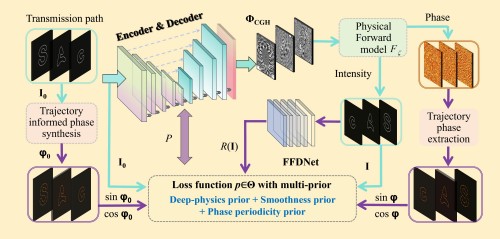
Figure 1: Working Principle of the Multi-Prior Physical Enhancement Neural Network (MPPN-RW)
On this basis, the team constructed an optical conveyor belt system and verified its ability to stably manipulate 1-μm-diameter gold particles. As shown in Figure 2, the particles can move continuously at a constant speed along a letter-shaped “CAS” trajectory, with no significant stagnation or deviation even in regions of high curvature. This demonstrates that the optical conveyor belt generated by MPPN-RW can simultaneously maintain both uniform particle velocity and precise spatial positioning, with average transport speeds of 3.79 μm/s, 8.16 μm/s, and 5.08 μm/s, respectively.
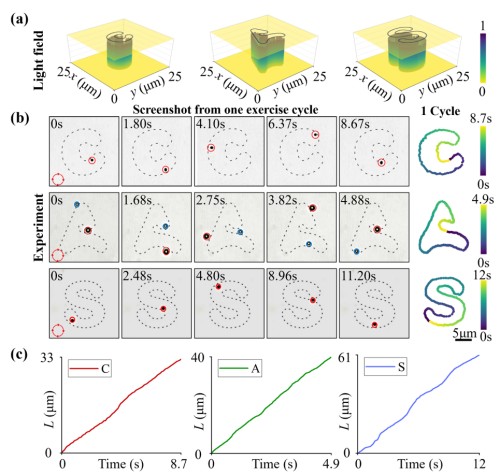
Figure 2. Optical conveyor belt transport of gold nanoparticles in the shapes of the letters ‘C’, ‘A’, and ‘S’.
To further validate the scalability and robustness of the MPPN-RW framework, researchers conducted long-distance, high-complexity transport-trajectory verification experiments, successfully achieving particle transport along arbitrary open free curves, such as the hand-drawn Chinese character “light” and the numeral “6” (as shown in Figure 3).
According to Bai Chen, “this technology is akin to building a ‘smart conveyor belt’ for light in the microscopic world. Traditional approaches are like drawing optical paths using fixed formulas—when faced with complex trajectories, errors are easy to occur. In contrast, the new method integrates physical laws with artificial intelligence to automatically design optical paths of arbitrary shapes, enabling microparticles to move stably along intricate trajectories such as petal-like patterns, letters, or even handwritten strokes. Not only does it account for the wave nature of light, but it also employs multiple constraints to ensure uniformity of the light field, so that during transport the particles essentially travel on a smooth, high-speed highway—less likely to deviate and free from any bottlenecks.”
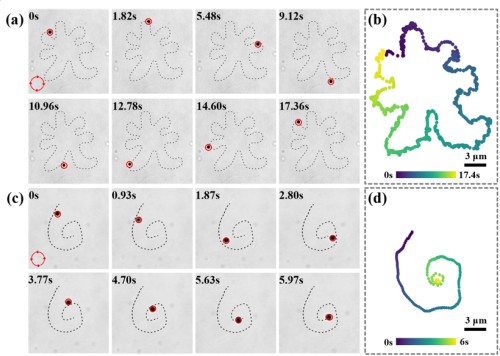
Figure 3. Long-distance transport of the trajectories of the Chinese character “light” and the numeral “6”
This study deeply integrates physical-model constraints with intelligent optimization algorithms, significantly enhancing the quality of tightly focused optical fields and the stable transport of microparticles. It advances optical tweezers technology from single-mode manipulation toward programmable, intelligent optical transport systems, thereby opening up new avenues for smart optical manipulation, cell assembly, and micro- and nanomanufacturing. As a major breakthrough in the Xi’an Institute of Optics and Precision Mechanics’ efforts to promote AI–optics convergence and innovation, this technology underscores the broad prospects of artificial intelligence in empowering the development of advanced optical technologies.
In recent years, the research team led by Researchers Yao Baoli and Bai Chen has continuously pursued cutting-edge research at the intersection of AI and optical microscopy imaging, as well as AI and optical micro-manipulation technologies, achieving a series of significant breakthroughs. Their work has been published in prestigious journals such as PNAS, Nature Communications, Science Advances, Opto-Electronic Advances, PhotoniX, Ultrafast Science, and Photonics Research, and they have been granted multiple national invention patents. In addition, the team has received numerous awards and honors, including the First-Class and Second-Class Shaanxi Provincial Science and Technology Awards and the designation as a Key Innovation Team for Science and Technology in Shaanxi Province.
Source: Xi’an Institute of Optics and Precision Mechanics
LATEST NEWS
Thank you for visiting the official website of Chongfan Technology. If you have cooperation intentions or suggestions, please contact us through the following methods, and we will reply as soon as possible, thank you!
Address: Room 403, Building 6, Phase III of R&D, No. 36 Xiyong Avenue, High tech Zone, Chongqing, China.
Telephone: +86-13658337211
E-mail: Sales@cfkeji.net
Website: www.cfkeji.net
Mobile Version