
Chongfan Technology
News
29
2026
-
04
International Team of Physicists Achieves Major Breakthrough in Laser Science
Author:
An international team of physicists has, for the first time, demonstrated a practical pathway to dramatically increase the intensity of high-power lasers. Published in Nature, this breakthrough has generated the strongest light ever produced in a laboratory, thereby opening the door to experiments that probe the fundamental laws of physics by enabling direct interactions between light and the quantum vacuum.
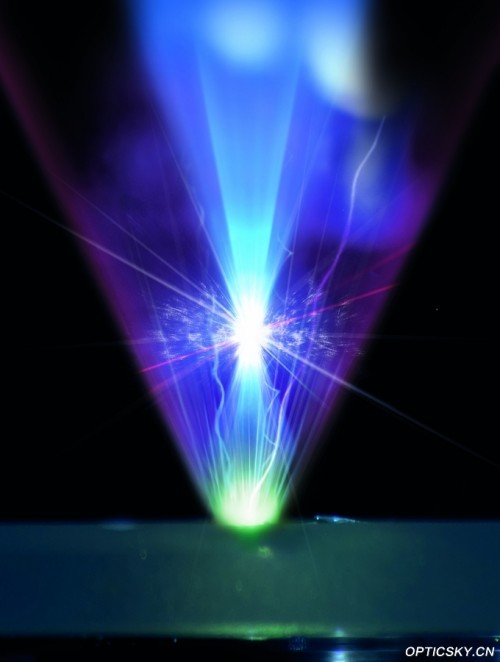
Generation of coherent harmonic focusing (CHF). The laser is focused onto the target, and the reflected violet beam forms an extremely intense CHF, thereby generating matter from light.
This work was led by Professor Peter Norreys and Dr. Robin Timmis at the University of Oxford, in close collaboration with Professor Brendan Dromey and Dr. Mark Yeung at Queen’s University Belfast, as well as scientists at the Central Laser Facility of the UK Science and Technology Facilities Council.
The research team used the Gemini laser at the Central Laser Facility to generate extremely intense ultraviolet light through an unusual process. Simply put, they fired a powerful laser beam at a cloud of charged particles—plasma—causing it to behave like a rapidly moving “mirror.” It’s akin to shining a flashlight at a mirror hurtling toward you at high speed: the reflected light is compressed and gains higher energy, much like how the pitch of an ambulance siren rises as it speeds past.
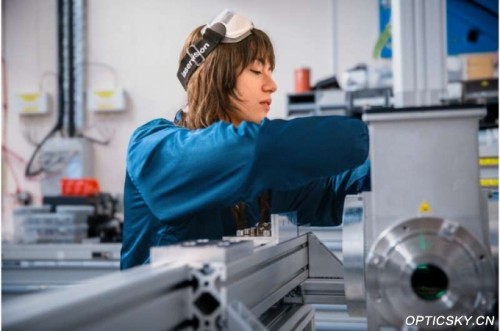
Dr. Robin Timmis operating the OHREX spectrometer
In this experiment, the “mirror” moves so rapidly that Einstein’s theory of relativity comes into play, boosting the light to higher energies. This effect is known as relativistic harmonic generation. The research team also demonstrated a method for further focusing this light, which they call coherent harmonic focusing.
To draw an analogy, it’s like using a magnifying glass to focus sunlight onto a tiny spot—its intensity is enough to ignite paper. In this case, instead of sunlight, we have lasers of various colors (wavelengths), which are combined and focused into an extremely small area, resulting in a tremendous concentration of energy.
This advancement may ultimately enable scientists to explore one of the most extreme frontiers of physics: the fundamental interactions between light and matter, as described by quantum electrodynamics.
To date, experiments in this field have required colliding high-energy particle beams with intense lasers and then painstakingly translating the results between different reference frames—somewhat like trying to understand a car crash by switching among multiple cameras in motion.
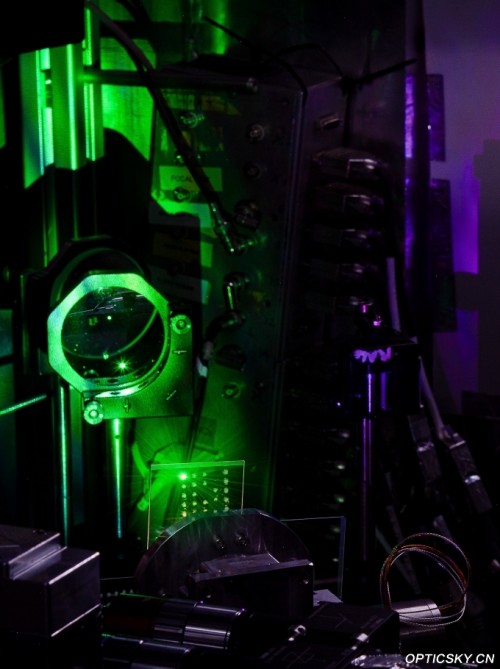
Vacuum chamber during interaction
This new approach, however, sidesteps this complexity. Since everything occurs within the laser system itself, scientists can directly observe the results without having to perform intricate frame-by-frame transformations. This should make the interpretation of future experiments much easier.
This research was conducted in 2024 and 2025 and involved extensive international collaboration, including the team led by Dr. Ed Gumbrell at AWE, the research group of Professor Karl Krushelnick at the Center for Ultrafast Optical Sciences at the University of Michigan in the United States, and the high-field physics and laser-acceleration research group headed by Professor Matt Zepf at the University of Jena in Germany. This work was partly based on the doctoral dissertation of Dr. Robin Timmis and was jointly funded by the Oxford Centre for High-Energy-Density Science and the Oxford–Berman Physics Scholarship Programme until she defended her thesis in 2024.
Dr. Robin Timmis, the first author and a researcher in the Department of Physics at the University of Oxford, said: “The findings we have achieved so far are truly fascinating, and we feel that we have only just begun to unravel the rich and complex physics underlying this mechanism. Simulation results suggest that we may have already created the most powerful coherent light source to date. I hope we will soon have the opportunity to return to the Gemini facility to confirm these results and apply what we have learned to larger-scale instruments, with the goal of generating even brighter light.”
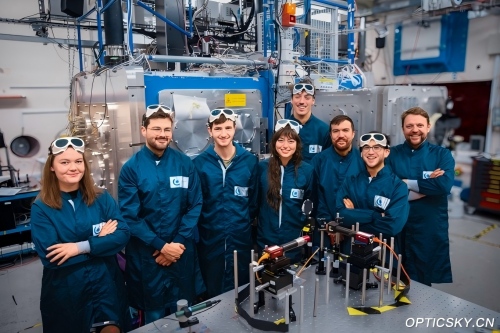
Members of the experimental team at the Gemini Laser Target Area
Senior author Professor Peter Norreys of the University of Oxford’s Department of Physics said: “We are thrilled to have achieved this remarkable result in the laboratory. It is a testament to Robin’s exceptional mastery of this subject, as she has attained the precise experimental conditions that we have been striving for over decades without success. It also truly reflects the dedication and professionalism of the rest of the Oxford team, as well as the teams at Queen’s University Belfast—led by Brendan Dromey and Mark Yeung, particularly Jonny Kennedy, Holly Huddleston, and Colm Fitzpatrick—along with the scientists at the Central Laser Facility at the Rutherford Appleton Laboratory, AWE in Aldermaston, and our esteemed international collaborators.”
Co-author Professor Brendan Dromey of Queen’s University Belfast commented: “This work integrates laser technology, plasma physics, and ultrafast materials science, and through meticulous optimization, it resolves the long-standing discrepancy between theory and experiment—a mismatch that has plagued this field for more than two decades.”
Source: phys
LATEST NEWS
Thank you for visiting the official website of Chongfan Technology. If you have cooperation intentions or suggestions, please contact us through the following methods, and we will reply as soon as possible, thank you!
Address: Room 403, Building 6, Phase III of R&D, No. 36 Xiyong Avenue, High tech Zone, Chongqing, China.
Telephone: +86-13658337211
E-mail: Sales@cfkeji.net
Website: www.cfkeji.net
Mobile Version