
Chongfan Technology
News
27
2026
-
04
AnGuang Proposes a Semi-Supervised AI Learning Framework for Unified 3D Medical Image Segmentation
Author:
Recently, Researcher Wang Huanqin from the team of Gui Huaqiang at the Institute of Optics and Electronics, Chinese Academy of Sciences, in collaboration with the First Affiliated Hospital of Anhui Medical University, the First People’s Hospital of Hefei, and other institutions, has developed a general-purpose semi-supervised AI learning framework. This framework supports three key tasks—semi-supervised learning (SSL), unsupervised domain adaptation (UDA), and semi-supervised domain generalization (Semi-DG)—and can significantly reduce the annotation burden in 3D medical image segmentation while enhancing the model’s multi-center generalization performance. The related findings have been published under the title “A General Semi-Supervised 3D Medical Image Segmentation Study from the Perspective of Frequency Shortcuts” in Pattern Recognition, a top-tier journal in Zone 1 of the computer science field.
In 3D medical image segmentation, manual annotation is labor-intensive, the workflow is cumbersome, and it relies heavily on expert operators. Semi-supervised learning, by contrast, leverages both highly accurate labeled data and large volumes of low-cost unlabeled images, thereby effectively advancing the state of the art in 3D medical image segmentation. Most existing semi-supervised methods assume that labeled and unlabeled data share a common source and exhibit similar feature distributions. However, in real-world clinical settings, medical research is often conducted through multi-center collaborations, with imaging data acquired using diverse modalities and acquisition protocols, leading to distributional shifts across datasets. This poses significant challenges for research, giving rise to issues such as unsupervised domain adaptation and semi-supervised domain generalization. Consequently, developing a versatile algorithmic framework capable of adapting to multiple tasks is crucial for addressing the twin challenges of scarce annotated data and domain shift in medical imaging. Building a unified framework that supports self-supervised learning, unsupervised domain adaptation, and semi-supervised domain generalization is essential for overcoming the dual hurdles of annotation scarcity and domain shift in 3D medical image segmentation. Furthermore, recent studies have shown that artificial neural networks tend to prioritize learning simple frequency-based features for classification, a phenomenon known as the “frequency shortcut.” While this biased learning strategy can simplify model training, it significantly undermines the model’s generalization capability. In semi-supervised learning, the commonly used pseudo-labels are inherently biased, which further exacerbates the adverse effects of the frequency shortcut.
To address the aforementioned pain points, Researcher Wang Huanqin’s team at the Anhui Institute of Optics and Fine Mechanics has innovatively proposed a novel approach to suppress frequency shortcuts. Leveraging an adversarial training framework, they have designed two entirely new data augmentation modules that constrain biased learning at the data level, thereby comprehensively enhancing the model’s generalization and adaptation capabilities. The first is the Low-Frequency Adversarial Adaptive Enhancement module (L-AAE), which prevents the model from over-relying on a single dominant frequency feature while, through bidirectional adversarial adjustment and style optimization, reducing the inter-source discrepancies in medical imaging data. The second is the Frequency-Adaptive Suppression Enhancement module (F-ASE), which dynamically adjusts the feature weights across different image frequencies, guiding the model to learn all frequency components in a balanced manner and thereby diminishing its excessive dependence on specific features. Finally, the original images are combined with the optimized adversarial samples and integrated into a semi-supervised learning framework for training. The team has conducted extensive comparative experiments on several publicly available benchmark datasets spanning SSL, UDA, and Semi-DG tasks, thoroughly validating the advanced nature and practical utility of this method.
This study offers a new approach to medical image segmentation under a semi-supervised learning paradigm. By mitigating the frequency shortcut problem, it trains AI models that exhibit greater stability and higher segmentation accuracy. In this experiment, even when using only the basic, general-purpose V-Net as a baseline, outstanding performance was achieved. Moreover, the two proposed modules—L-AAE and F-ASE—are functionally independent of the model architecture, not limited to specific network structures, highly compatible, and broadly applicable; they can be rapidly adapted and deployed across various mainstream algorithmic models. In addition, this optimization strategy for reducing frequency shortcuts is equally effective in complex scenarios such as weakly supervised learning and settings with significant data distribution discrepancies, thereby universally enhancing the stability of AI models. Looking ahead, it holds promise for broader application beyond medical image segmentation into many other research domains.
PhD student Huang Yigeng is the first author of the paper, with Researcher Wang Huanqin serving as the corresponding author. This research was supported by the National Key R&D Program and the Anhui Provincial Translational Medicine Research Project.
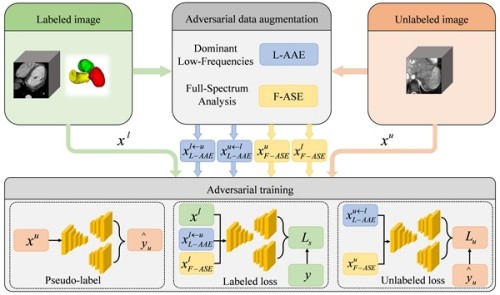
Schematic diagram of the general semi-supervised learning framework proposed in this paper.
Source: Anhui Institute of Optics and Fine Mechanics
LATEST NEWS
Thank you for visiting the official website of Chongfan Technology. If you have cooperation intentions or suggestions, please contact us through the following methods, and we will reply as soon as possible, thank you!
Address: Room 403, Building 6, Phase III of R&D, No. 36 Xiyong Avenue, High tech Zone, Chongqing, China.
Telephone: +86-13658337211
E-mail: Sales@cfkeji.net
Website: www.cfkeji.net
Mobile Version