
Chongfan Technology
News
03
2026
-
03
Ding Shiqian’s team from the Department of Physics at Tsinghua University: Vacuum Ultraviolet Light Source for Nuclear Optical Clocks
Author:
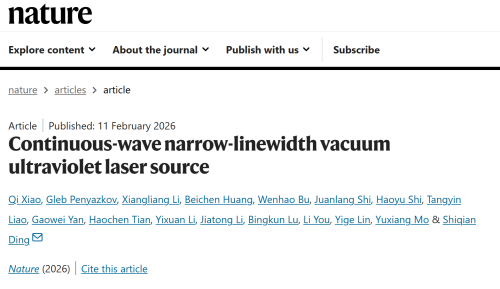
Recently, the team led by Associate Professor Ding Shiqian from the Department of Physics at Tsinghua University has achieved a major breakthrough in continuous-wave vacuum ultraviolet light sources, successfully developing a 148 nm continuous-wave laser source with an ultra-narrow linewidth. This marks the first time that ultra-stable laser technology has been advanced into the vacuum ultraviolet wavelength range, overcoming the "final core bottleneck" in the development of nuclear optical clocks. The newly developed laser source delivers an output power exceeding 100 nW in the target wavelength band, with a linewidth far below 100 Hz and continuous tunability across the 140 to 175 nm range. Compared with previously reported single-frequency vacuum ultraviolet light sources, its linewidth is reduced by nearly a million times, perfectly meeting the critical requirements for the development of thorium-229 nuclear optical clocks and for quantum coherent control of nuclear transitions. On February 11, 2026, the research findings were published online in the prestigious international journal Nature under the title "Continuous-wave narrow-linewidth vacuum ultraviolet laser source." At the same time, Physics Magazine, published by the American Physical Society (APS), featured a special commentary article in its Viewpoint section, providing an in-depth analysis of this groundbreaking achievement.
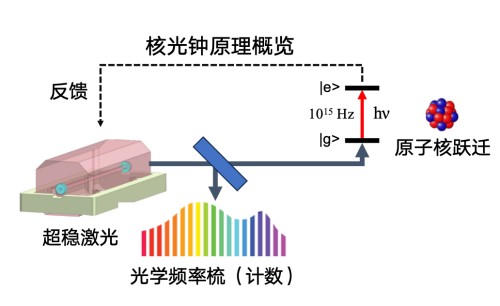
Overview Diagram of the Nuclear Optical Clock Principle
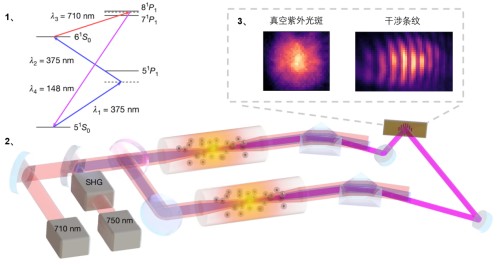
Figure 1: Resonance-enhanced four-wave mixing process involving cadmium atoms; Figure 2: Schematic diagram of the experiment; Figure 3: Vacuum ultraviolet spot and interference fringes captured by the camera.
Optical clocks provide the most precise time and frequency standards and hold significant strategic value in applications such as navigation and testing fundamental physical laws. Atomic optical clocks, which use electronic transitions as their reference, are relatively sensitive to external electromagnetic environments and rely on sophisticated experimental setups—including ultra-high vacuum, laser cooling, and trapping—that limit their practical deployment beyond laboratory settings. In the past two years, research on nuclear optical clocks has advanced rapidly, proposing the use of the low-energy nuclear transition of the thorium-229 nucleus in the 148-nanometer vacuum ultraviolet band as a new reference standard. By replacing electronic transitions with nuclear transitions, this approach promises a paradigm shift at the fundamental level of optical-clock technology. Since the atomic nucleus resides within the atom itself and is extremely small in scale, its interaction with external electromagnetic fields is comparatively weaker, making it much less sensitive to environmental disturbances. As a result, nuclear optical clocks combine exceptional precision, strong resistance to environmental perturbations, and the potential for portable, engineering-friendly designs—leading them to be widely regarded as a strategically前沿 direction in today’s quantum precision measurement field.
The key bottleneck in the development of nuclear optical clocks lies in the lack of a 148 nm continuous-wave laser. To address this challenge, the U.S. Defense Advanced Research Projects Agency (DARPA) launched the SUNSPOT program in 2025, focusing specifically on the development of a 148 nm continuous-wave light source. Ding Shiqian’s team broke through the conventional approach based on nonlinear crystals and theoretically proposed a continuous-wave vacuum ultraviolet generation scheme relying on four-wave mixing in metal vapor. Even before the SUNSPOT program was officially approved in the U.S., they were the first to experimentally achieve 148 nm continuous-wave output, reducing the linewidth by nearly six orders of magnitude compared to previous single-frequency vacuum ultraviolet lasers. This breakthrough will provide crucial light-source support for high-resolution spectroscopy and quantum coherent control of the thorium-229 nuclear transition, completing the final piece of the puzzle in the development of nuclear optical clocks.
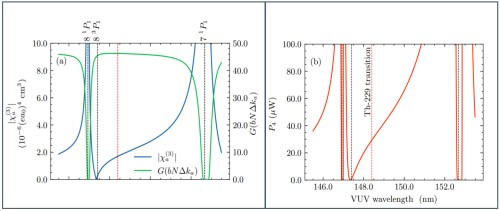
Left: Nonlinear polarizability and phase-matching function near the thorium-229 isomeric transition; Right: Vacuum ultraviolet laser output power near the thorium-229 isomeric transition.
It is worth noting that the research team has developed a phase-detection method that can operate stably even under extremely low laser power conditions. Furthermore, experiments have revealed that in hot metal vapor, Doppler and collision broadening on the gigahertz scale do not introduce additional phase noise during four-wave mixing. This finding indicates that the coherence of the vacuum ultraviolet light field output is primarily governed by the stability of the fundamental-frequency laser, thereby extending ultra-stable laser technology to the vacuum ultraviolet wavelength range and laying a solid foundation for the further development of coherent vacuum ultraviolet sources tailored to other critical wavelengths and higher performance specifications.
This light source platform features continuous-wave operation, excellent coherence, and wide-range tunability. In addition to serving nuclear optical clocks, it can also function as a versatile vacuum ultraviolet coherent light source platform, supporting quantum precision measurement research such as aluminum-ion atomic optical clocks, as well as cutting-edge applications including quantum information-related experiments, angle-resolved photoemission spectroscopy of condensed matter, and high-resolution vacuum ultraviolet spectroscopy. Addressing the needs of vacuum ultraviolet metrology, chip inspection, and mechanism studies for critical semiconductor materials and processes, this platform is expected to promote the independent control of advanced testing and characterization equipment and key components, thereby enhancing the resilience of critical links in the industrial chain.
The co-first authors of this paper are Xiao Qi, an undergraduate student from Tsinghua University’s class of 2021; Pang Yake, a doctoral student from the class of 2023 (Gleb Penyazkov, an international student); and Li Xiangliang, an assistant researcher at the Beijing Academy of Quantum Information Sciences. The corresponding author is Ding Shiqian, an associate professor in the Department of Physics at Tsinghua University and a part-time researcher at the Beijing Academy of Quantum Information Sciences. This represents the first experimental achievement of Ding Shiqian’s laboratory since its establishment more than four years ago, and also marks a breakthrough: an undergraduate student has published a paper as the first author in a top-tier international journal. This accomplishment highlights the team’s success in cultivating outstanding talent under the guidance of major research initiatives. Professors Mo Yuxiang from the Department of Physics at Tsinghua University, Lin Yige, a researcher at the National Institute of Metrology, and You Li, also a professor in the Department of Physics at Tsinghua University, made significant contributions to this work. The research was supported by the National Natural Science Foundation of China, the Beijing Municipal Science and Technology Program, and Tsinghua University’s “Dushi Plan.”
Source: Tsinghua University
LATEST NEWS
Thank you for visiting the official website of Chongfan Technology. If you have cooperation intentions or suggestions, please contact us through the following methods, and we will reply as soon as possible, thank you!
Address: Room 403, Building 6, Phase III of R&D, No. 36 Xiyong Avenue, High tech Zone, Chongqing, China.
Telephone: +86-13658337211
E-mail: Sales@cfkeji.net
Website: www.cfkeji.net
Mobile Version