
Chongfan Technology
News
27
2026
-
02
Topological Charge Jump Driven by Destructive Interference in a Bilayer Optical Metasurface
Author:
In optical metasurfaces, bound states in the continuum (BICs)—as polarization-vortex singularities in momentum space—carry integer topological charges and exhibit rich topological optical properties. Theoretically, they possess an infinitely large quality factor (Q-value), making them an ideal platform for realizing ultra-low-threshold lasers, ultra-high-sensitivity sensing, and precise control of light fields. The topological properties of BICs are strictly constrained by symmetry: different symmetries typically correspond to distinct topological charges. Current research efforts have mainly focused on specific topological charges permitted by given symmetries. However, a frequently overlooked fact is that, under the protection of the same symmetry, BICs can support multiple topological charges simultaneously. Therefore, how to dynamically tune the topological charge of BICs—from low-order to high-order—while preserving the structural symmetry remains a significant challenge in the field of optical metasurfaces.
Recently, the research team led by Junjie Li from the Microfabrication Laboratory at the Institute of Physics, Chinese Academy of Sciences/National Center for Research in Condensed Matter Physics, Beijing, designed and fabricated a bilayer titanium dioxide optical metasurface with triple rotational symmetry. By simply adjusting the thickness of the spacer layer between the two metasurface layers, the team was able to directly induce a topological charge transition of the bound-in-the-continuum (BIC) state—from a low-order charge of +1 to a high-order charge of -2—without breaking the structural symmetry. Using perturbation theory, the team rigorously analytically derived the far-field polarization vector of the near-BIC resonant state, revealing the underlying physical mechanism behind the topological transition: when the spacer-layer thickness meets certain specific conditions, the quasi-BIC radiative states of the upper and lower layers undergo destructive interference. This interference not only directly triggers the jump in topological charge but also suppresses energy dissipation, significantly enhancing the quality factor (Q value) of the near-BIC resonant state. Experimentally, the team employed electron-beam lithography combined with spin-coated glass (SOG) spacer-layer fabrication techniques to successfully prepare bilayer metasurface samples with extremely high alignment accuracy. Through angle-resolved reflectance spectroscopy measurements, they clearly observed the spectral signatures corresponding to the topological charge transition and confirmed the remarkable enhancement effect of destructive interference on the Q value of the resonant modes.
This work has, for the first time, demonstrated dynamic manipulation of the topological charge of BICs while preserving symmetry in optical metasurfaces, breaking the conventional notion that topological properties could only be tuned by breaking symmetry. It provides a new approach for exploring novel topological optical phenomena in optical metasurfaces.
The relevant research findings, titled “Topological Transition Mediated by Destructive Interference in Bilayer Hyperbolic Surfaces,” have been published in Physical Review Letters, 136, 043801 (2026). Associate Researcher Bo Wang from the Microfabrication Laboratory of the Institute of Physics, Chinese Academy of Sciences, is the first author of the paper, while Associate Researcher Ruhao Pan and Researcher Junjie Li are the co-corresponding authors. This work was supported by the National Natural Science Foundation of China, the Chinese Academy of Sciences’ Young Team Program in Basic Research, and the Huairou Comprehensive Extreme Conditions Experimental Facility.
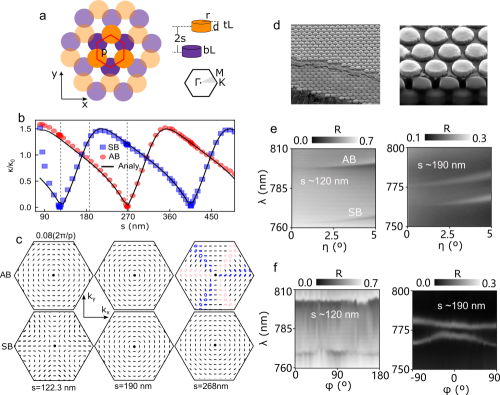
Figure a: Schematic diagram of a bilayer titanium dioxide metasurface; b: Theoretical prediction of destructive interference in the far-field radiation of resonant states; c: Distribution of far-field polarization vectors in momentum space for resonant states of metasurfaces with different intermediate-layer thicknesses; d: Bilayer metasurface fabricated by lithographic patterning; e and f: Angle-resolved reflectance spectra measured experimentally.
Source: Institute of Physics
LATEST NEWS
Thank you for visiting the official website of Chongfan Technology. If you have cooperation intentions or suggestions, please contact us through the following methods, and we will reply as soon as possible, thank you!
Address: Room 403, Building 6, Phase III of R&D, No. 36 Xiyong Avenue, High tech Zone, Chongqing, China.
Telephone: +86-13658337211
E-mail: Sales@cfkeji.net
Website: www.cfkeji.net
Mobile Version