
Chongfan Technology
News
27
2026
-
02
A Möbius metasurface for fully decoupled bidirectional optical control
Author:
The team led by Wei Lu, Xiaoshuang Chen, Guanhai Li, Feilong Yu, and Rongsheng Chen from the Shanghai Institute of Technical Physics has proposed a single-layer dielectric Möbius metasurface that leverages a topology-inspired polarization-path-reversal mechanism to achieve fully decoupled control in three dimensions. Inspired by the topological properties of the Möbius strip, the authors’ design maps forward and reverse polarization trajectories onto a unified Poincaré sphere via phase synthesis-driven coordinate transformations, thereby enabling directionally selective phase responses for arbitrary elliptically polarized states. To overcome the trade-off between dispersion and polarization functionality, the authors have introduced a neural-network framework capable of co-optimizing the Jones-matrix responses across multiple polarizations, wavelengths, and propagation directions. In experiments, the authors demonstrated six fully independent holographic channels—defined by three polarization-wavelength combinations propagating in opposite directions—that enabled high-fidelity image reconstruction with crosstalk among channels below 6.4%. Compared to Janus-type or multilayer metasurfaces, which are limited to interleaved or orthogonal polarization encoding, the authors’ approach offers a compact, lossless, and manufacturable solution for multidimensional optical multiplexing.
The research findings were published on February 19, 2026, in Advanced Photonics under the title “Möbius metasurface for fully decoupled bidirectional light control.”

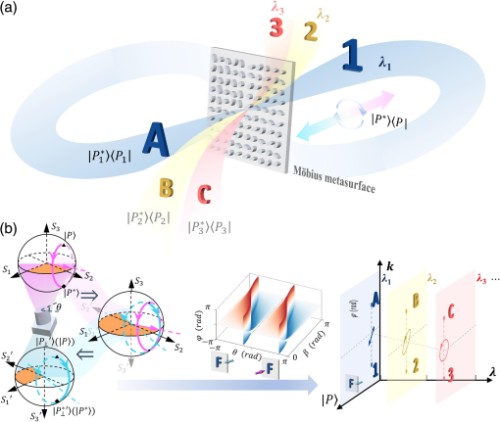
Figure 1: Concept and Design Principle of a Möbius Metasurface for Asymmetric Multidimensional Light Control
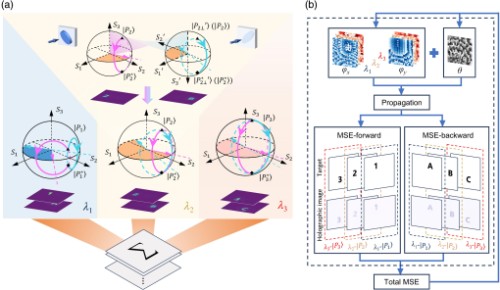
Figure 2: Design of a Multidimensional Möbius Metasurface Based on Binary Polarization Path Reversal and Neural-Network-Driven Optimization
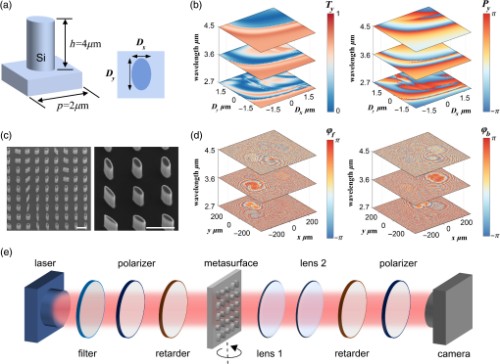
Figure 3: Design, Fabrication, and Experimental Setup of Metasurface Atoms for the Möbius Metasurface
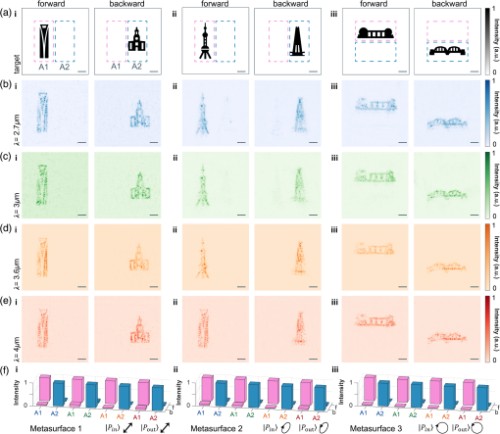
Figure 4: Experimental demonstration of bidirectional vector holography under multiple polarization states
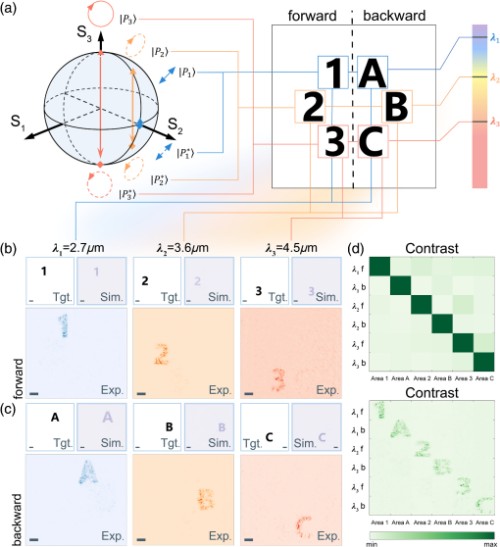
Figure 5: Six-channel multidimensional holography based on a Möbius metasurface
Source: Optical World
LATEST NEWS
Thank you for visiting the official website of Chongfan Technology. If you have cooperation intentions or suggestions, please contact us through the following methods, and we will reply as soon as possible, thank you!
Address: Room 403, Building 6, Phase III of R&D, No. 36 Xiyong Avenue, High tech Zone, Chongqing, China.
Telephone: +86-13658337211
E-mail: Sales@cfkeji.net
Website: www.cfkeji.net
Mobile Version