
Chongfan Technology
News
03
2026
-
03
Shanxi University Has Achieved Significant Progress in Research on Spectrally Coded Parallel LiDAR.
Author:
Recently, the research team led by Professor Lianquan Xiao from the Institute of Laser Spectroscopy and the National Key Laboratory of Optical Quantum Technologies and Devices at Shanxi University has achieved significant progress in the study of spectrally encoded parallel LiDAR based on super-bunching light sources. This breakthrough overcomes the limitations imposed by time-frequency domain crosstalk between optical channels and ambiguous distance measurements, enabling a substantial improvement in imaging speed and image quality while effectively mitigating interference from strong background noise. The research findings, titled “Spectrally Encoded Parallel LiDAR Driven by Super-Bunching Light,” have been published in Nature Communications. Xuedong Zhang, a doctoral student at the Institute of Laser Spectroscopy, and Xinghui Liu, a young faculty member, are co-first authors of the paper. Xinghui Liu, Professor Lianquan Xiao, and Professor Chengbing Qin serve as co-corresponding authors.
As a core technology for environmental perception, LiDAR plays an important role in unmanned autonomous devices such as self-driving cars, drones, and intelligent robots. Compared with purely vision-based solutions, LiDAR can provide high-precision, real-time three-dimensional spatial reconstruction with a lower computational load, ensuring that autonomous systems operate safely and reliably under various conditions. Moreover, LiDAR’s superior optical ranging and object recognition capabilities in noisy environments significantly enhance its robustness in complex scenarios. Currently, the mainstream development trend in LiDAR involves using parallel architectures to achieve real-time multi-channel signal acquisition. Parallel LiDAR not only greatly improves data acquisition speed and imaging resolution but also reduces the system’s reliance on mechanical components for beam steering, thereby enhancing its vibration resistance. However, inter-channel interference in both the time and frequency domains remains a major factor limiting the further advancement of parallel LiDAR. In recent years, techniques such as time-stretching and chaotic optical frequency combs have partially addressed channel interference; yet these approaches still face challenges when it comes to long-range detection and dynamic target tracking.
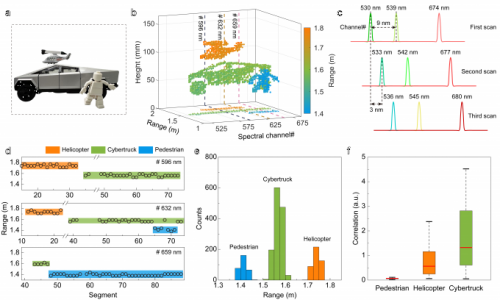
Figure 1. Schematic diagram of 3D imaging using spectrally encoded parallel LiDAR.
The research team has proposed a novel spectral-coding parallel LiDAR scheme based on an independently developed super-bunching light source. Leveraging the naturally quasi-orthogonal properties of the super-bunching light source across different wavelength bands, this approach enables interference-free spectral-coding-based parallel channel division without the need for complex encoding/decoding procedures. The technique has been applied to LiDAR ranging and imaging. This parallel LiDAR system boasts stable parallel ranging capabilities, rapid and accurate three-dimensional reconstruction, and effective target classification. Test results demonstrate that the system achieves high-precision ranging with an error as low as 4 mm and can detect dynamic targets moving at speeds as low as 5 mm/s. Moreover, this parallel LiDAR system overcomes the range limitation imposed by pulse repetition periods in conventional time-of-flight LiDAR systems, enabling high-precision ranging and three-dimensional imaging at distances exceeding 40 meters. Even under conditions where noise levels exceed the echo signal by a factor of 1,000, the system exhibits outstanding anti-interference performance.
The spectral-coding parallel LiDAR proposed in this work boasts high precision, long-range detection capability, dynamic target capture, accurate three-dimensional environmental reconstruction, and excellent anti-interference performance. It demonstrates tremendous potential in the development of advanced parallel LiDAR technologies and is driving forward the advancement of environmental sensing technologies.
This work was supported by the National Key R&D Program of the Ministry of Science and Technology, the National Natural Science Foundation of China, the Shanxi Province Basic Research Program, the National Key Laboratory of Photonic Quantum Technologies and Devices, and the Joint Provincial-Ministerial Collaborative Innovation Center for Extreme Optics.
Source: Shanxi University
LATEST NEWS
Thank you for visiting the official website of Chongfan Technology. If you have cooperation intentions or suggestions, please contact us through the following methods, and we will reply as soon as possible, thank you!
Address: Room 403, Building 6, Phase III of R&D, No. 36 Xiyong Avenue, High tech Zone, Chongqing, China.
Telephone: +86-13658337211
E-mail: Sales@cfkeji.net
Website: www.cfkeji.net
Mobile Version