
Chongfan Technology
News
15
2026
-
01
Magic-Angle Graphene—Light-Controlled | Nature Physics
Author:
The flat bands in magic-angle graphene structures exhibit a variety of strongly correlated and topological phenomena. Optical probing and control of these phenomena can reveal crucial information about symmetry, dynamical properties, and other key aspects. However, due to the energy gap being significantly smaller than the wavelength of light, related research has long faced substantial challenges.
Recently, the team led by Eylon Persky at Stanford University published a paper in Nature Physics reporting a near-infrared light modulation scheme for magic-angle twisted bilayer graphene (MATBG) devices based on single-layer tungsten diselenide (WSe₂) substrates. This approach enables effective control over the system’s orbital magnetism and the associated anomalous Hall effect.
Studies have shown that by using circularly polarized light, it is possible to tune both the hysteresis loop and the amplitude of the anomalous Hall effect near integer Moiré filling factors. By modulating the helicity of the incident light, we observed a periodic modulation of the transverse resistance over a wide range of filling factors. This result suggests the presence of orbital magnetization in the system, induced by the strong light-induced inverse Faraday effect.
In the transition region between the metallic state and the anomalous Hall effect state, a significant random switching effect in the Hall resistivity was also observed. This phenomenon can be attributed to the formation of magnetic-domain percolation clusters under optical control. Therefore, optical techniques hold promise as an effective tool for tuning correlation effects and topological properties in moiré superlattice structures.
Optical Control of Orbital Magnetism in Magic-Angle Twisted Bilayer Graphene. In magic-angle twisted bilayer graphene, orbital magnetism can be optically tuned.
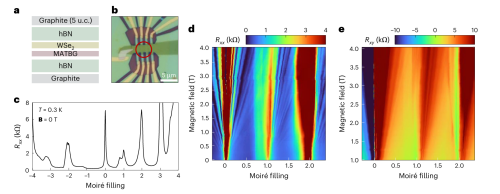
Figure 1: Transmission Characteristics.

Figure 2: Photothermal Heating.
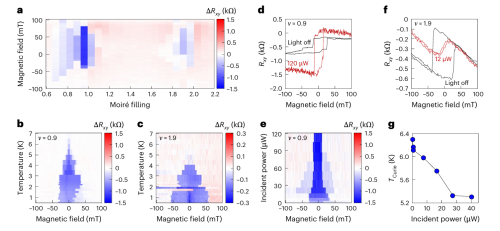
Figure 3: Anomalous Hall Effect (AHE) at integer Landau filling factor ν=1.
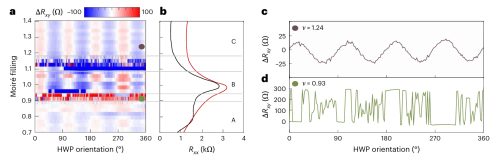
Figure 4: Optical addressing of the anomalous Hall effect (AHE).

Figure 5: Optical training of the anomalous Hall effect (AHE).
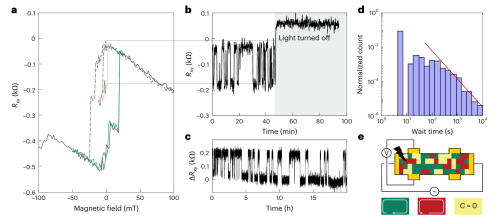
Figure 6: Photoinduced Switching Dynamics.
Source: Today's New Materials
LATEST NEWS
Thank you for visiting the official website of Chongfan Technology. If you have cooperation intentions or suggestions, please contact us through the following methods, and we will reply as soon as possible, thank you!
Address: Room 403, Building 6, Phase III of R&D, No. 36 Xiyong Avenue, High tech Zone, Chongqing, China.
Telephone: +86-13658337211
E-mail: Sales@cfkeji.net
Website: www.cfkeji.net
Mobile Version