
Chongfan Technology
News
12
2026
-
03
Peking University Has Achieved Significant Progress in the Field of Integrated Optoelectronic Chips and Wireless Communications.
Author:
Recently, the research team led by Researcher Chang Lin at the School of Electronic Engineering, Peking University, in collaboration with Professor Song Lingyang and Researcher Di Boya, published an online research article titled “Multiband wireless systems based on microwave integrated photonics with metasurfaces” in the top-tier academic journal Nature Photonics. For the first time in the world, the team has proposed a scalable, unified platform that, by integrating photonic integrated circuits with electromagnetic metasurfaces, successfully realizes a parallel wireless communication architecture capable of supporting mobile systems across diverse frequency bands—from 2G to 6G and beyond. This breakthrough not only breaks down the barriers to multi‑band hardware integration but also provides a foundational solution for reducing costs and improving efficiency in future large‑scale wireless systems.
In today’s information age, wireless technology serves as the absolute cornerstone of mobile communications and the Internet of Things. As data capacity demands continue to surge, communication systems have evolved from 2G all the way to the emerging 6G, constantly expanding into new frequency bands. However, traditional architectures face numerous fundamental challenges when it comes to multi‑band integration. The inherent bandwidth limitations of electronic components restrict their operation to narrow spectral ranges, meaning that each generation of wireless system requires its own dedicated RF front‑end, resulting in severe hardware redundancy. Particularly in the high‑frequency bands, this conventional stacking approach leads to unaffordable costs and extremely high terminal power consumption. Moreover, as frequencies increase, traditional antenna technologies suffer from high dynamic component power consumption and complex feed networks, making large‑scale deployment difficult—resulting in reduced energy efficiency. Typically designed for a single frequency, these antennas also lack multi‑band beamforming capabilities, severely limiting the performance potential of high‑frequency bands.
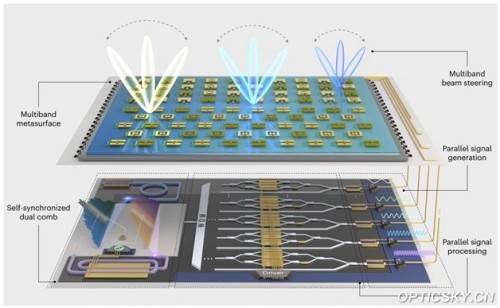
Parallel Wireless System Architecture Based on Integrated Optics and Metasurfaces
To overcome these challenges, the research team developed a novel optoelectronic integrated drive solution for large-scale metasurfaces, fundamentally transforming conventional wireless terminal design approaches. Leveraging self-synchronizing dual-comb technology, this platform can generate more than 60 microwave frequencies—each reaching up to 100 GHz and fully reconfigurable—with no need for discrete electronic oscillators. Building on this technology, the team proposed a multi‑band parallel transmitter based on integrated optics and metasurfaces. To achieve spatial signal control, the team introduced low‑power, compact metasurfaces for multi‑band beamforming. Compared with traditional phased arrays, metasurface designs are more compact, offer flexible beam control capabilities, and can reduce power consumption by over 40%. This architecture breaks through conventional bottlenecks and successfully realizes the highly challenging task of 1024‑QAM high‑order communication modulation and transmission—a breakthrough that places this work at the forefront of photonics‑assisted wireless link technology. Even more groundbreaking, this architecture significantly shortens the signal path in the RF front‑end, enabling, for the first time, the direct driving of wireless edge devices using standard silicon‑based optoelectronic transceivers from data centers, thereby establishing seamless, energy‑efficient, and low‑latency connectivity between data center processing and wireless networks. During experimental validation, the system not only achieved all‑solid‑state millimeter‑wave point cloud radar imaging but also successfully transmitted high‑definition video frames, demonstrating outstanding performance and versatile, integrated functionality.
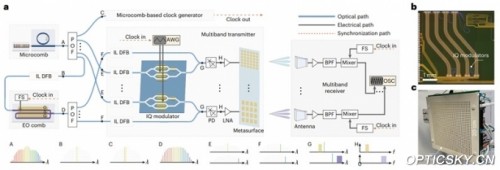
Parallel Wireless System Experimental Link
In the future, this highly integrated technology will provide a transformative cornerstone for the development of full‑band wireless communication systems. It not only holds the promise of dramatically reducing the size of base stations and accelerating the transition of millimeter‑wave and terahertz bands from research to practical applications, but also significantly lowers transmission latency, offering robust support for latency‑critical end‑use scenarios such as autonomous driving and satellite communications.
The co-first authors of the paper are Chen Yujun, Gao Jiahao, doctoral students at the School of Electronics, Peking University, and Zhang Xuguang, a postdoctoral fellow at the same school. Chang Lin, Di Boya, and Song Lingyang serve as the co-corresponding authors. Key collaborators also include Professor Wang Cheng of City University of Hong Kong, Professor Li Zheng of Beijing Jiaotong University, Dr. Zhang Ke, a PhD graduate from City University of Hong Kong, PhD candidates Chen Yikun and Shang Chengfei, postdoctoral fellows Zhang Xiangpeng and Zhang Lei, PhD candidates Zhou Zixuan and Zhang Xiaoyu, and PhD candidate Gao Jiapan from ShanghaiTech University. This work was completed by the Key Laboratory of Photonics Transmission and Communication at the School of Electronics, Peking University, as the primary institution. The research received strong support from the National Natural Science Foundation of China, the Beijing Outstanding Young Scientist Program, the Beijing Natural Science Foundation, the Shanghai 2025 “Science and Technology Innovation Action Plan,” the Shijiazhuang–Peking University Joint Research Project, and the He Xiangjian Science Fund, among others.
Source: Peking University
LATEST NEWS
Thank you for visiting the official website of Chongfan Technology. If you have cooperation intentions or suggestions, please contact us through the following methods, and we will reply as soon as possible, thank you!
Address: Room 403, Building 6, Phase III of R&D, No. 36 Xiyong Avenue, High tech Zone, Chongqing, China.
Telephone: +86-13658337211
E-mail: Sales@cfkeji.net
Website: www.cfkeji.net
Mobile Version