
Chongfan Technology
News
12
2026
-
03
Progress Made in Asteroid Spectroscopy Research
Author:
In the solar system, asteroids preserve primordial information from the early days of solar system formation 4.6 billion years ago. Based on the relationship between the intensity of sunlight reflected by asteroids and its wavelength, astronomers classify asteroids into three major categories: S, C, and X. Among these, S‑type asteroids are the most common type of near-Earth asteroid, primarily found in the inner region of the main asteroid belt. Their primary constituents include silicate minerals such as olivine and pyroxene, which closely resemble the ordinary chondrites commonly found on Earth. Typically, scientists must compare asteroid spectra with laboratory data from terrestrial meteorites in order to infer their mineral composition. However, the observational conditions in space differ significantly from those in the laboratory, presenting numerous challenges to this comparative analysis.
Recently, an international research team including the Shanghai Astronomical Observatory of the Chinese Academy of Sciences has made progress in the field of asteroid spectral research. Through experimental analysis of a series of ordinary chondrite meteorite samples, the research team systematically investigated the spectral response mechanisms of S-type asteroids in the visible/near-infrared wavelength range. The study found that both high-phase-angle observation conditions and fine-grained surface materials can significantly increase spectral slope, with effects similar to those of space weathering. In other words, the surface state of asteroids and the observation angle can “distort” their spectral characteristics, necessitating correction in order to accurately interpret their composition.
The study also revealed the “competitive” effects of thermal metamorphism and shock metamorphism on spectra: the stronger the thermal metamorphic process, the more pronounced the absorption features; the higher the degree of shock metamorphism, the weaker the absorption features. This finding provides new clues for scientists to reconstruct the thermal evolution history of asteroids. At the same time, the research has clarified a long‑standing question in the academic community: although the surfaces of S‑type asteroids contain small amounts of iron–nickel metal (typically less than 10%), the impact of this metal on spectral morphology is virtually negligible.
Based on the aforementioned research findings, the research team further analyzed the target bodies of several asteroid exploration missions. The results indicate that 99942 Apophis—the target of NASA’s OSIRIS-REx mission—and 469219 Kamo’oalewa—the target of China’s Tianwen‑2 mission—are both S‑type near-Earth asteroids with compositions similar to LL ordinary chondrites; meanwhile, 4179 Toutatis, which was flown by and explored during the Chang’e‑2 mission, has a composition more closely resembling L ordinary chondrites. This series of comparisons not only validated the reliability of spectral analysis methods but also provided crucial scientific support for China’s future asteroid sample‑return missions.
This study has deepened the academic community’s understanding of the surface material composition of S-type asteroids, advanced the development of asteroid composition remote sensing, and provided crucial scientific support for China’s asteroid exploration missions.
The relevant research findings were published in the Astrophysical Journal Supplement Series. The research was supported by the National Natural Science Foundation of China and the China Postdoctoral Science Foundation, among others.
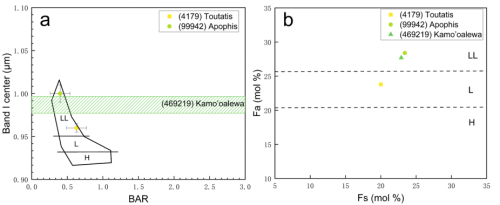
Mineralogical Analysis Map of Multiple Asteroid Exploration Mission Targets Based on Spectroscopic Observation Data
Source: Shanghai Astronomical Observatory
LATEST NEWS
Thank you for visiting the official website of Chongfan Technology. If you have cooperation intentions or suggestions, please contact us through the following methods, and we will reply as soon as possible, thank you!
Address: Room 403, Building 6, Phase III of R&D, No. 36 Xiyong Avenue, High tech Zone, Chongqing, China.
Telephone: +86-13658337211
E-mail: Sales@cfkeji.net
Website: www.cfkeji.net
Mobile Version