
Chongfan Technology
News
15
2026
-
01
Important progress made by a Chinese research team in the field of accelerator-based terahertz sources.
Author:
Recently, the research group led by Professor Yan Lixin from the Department of Engineering Physics at Tsinghua University, in collaboration with the Dalian Institute of Chemical Physics of the Chinese Academy of Sciences and the Shenzhen Advanced Light Source Research Institute, reported significant progress in the field of accelerator-based terahertz sources. The research team conducted the first experiment on a coherent terahertz free-electron laser driven by an electron-beam pulse train at the Dalian Coherent Light Source, achieving tunable narrow-band terahertz radiation output on the order of hundreds of microjoules across the entire 1–20 THz frequency range. At the 10 THz frequency point, they even attained single-pulse energies approaching millijoules. This breakthrough sets a new international record for radiation energy in this frequency band and offers an effective approach to addressing the longstanding challenge of the "terahertz gap" in light sources.
Terahertz radiation (THz) typically refers to electromagnetic waves with frequencies ranging from 0.1 to 10 THz, corresponding to wavelengths from 3 mm to 30 μm—a spectral region situated between microwaves and infrared light. Due to its unique frequency characteristics, terahertz radiation can efficiently excite various collective modes in materials, such as phonons, magnons, and excitons, making it highly valuable for cutting-edge research in areas like superconductivity and quantum materials. However, because the terahertz frequency range lies in the transition zone between the frequency bands covered by optical and electronic technologies, the development of high-power, narrow-bandwidth terahertz sources has long been plagued by technical bottlenecks. In particular, the 1–10 THz frequency band—the band with the most pressing demand—still lacks an effective method for generating high-power, narrow-band terahertz radiation that can be tuned across the entire frequency range. This persistent challenge is known as the "terahertz gap" problem.
Based on the coherent radiation mechanism of ultrashort electron bunches, Yan Lixin’s research group has conducted nearly two decades of continuous exploration and research in this field. Although free-electron lasers (FELs) have achieved remarkable success in short-wavelength regimes such as the extreme ultraviolet and X-ray bands and have developed various high-gain schemes—including SASE, HGHG, and EEHG—when it comes to the terahertz frequency range, the severe diffraction effects associated with its long wavelength significantly weaken the interaction between the electron beam and the radiation, making it difficult to implement conventional high-gain schemes. To address this challenge, the research group has proposed a solution based on the super-radiant free-electron laser mechanism. At the heart of this mechanism is the use of a pre-formed train of terahertz electron bunches to drive the free-electron laser. This approach bypasses the microbunching stage typically found in conventional FELs, allowing the electron bunches to directly achieve coherent superposition of the radiation field through their pulse train. As a result, the resulting coherent radiation exhibits a power scaling that is proportional to the square of the number of electrons. During their passage through the undulator, these microbunches continuously interact with the radiation field at the phase of maximum deceleration, enabling rapid extraction of electron-beam energy and dramatically enhancing radiation efficiency. Ultimately, this approach overcomes the limitations imposed by diffraction effects, thereby achieving higher terahertz radiation energies.
Building on the above-mentioned approach, and following the team’s 2023 publication on a space-charge-force-modulated scheme that generates tunable ultrashort electron-beam pulse trains spanning the 1–10 THz frequency range, the research team further introduced an X-band accelerating cavity to compensate for nonlinearities in the radio-frequency (RF) chirp. This enabled them to extend the frequency tuning range of the electron-beam pulse trains up to 15 THz. Subsequently, by using these pulse trains to drive a superradiant free-electron laser, they successfully achieved continuous, tunable, high-power, narrow-band terahertz radiation across the entire 1–20 THz frequency band.
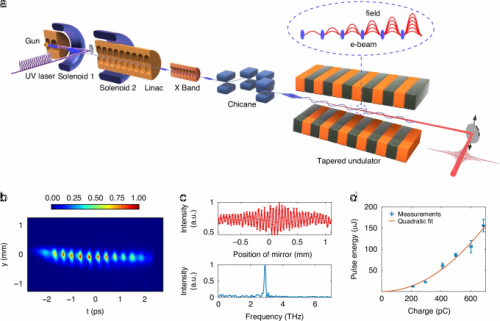
Figure 1. Schematic diagram of the principle of superradiant terahertz free-electron laser: (a) Experimental setup; (b) Longitudinal distribution of the electron beam; (c) Spectral characteristics of the radiation; (d) Relationship between the radiation pulse energy and the square of the charge.
The layout of the experimental setup is shown in Figure 1a. A train of quasi-flat-top ultraviolet laser pulses generated by pulse stacking is directed onto the photocathode, producing a train of electron bunches with initial density modulation. Subsequently, these bunches undergo a space-charge oscillation process, transforming into periodic energy modulation that becomes increasingly pronounced during subsequent transport. By means of a downstream accelerator tube and an X-band harmonic cavity, the energy and energy chirp of the electron beam can be adjusted. The magnetic compressor located downstream then converts the energy chirp of the electron beam into density modulation at the target frequency, which is subsequently fed into the undulator to drive a super-radiant free-electron laser. Figures 1b through 1d respectively illustrate the longitudinal density modulation of the electron beam measured by a deflection cavity, the spectral characteristics of the radiation, and the relationship between the radiation pulse energy and the square of the charge. These results not only confirm the coherence of the radiation but also demonstrate that increasing the charge can further enhance the radiation energy.

Figure 2. Main characteristics of the radiation and simulation results of energy growth: (a) Spectral characteristics of the radiation; (b) Measurement results of single-pulse energy; (c) Simulation results of radiation energy growth.
As shown in Figure 2, the experiment achieved pulse energies on the order of hundreds of microjoules across the entire 1–20 THz frequency band under a planar undulator configuration. At the 10 THz frequency point, the single-pulse energy reached 390 μJ. Furthermore, after adopting a graded-index undulator, the single-pulse energy was boosted to as high as 900 μJ—this represents the highest radiation energy ever reported internationally for a narrow-band terahertz source operating in this frequency range.
The research findings, titled “Superradiant terahertz free electron laser driven by electron microbunch trains,” were published on January 8, Beijing time, in *Light: Science & Applications*.
Dr. Liang Yifan from the Shenzhen Advanced Light Source Research Institute and Li Tong, a 2022 Ph.D. student in the Department of Engineering Physics at Tsinghua University, are co-first authors of the paper. Professor Yan Lixin and Professor Tang Chuanxiang from the Department of Engineering Physics at Tsinghua University, along with Researcher Zhang Weiqing and Researcher Wu Guorong from the Dalian Institute of Chemical Physics, Chinese Academy of Sciences, are co-corresponding authors of the paper. This research was supported by the Beijing Universities’ Program for Outstanding Young Scientists, the Chinese Academy of Sciences’ Project for the Development of Scientific Instruments and Equipment, the National Natural Science Foundation of China, and Tsinghua University’s “Dushi” Special Fund.
Source: Tsinghua University
LATEST NEWS
Thank you for visiting the official website of Chongfan Technology. If you have cooperation intentions or suggestions, please contact us through the following methods, and we will reply as soon as possible, thank you!
Address: Room 403, Building 6, Phase III of R&D, No. 36 Xiyong Avenue, High tech Zone, Chongqing, China.
Telephone: +86-13658337211
E-mail: Sales@cfkeji.net
Website: www.cfkeji.net
Mobile Version