
Chongfan Technology
News
04
2026
-
09
Progress has been made in the calibration research of ocean optical satellites.
Author:
The Pacific Invariant Calibration Site (PICS) is a critical reference target that underpins the replacement, cross‑calibration, and long-term stability monitoring of ocean color satellite systems. Current research primarily relies on the mean, standard deviation, or empirical thresholds of optical and atmospheric parameters to evaluate candidate sites, while insufficient attention is paid to long-term trends, seasonal stability, and changes in water‑column spectral characteristics, making it difficult to comprehensively characterize the temporal stability of ocean calibration sites.
Recently, a research team from the South China Sea Institute of Oceanology, Chinese Academy of Sciences, has made progress in the calibration of ocean‑optical satellites. Drawing on long‑term global MODIS‑Aqua observations from 2002 to 2021, the team developed an oceanic PICS evaluation framework that accounts for both long‑term trends, the frequency of favorable conditions at the monthly scale, and the stability of water‑body spectral characteristics. Using this framework, they identified a number of stable candidate regions, including the North Pacific, the South Pacific, the Atlantic, and the central Indian Ocean.
The study found that the North Pacific region, where MOBY is located, exhibits high long-term stability, whereas some traditionally proposed candidate regions, despite favorable average optical conditions, display pronounced long-term variability, indicating that “optical cleanliness” does not necessarily imply “long-term stability.” Furthermore, the study conducted preliminary cross-calibration experiments between MODIS–Aqua and HY‑1D COCTS using newly identified candidate regions, thereby demonstrating their potential as reference targets for assessing inter-satellite radiometric consistency.
This study provides new technical support for the global screening of ocean color satellite calibration sites, multi-satellite cross-calibration, and the establishment of long-term ocean color climate data records.
The relevant research findings were published in IEEE Transactions on Geoscience and Remote Sensing. The study was supported by the National Natural Science Foundation of China, the Ministry of Science and Technology, and other agencies.
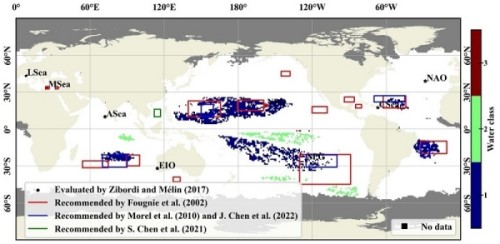
Comparison of Pseudo-Invariant Field Identification Results with Those of Other Studies
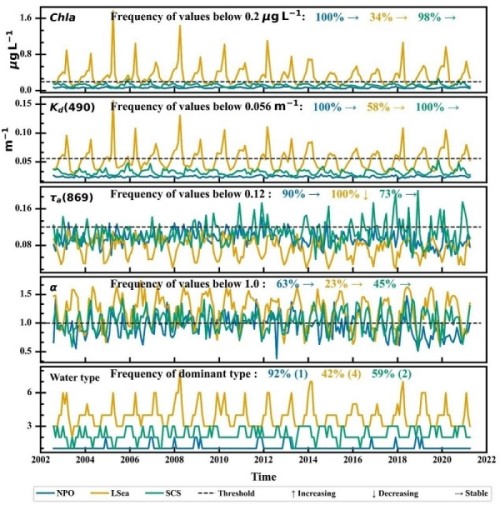
Assessment Results for Typical Calibration Sea Areas Based on the Method Proposed in This Paper
Source: South China Sea Institute of Oceanology
LATEST NEWS
Thank you for visiting the official website of Chongfan Technology. If you have cooperation intentions or suggestions, please contact us through the following methods, and we will reply as soon as possible, thank you!
Address: Room 403, Building 6, Phase III of R&D, No. 36 Xiyong Avenue, High tech Zone, Chongqing, China.
Telephone: +86-13658337211
E-mail: Sales@cfkeji.net
Website: www.cfkeji.net
Mobile Version