
Chongfan Technology
News
04
2026
-
09
Laser‑based reflective tomography enables high‑resolution nonline-of‑sight imaging without scanning at a range of 3.3 kilometers.
Author:
Traditional optical imaging can only detect objects within the direct line of sight, whereas non‑line‑of‑sight imaging overcomes this physical limitation by detecting photons that have undergone multiple scattering in the environment and reconstructing hidden scenes that are otherwise obscured. This technology holds great promise for applications in autonomous driving, disaster rescue, medical diagnostics, and industrial inspection. However, most state-of-the-art non‑line‑of‑sight imaging methods rely on scanning to acquire imaging data, leading to an intractable trade-off between acquisition speed and spatial resolution. Moreover, in long-range imaging scenarios, the energy of multiply scattered photons decays rapidly, further exacerbating this trade-off.
Laser‑based reflective tomography possesses the capability to surpass the diffraction limit and achieve high‑resolution reconstruction; its integration into non‑line‑of‑sight imaging holds promise for offering a new approach to resolving the aforementioned trade‑off.
Recently, a team from the Institute of Optics and Electronics of the Chinese Academy of Sciences has introduced laser‑reflection tomography into the field of non‑line‑of‑sight imaging. By leveraging diffusely reflecting relay walls as natural laser beam expanders, they acquire scattered photon signals using a single‑point detector and, by integrating multi‑angle projection data generated through target rotation, employ tomographic reconstruction algorithms to achieve high‑precision reconstruction of hidden scenes.
This method, in terms of its imaging mechanism, eliminates the traditional scanning‑based non‑line‑of‑sight imaging approach’s reliance on large‑area relay‑surface scanning, thereby reducing the complexity of data acquisition and overcoming the fundamental trade‑off between resolution and imaging speed inherent in scanning techniques. It thus offers a new technological paradigm for achieving long‑range, high‑resolution, rapid non‑line‑of‑sight imaging. Building on this concept, the team has, under laboratory conditions, simultaneously achieved higher resolution and faster imaging speeds, and extended this method to kilometer‑scale long‑range scenarios.
Experimental results demonstrate that, under indoor close-range conditions, this method achieves approximately a two-fold improvement in spatial resolution and an approximately 91-fold increase in imaging speed compared to conventional scanning approaches. In long-range outdoor experiments, the study realized non-line-of-sight imaging at a distance of 3.3 kilometers, yielding clear images of hidden targets with a spatial resolution better than 3 centimeters in just about three minutes of acquisition time.
This study has overcome the physical limitations imposed by scanning mechanisms on non-line-of-sight imaging performance, establishing a novel non-line-of-sight tomographic imaging framework and laying the methodological and technical groundwork for further advances in this field.
The relevant research findings were published in Opto-Electronic Science.
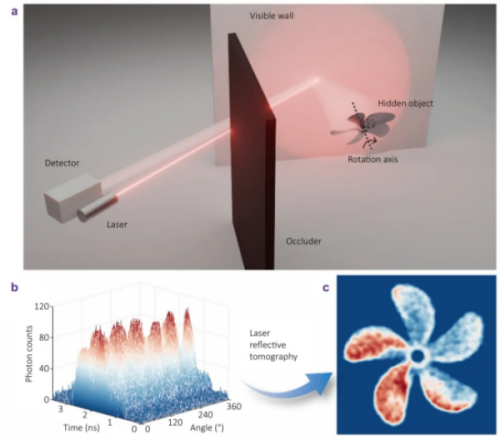
Non-Line-of-Sight Imaging Based on Reflective Tomography
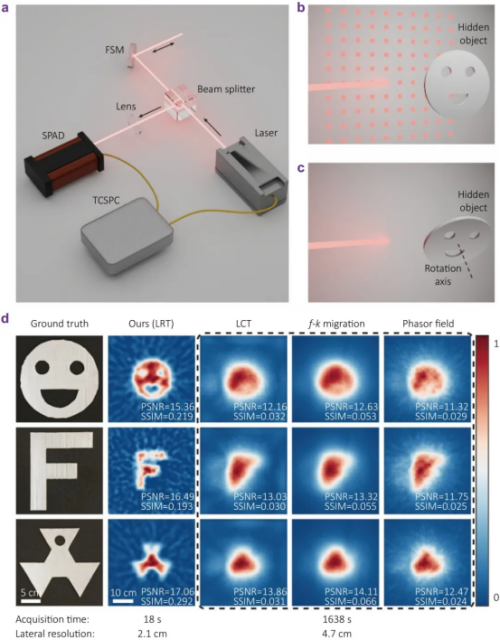
Near-field non-line-of-sight imaging experiment
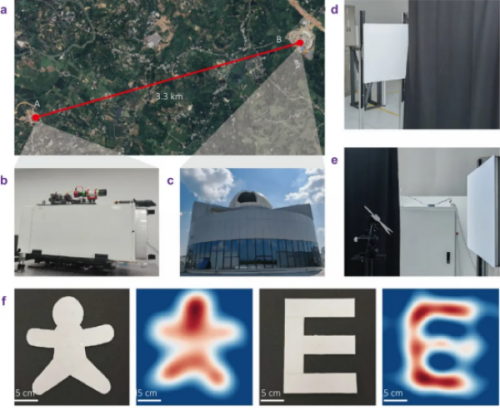
Experimental Study on Long-Range Non-Line-of-Sight Imaging Based on Reflective Tomography
Source: Institute of Optoelectronic Technology
LATEST NEWS
Thank you for visiting the official website of Chongfan Technology. If you have cooperation intentions or suggestions, please contact us through the following methods, and we will reply as soon as possible, thank you!
Address: Room 403, Building 6, Phase III of R&D, No. 36 Xiyong Avenue, High tech Zone, Chongqing, China.
Telephone: +86-13658337211
E-mail: Sales@cfkeji.net
Website: www.cfkeji.net
Mobile Version
