
Chongfan Technology
News
07
2026
-
09
Angle-resolved photoemission spectroscopy of multilayer cuprate high-temperature superconductors has revealed the intrinsic electronic phase diagram and the mechanism of electron pairing.
Author:
The parent compounds of copper‑oxide high‑temperature superconductors are antiferromagnetic Mott insulators, and superconductivity is typically induced by doping with charge carriers. For a long time, whether the system remains insulating or becomes metallic at extremely low doping levels (<0.05) has been one of the central controversies. Transport measurements on single‑ and bilayer systems indicate an insulating state in this regime; however, in such materials, the CuO₂ planes are susceptible to defects originating from neighboring carrier‑rich layers, so it remains unclear whether the observed insulating behavior reflects the intrinsic electronic phase diagram. By contrast, multilayer copper oxides (four layers or more), with their inner CuO₂ planes far removed from defect sources, can effectively screen disorder and thus provide an ideal platform for investigating the intrinsic phase diagram. Nevertheless, high‑quality multilayer single crystals are exceedingly rare, limiting the progress of related studies.
Recently, the teams of Xingjiang Zhou and Lin Zhao at the Institute of Physics, Chinese Academy of Sciences, and the Beijing National Laboratory for Condensed Matter Physics, employed high-resolution laser angle-resolved photoemission spectroscopy—capable of micron-scale spatial resolution and two-dimensional momentum mapping—to ingeniously exploit naturally occurring coexisting phases with different layer numbers in three‑layer Bi2223 samples. By performing large‑area micro‑area scans, they successfully localized and probed microregions of Bi‑based single crystals containing 5 to 8 CuO₂ layers, systematically establishing the intrinsic electronic structure at extremely low doping levels. Their key findings can be summarized as follows: First, Fermi pockets were clearly observed on both the innermost and second‑innermost CuO₂ planes across all multilayer systems, persisting even at doping levels as low as 0.007; this provides strong evidence that minute doping can induce a sharp transition from a Mott insulator to a metallic state in the parent compound. Second, the innermost Fermi pocket is gapless, whereas the second‑innermost plane exhibits anisotropic superconducting gaps. Third, the superconducting gap on the second‑innermost plane reaches up to 33 meV, indicating that, in the presence of long-range antiferromagnetic order, robust electron pairing has already been established on the CuO₂ planes. The study demonstrates that the low‑doping insulating behavior previously reported in monolayer and bilayer systems should be attributed to carrier localization caused by disorder, rather than to intrinsic material properties. By combining these results with the mean‑field t–U model, the team successfully simulated the observed Fermi pockets and band structures, further revealing a close link between pairing interactions and the superexchange spin‑coupling mechanism, thereby providing crucial insights into the pairing mechanism of cuprate superconductors.
The aforementioned findings, titled “Persistent Fermi pockets and robust electron pairing in lightly doped CuO₂ planes of cuprate superconductors,” were published in Nature Communications on June 4, 2026. Ph.D. students Hao Chen, Jumin Shi, Yinghao Li, and Xiangyu Luo from the Institute of Physics served as co-first authors, while Academician Xingjiang Zhou and Researcher Lin Zhao were co-corresponding authors. Professor Chengtian Lin of the Max Planck Institute for Solid State Research in Germany provided high-quality Bi₂Sr₂CaCu₂O₈₊ₓ single crystals, and Academician Taotao Xiang offered theoretical support. This work was supported by the National Natural Science Foundation of China, the National Key R&D Program, the Chinese Academy of Sciences’ Strategic Priority Science and Technology Program (Category B), the Quantum Science and Technology Innovation Project, and the CAS Youth Innovation Promotion Association; part of the research was carried out with the assistance of the Comprehensive Experimental Facility for Extreme Conditions (SECUF).
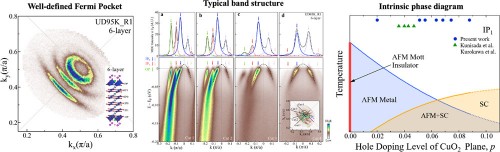
Figure. (Left) Fermi surfaces of multiple Fermi pockets in a six-layer Bi‑based cuprate superconductor. (Center) Typical band structures along different momentum directions around the Fermi pockets. (Right) The intrinsic phase diagram of a clean copper‑oxygen plane.
Source: Institute of Physics
LATEST NEWS
Thank you for visiting the official website of Chongfan Technology. If you have cooperation intentions or suggestions, please contact us through the following methods, and we will reply as soon as possible, thank you!
Address: Room 403, Building 6, Phase III of R&D, No. 36 Xiyong Avenue, High tech Zone, Chongqing, China.
Telephone: +86-13658337211
E-mail: Sales@cfkeji.net
Website: www.cfkeji.net
Mobile Version