
Chongfan Technology
News
24
2026
-
08
Scientists have, for the first time, used a dark cavity to enhance vacuum fluctuations in superconductors.
Author:
Recently, the University of Science and Technology of China and other institutions have made significant advances in the field of quantum-state control, achieving, for the first time, vacuum-fluctuation–enhanced superconductivity using a dark cavity.
In the realm of quantum electrodynamics, the vacuum is far from empty; it teems with the continuous creation and annihilation of virtual particles, resembling a dynamic “ocean” brimming with vacuum fluctuations. However, in free space, these vacuum fluctuations are typically too weak to produce observable effects on macroscopic condensed‑matter systems. Turning this effect into a resource for controlling quantum many‑body states is a central challenge at the intersection of condensed‑matter physics and cavity quantum electrodynamics.
In recent years, a team from the University of Science and Technology of China has been dedicated to studying quantum fluctuation effects in condensed‑matter systems. In earlier work, the group succeeded in actively controlling vacuum fluctuations themselves, achieving a reversible transition of the Casimir force from attraction to repulsion. This breakthrough inspired the team to pursue an ambitious new research direction: could vacuum fluctuations be harnessed to enable controllable tuning of macroscopic quantum states?
To this end, the team introduced a dark cavity composed of terahertz split-ring resonators, which, by reshaping the electromagnetic environment, significantly amplifies vacuum fluctuations. By embedding the superconductor niobium diselenide within this dark cavity, they observed a substantial enhancement of its superconducting critical temperature. In a six-layer niobium diselenide device, the critical temperature increased by as much as 5.4%. Moreover, the superconductor’s critical current and critical magnetic field were also markedly enhanced near the superconducting transition. This represents the first experimental observation worldwide of vacuum-fluctuation–induced enhancement of superconductivity.
Through rigorous control experiments, the team ruled out conventional factors such as strain, degradation, and inhomogeneity. In particular, the experiments revealed that the superconducting enhancement effect exhibits a resonance‑peak‑shaped dependence on the dark cavity’s characteristic frequency, providing crucial evidence for coupling between the superconducting state and the dark cavity.
Based on the Ginzburg–Landau framework, researchers have theoretically proposed that the superconducting state exchanges virtual photons with the cavity mode, thereby reducing the superconducting energy and enhancing superconductivity. The superconductivity enhancement is most pronounced when the characteristic energy of the cavity mode matches the low-energy fluctuation energy of the superconducting material.
This study achieves non‑contact, externally driven‑free enhancement of the superconducting steady state by engineering cavity‑induced vacuum fluctuations, offering new avenues for investigating superconducting mechanisms and designing novel superconducting devices.
The relevant research findings were published in Nature.
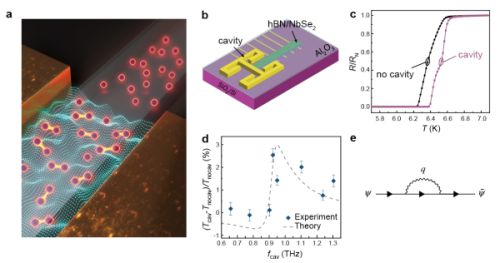
(a) Schematic diagram of vacuum-fluctuation-enhanced superconductivity; (b) Schematic diagram of a superconductor–dark-cavity coupling device; (c) Comparison of superconducting electrical transport results outside and inside the cavity; (d) Dependence of the superconductivity enhancement factor on the characteristic frequency of the dark cavity; (e) Feynman diagram depicting the exchange of virtual photons between the superconducting state and the dark cavity.
Source: University of Science and Technology of China
LATEST NEWS
Thank you for visiting the official website of Chongfan Technology. If you have cooperation intentions or suggestions, please contact us through the following methods, and we will reply as soon as possible, thank you!
Address: Room 403, Building 6, Phase III of R&D, No. 36 Xiyong Avenue, High tech Zone, Chongqing, China.
Telephone: +86-13658337211
E-mail: Sales@cfkeji.net
Website: www.cfkeji.net
Mobile Version
