
Chongfan Technology
News
15
2026
-
07
Nanofiber–Photonic Trap, Surface Forces | Nature Photonics
Author:
Efficiently coupling neutral atoms to the guided light in nanophotonic waveguides—a key research direction in quantum optics and quantum information in recent years—enables long-range photon-mediated atom–atom interactions, which hold great promise for applications in cavity quantum electrodynamics, waveguide quantum electrodynamics, quantum information processing, the generation of nonclassical optical states, and the construction of quantum networks. Current experimental schemes employ a two-color dipole trap to confine atoms within the evanescent field of a nanofiber: a red-detuned laser provides an attractive force that pulls the atoms toward the waveguide surface, while a blue-detuned laser generates a repulsive force to prevent the atoms from colliding with the surface, thereby establishing a stable trapping position approximately several hundred nanometers away from the surface.
Recently, Riccardo Pennetta, Arno Rauschenbeutel, and colleagues at Humboldt University of Berlin published in Nature Photonics that, on a nanofiber–cold‑atom interface platform, they experimentally demonstrated for the first time a hybrid nanophotonic trap. By leveraging surface forces as the attractive component to confine atoms and combining them with the repulsive forces provided by a blue‑detuned evanescent field, they successfully trapped laser‑cooled cesium atoms.
Experiments confirm that the attractive force of this hybrid optical trap arises from the superposition of the Casimir–Polder interaction and the electrostatic force generated by surface charges on the nanofiber. The trap depth is approximately 1 µK, and the potential minimum lies about 650 nm above the fiber surface. Despite the extremely shallow trap depth, an adiabatic transfer protocol achieves a loading efficiency as high as 96%—comparable to that of conventional two‑color dipole traps—and yields atomic storage times of up to 140 ms. Moreover, the Ramsey coherence time and the spin‑echo coherence time reach 17.8 ms and 44.7 ms, respectively, representing improvements of more than an order of magnitude over conventional nanophotonic traps. These results open new avenues for the development of neutral‑atom quantum technologies.
Hybrid nanophotonic trap for cold atoms using surface forces and a blue-detuned evanescent field. A hybrid nanophotonic trap for cold atoms that leverages surface forces and a blue-detuned evanescent field.
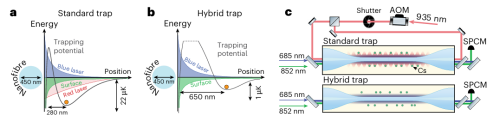
Figure 1: Standard and hybrid nanofiber traps for laser cooling atoms. At a distance of approximately 650 nm from the fiber surface, atoms experience two types of attractive forces: the Casimir–Polder force arising from quantum vacuum fluctuations, and the Coulomb attraction due to electrostatic charges on the fiber surface. A blue-detuned repulsive beam is maintained to counterbalance these attractions, resulting in an extremely shallow potential well only about 1 µK deep (Fig. 1b). An adiabatic transfer protocol is employed: atoms are first confined near the surface (at 280 nm) using a standard two-color optical trap, after which the red-detuned trapping beam is gradually switched off, allowing the atoms to “slide” into the remote hybrid trap without any perceptible motion (Fig. 2b). The transfer efficiency reaches 96%, and the post-transfer atomic temperature is reduced to approximately 250 nK.
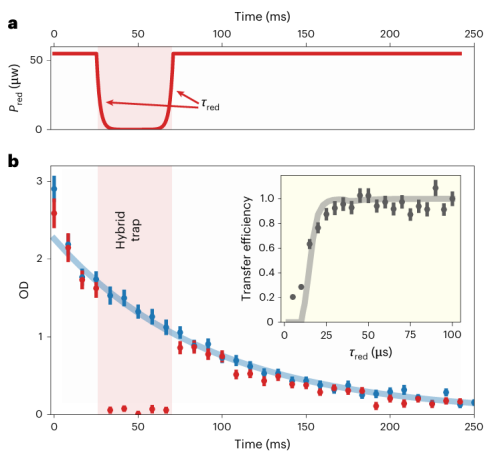
Figure 2: Atoms loaded into a hybrid optical trap.
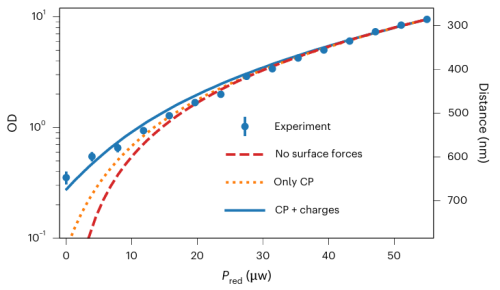
Figure 3: Potential energy reconstruction of a hybrid optical trap.
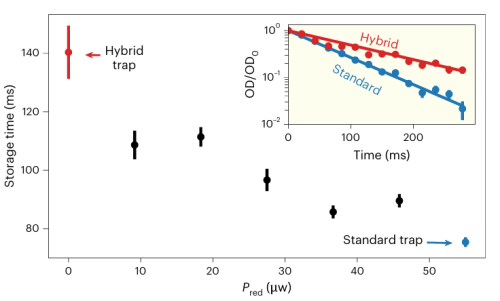
Figure 4: Storage times for the standard optical trap and the hybrid optical trap.
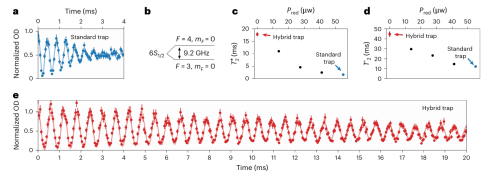
Figure 5: Atomic coherence times for the standard optical trap and the hybrid optical trap.
Source: Today’s New Materials
LATEST NEWS
Thank you for visiting the official website of Chongfan Technology. If you have cooperation intentions or suggestions, please contact us through the following methods, and we will reply as soon as possible, thank you!
Address: Room 403, Building 6, Phase III of R&D, No. 36 Xiyong Avenue, High tech Zone, Chongqing, China.
Telephone: +86-13658337211
E-mail: Sales@cfkeji.net
Website: www.cfkeji.net
Mobile Version