
Chongfan Technology
News
15
2026
-
07
Laser-Driven Wakefield Accelerator—Plasma Waveguide | Nature Physics
Author:
Laser-plasma accelerators sustain electric fields several orders of magnitude stronger than those in conventional radio-frequency cavities, paving the way for the development of ultra‑compact, high‑energy particle accelerators. It has been predicted that a meter‑scale accelerator could deliver electron energies exceeding 100 GeV—comparable to the highest electron energies achieved at CERN’s Large Electron–Positron Collider (LEP). However, electron energy gain remains limited by dephasing effects: electrons eventually outpace the accelerating field driven by sub‑relativistic laser pulses. By employing focused laser pulses that maintain continuous focusing along the accelerator axis, it is possible to drive plasma waves at the speed of light in vacuum, thereby eliminating the dephasing problem.
Recently, the team led by C. D. Arrowsmith at the University of Rochester published a paper in Nature Physics, proposing a novel scheme for achieving “phase‑lossless” acceleration in plasma waveguides. The underlying physical principle is as follows: by superposing multiple radial modes within the plasma waveguide and precisely assigning a distinct frequency to each mode, a spatiotemporal composite pulse is constructed. The interference‑induced intensity peak of this pulse propagates at the speed of light in vacuum while maintaining a constant beam spot size and an ultrashort pulse duration, thereby completely circumventing the trade‑offs inherent in conventional flying focal points.
Focal‑point acceleration technology boosts electrons to energies far beyond the conventional phase‑slip limit, with an enhancement factor of up to two. This provides a proof of concept for spatiotemporal control of laser‑driven wakefield structures and for generating teraelectronvolt (TeV)–scale electron beams using near‑future multi‑petawatt lasers.
Dephasingless laser wakefield acceleration of electrons using a flying focus. Phase-locked laser-wakefield electron acceleration based on a flying focus.
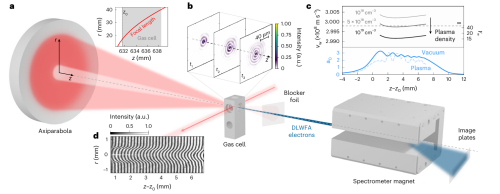
Figure 1: Experimental setup.
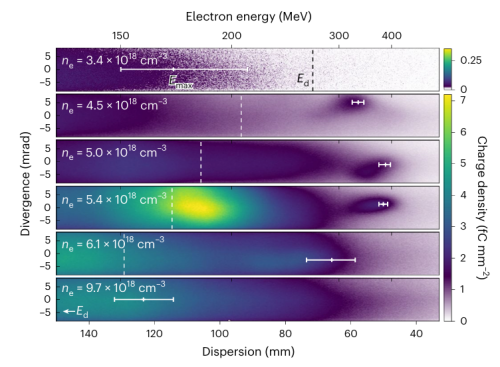
Figure 2: Electron spectroscopy.
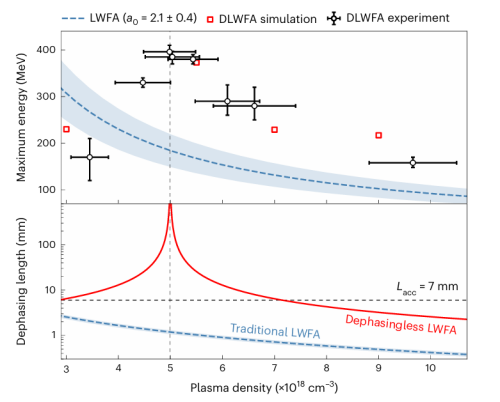
Figure 3: Enhancement of the maximum electron energy and the phase‑loss length.
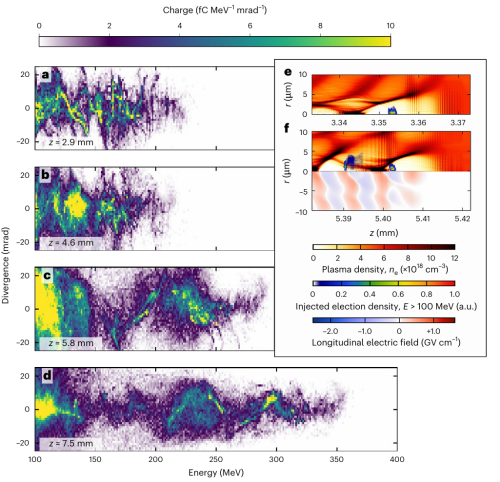
Figure 4: Particle-in-Cell (PIC) simulation of the experiment.
Source: Today’s New Materials
LATEST NEWS
Thank you for visiting the official website of Chongfan Technology. If you have cooperation intentions or suggestions, please contact us through the following methods, and we will reply as soon as possible, thank you!
Address: Room 403, Building 6, Phase III of R&D, No. 36 Xiyong Avenue, High tech Zone, Chongqing, China.
Telephone: +86-13658337211
E-mail: Sales@cfkeji.net
Website: www.cfkeji.net
Mobile Version