
Chongfan Technology
News
06
2026
-
07
Hot topics such as chiral metasurfaces, cavity‑drum‑type membranes, and single‑layer achromatic AR waveguides | Editors’ Pick Collection, Volume 14, Issue 5 of Photonics Research
Author:
Photonics Research Volume 14, Issue 5 features a total of 59 papers spanning several cutting-edge research areas, including fiber optics and optical communications, optical devices, and integrated optics. Among these, seven papers were selected as Editors’ Picks, covering such hot topics as hollow-core fiber sensing and chiral metasurface–based biosensing, as well as wide-tuning high-power lasers, on-chip gain‑modulated modulators, and single-layer achromatic AR waveguides. Below are abstracts of seven Editors’ Pick papers. , welcome dot Click the link to read the full text. , with the hope of providing valuable scholarly reference and inspiration to interested readers.
Fiber Optics and Optical Communications
-
Breaking the Trade-off Between Sensitivity and Frequency in Two-Photon 3D-Printed Hollow-Cavity Fabry–Perot Fiber-Optic Ultrasonic Sensors
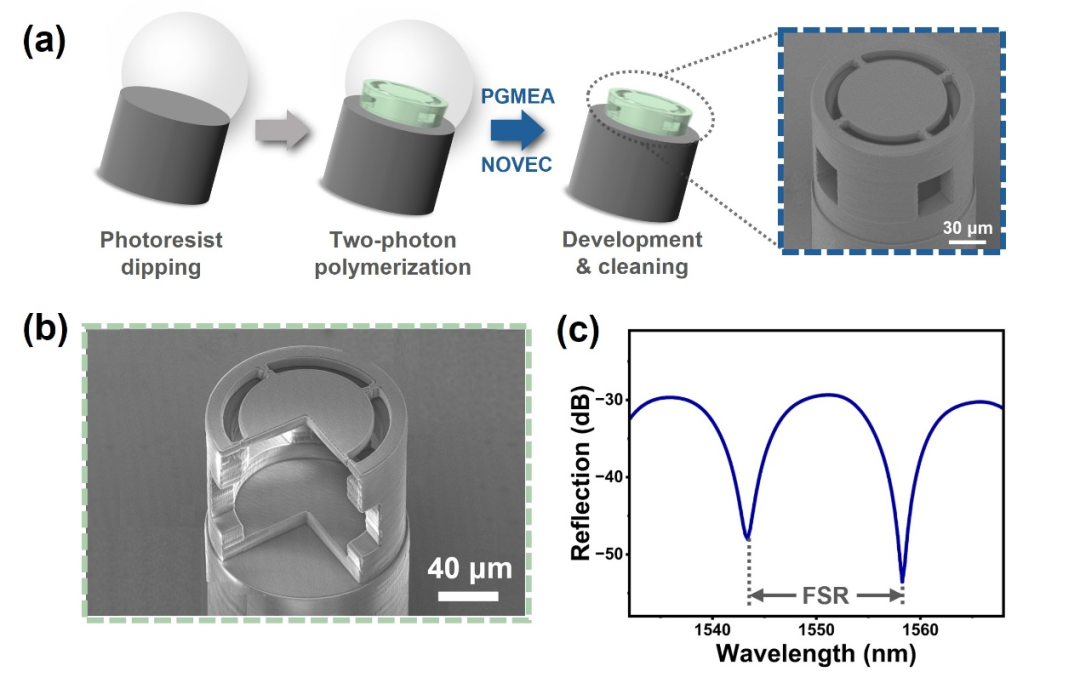
To address the challenge in diaphragm‑type fiber‑optic Fabry–Perot interferometric (FPI) ultrasonic sensors of simultaneously achieving high sensitivity and a favorable frequency response, A joint team from the Shenzhen Institute of Advanced Technology, Chinese Academy of Sciences, South China University of Technology, and other institutions has developed an optical fiber Fabry–Perot ultrasonic sensor featuring a cavity‑type tympanic‑membrane‑based diaphragm structure. This design breaks the conventional trade‑off between sensitivity and frequency response, enabling ultra‑high sensitivity across the high‑frequency range. This work First time A cavity‑drum‑type diaphragm structure is proposed, which to some extent overcomes the trade‑off between sensitivity and frequency response that has long constrained diaphragm‑based fiber‑optic FPI ultrasonic sensors, offering a novel device design approach for high‑frequency, weak‑signal ultrasonic detection. Moreover, the proposed sensor exhibits notable advantages such as miniaturization, electromagnetic interference immunity, and high sensitivity, holding promise for critical applications in online partial discharge monitoring of high‑voltage electrical equipment and in interventional photoacoustic imaging in medicine.
Thesis Title : Breaking the sensitivity-frequency trade-off in a two-photon 3D-printed hollow-tympanic diaphragm Fabry–Perot fiber ultrasonic sensor
-
Realizing Low-Frequency Acoustic Sensing Using Anti-Resonant Hollow-Core Fiber
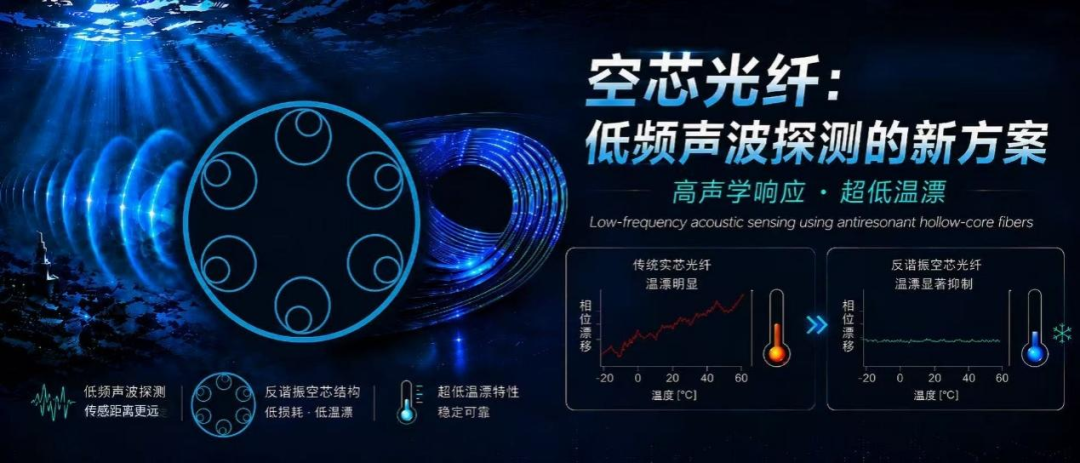
Dr. Ding Meng, a member of Professor Radan Slavík’s team at the Centre for Photonics Research at the University of Southampton in the UK, together with Dr. Wu Luocheng, a member of Professor Paul White’s team at the Institute of Acoustics and Vibration at the University of Southampton, have proposed a novel approach for detecting low-frequency acoustic waves using hollow-core optical fibers. , team Pioneering The hollow-core fiber based on ultra-low-expansion glass can effectively suppress the acoustic pressure–temperature cross-sensitivity by more than three orders of magnitude. By moving beyond the conventional “post‑processing temperature compensation” approach, this fiber reduces temperature sensitivity at the very source—through its material and structural design—providing critical fiber‑optic support for the practical deployment of low‑frequency acoustic sensing and marking a significant breakthrough in the field of fiber‑optic sensing. In the future, it could be widely applied to marine acoustic detection, seismic and volcanic monitoring, deep-sea resource exploration, and health monitoring of aerospace engines, among other applications.
Thesis Title : Towards low-frequency acoustic sensing using antiresonant hollow-core fibers
Optical Devices
-
Terahertz microfluidic sensor based on β‑cyclodextrin‑functionalized chiral metasurfaces for the recognition and detection of amino acid enantiomers.
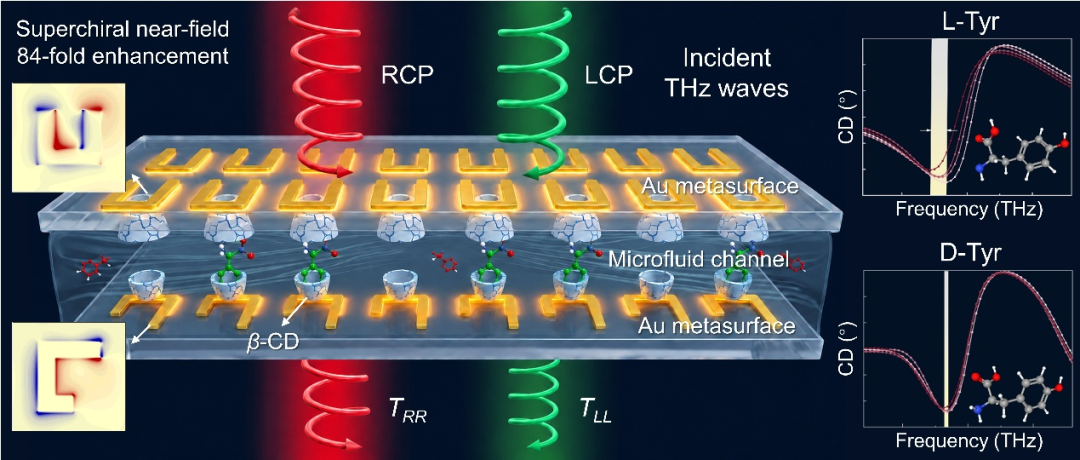
Chiral recognition is of paramount importance in life sciences, disease diagnosis, and the development of chiral drugs; however, strong absorption in aqueous environments and weak chiral signals pose significant challenges to terahertz detection. Professor Chang Shengjiang and Associate Professor Ji Yinyun’s team at Nankai University have, for the first time, proposed a terahertz microfluidic biosensor based on a β‑cyclodextrin‑functionalized bilayer chiral metasurface, enabling highly selective recognition and detection of amino acid enantiomers. This bilayer metasurface can generate an 84-fold enhancement of the hyperchiral near-field, significantly boosting light–matter interactions. The team also integrated microfluidic channels to overcome the challenge of water absorption in liquid phases, and leveraged β… – The host–guest specific recognition mechanism of cyclodextrins enables the targeted capture and selective enhancement of L‑amino acids, thereby addressing at the molecular level the critical challenge of selectivity in terahertz chiral sensing. Experimental results demonstrate that L… – The frequency shift of the L‑form of phenylalanine (L‑tyrosine) is approximately five times that of the D‑form (4.2 times), with a detection limit as low as 0.05 mg/mL, providing an effective strategy for label-free, highly sensitive terahertz detection of chiral biomolecules.
Lasers and Laser Optics
-
A flexible high-power laser system with adjustable pulse durations ranging from 100 ps to 10 ns.
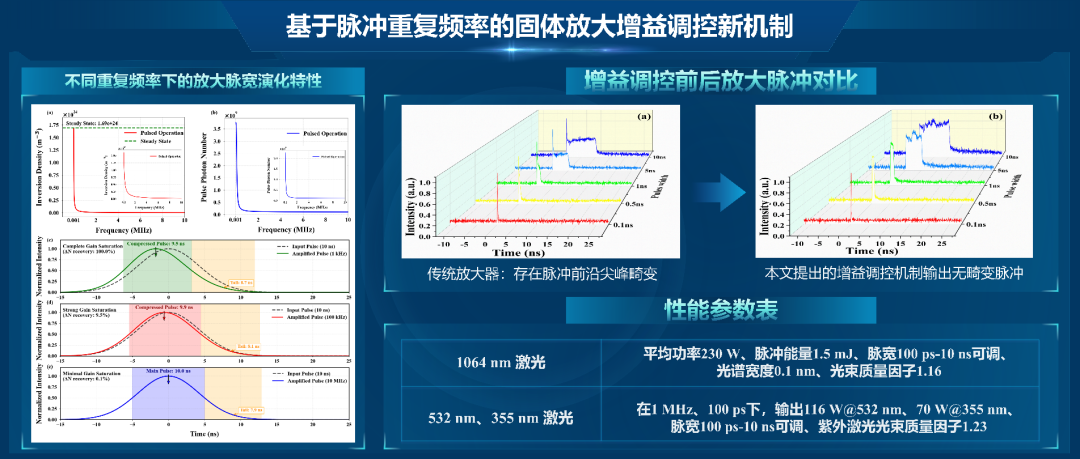
Professor Zhang Baitao’s team at the State Key Laboratory of Crystal Materials, Shandong University, based on a gain-switched semiconductor seed source and a fiber–solid hybrid master oscillator power amplifier architecture, numerically simulated the evolution of amplified pulse width under various repetition rates and proposed a novel mechanism for controlling solid-state amplification gain via pulse repetition frequency. By reducing the operating repetition rate, the initial population inversion is decreased, placing the amplifier in a “low-gain, weak-saturation” regime. This effectively suppresses pulse‑front spikes and enables wide‑range, continuously tunable, distortion‑free pulse output. At 1064 nm, the system achieves a peak average power of 230 W, with pulse durations continuously adjustable from 100 ps to 10 ns, a spectral width of 0.1 nm, and a beam quality factor better than 1.16. Through nonlinear frequency conversion, under conditions of 1 MHz repetition rate and 100‑ps pulse duration, it delivers 116 W of 532‑nm green light and 70 W of 355‑nm ultraviolet laser, both with beam quality factors exceeding 1.23. This research… First time It achieves independently tunable pulse width and repetition rate for high‑power infrared, green, and ultraviolet laser outputs, offering a new approach to developing high‑power, wide‑pulse‑width, wavelength‑tunable pulsed laser sources.
Thesis Title : Flexible high-power laser system with adjustable pulse duration from 100 ps to 10 ns
Imaging Systems, Microscopy, and Displays
-
Colorless Single-Layer Waveguide for Wide-Angle Augmented Reality Displays
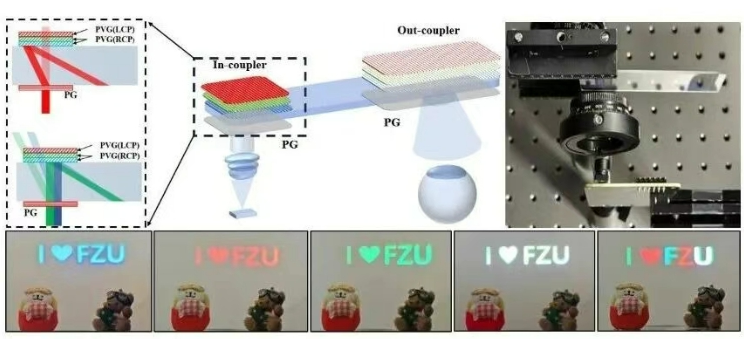
The research team led by Professor Chen Enguo at Fuzhou University’s Mindu Innovation Laboratory, in collaboration with Shenzhen University and the Hong Kong University of Science and Technology, has innovatively proposed a single-layer achromatic optical waveguide architecture tailored for augmented reality (AR) near-eye displays, offering a novel solution to the chromatic dispersion challenges inherent in conventional single-layer full-color polarization‑based holographic waveguides. This structure integrates a dual‑polarization grating (PG) unit to achieve targeted compensation for the angular deviation of red light diffraction, while ensuring that the propagation paths of blue and green light remain unaffected, thereby guaranteeing stable color transmission. Based on theoretical analysis and simulation validation, the research team fabricated an AR prototype and conducted experimental tests. The results show that, in a glass waveguide with a refractive index of 1.51, the proposed structure can realize a horizontal full‑color field of view of 18.4°, representing a 2.6‑fold improvement over conventional designs. Furthermore, when silicon carbide with a refractive index of 2.6 is used as the waveguide material, the horizontal full‑color field of view can be extended to 84°. This work breaks through the technical limitations of single‑layer full‑color diffractive waveguides and achieves significant progress in balancing device miniaturization with wide‑angle display requirements, providing an important technical reference for the design and industrial application of high‑performance full‑color AR diffractive waveguides.
Thesis Title : Achromatic single-layer waveguide for wide-view augmented reality displays
Integrated Optics
-
Integrated 110 GHz Bandwidth Net-Gain Modulator in Erbium-Doped Lithium Niobate Thin Films
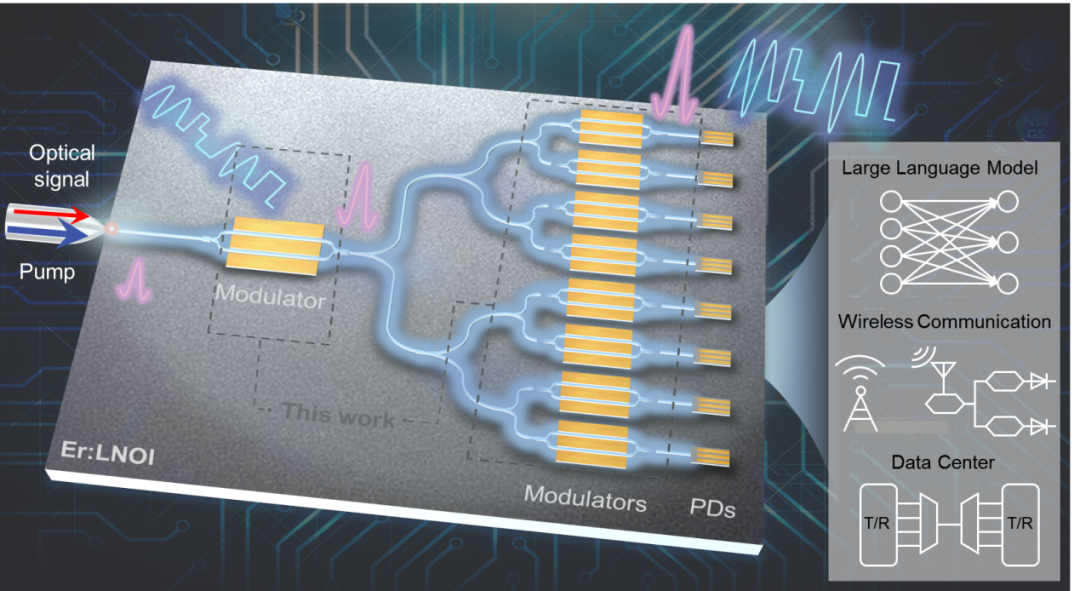
The era of artificial intelligence calls for ultra‑high‑speed, low‑loss optical interconnect chips and ultra‑high‑speed, low‑latency optical computing chips, with the electro‑optic modulator—responsible for loading data and adjusting weights—at their core. The research team led by Professor Weiwen Zou at Shanghai Jiao Tong University has successfully demonstrated a gain‑enhanced Mach–Zehnder electro‑optic modulator based on an erbium‑doped thin‑film lithium niobate platform, enabling both high‑efficiency optical amplification and ultra‑broadband modulation within a single device. The modulator integrates optical amplification within its waveguide, enabling the optical signal to achieve gain while performing high-speed electro-optic modulation. Experimental results demonstrate that the device delivers on-chip net optical gain exceeding 6 dB, an electro-optic bandwidth surpassing 110 GHz, and supports data rates of up to 144 Gbit/s, seamlessly integrating electro-optic conversion with optical amplification. By employing a single integrated structure, this device addresses the performance degradation caused by cumulative insertion loss in cascaded electro-optic modulators for optical interconnect and optical computing chips, while simultaneously enabling wide bandwidth, high‑speed signal transmission, and on-chip net gain.
Thesis Title : On-chip net-amplified modulator in erbium-doped thin-film lithium niobate with 110-GHz bandwidth
Spectroscopy
-
Ultra-low‑spectral‑resolution imaging achieved via broadband Fabry–Perot resonance and single-photon detection.
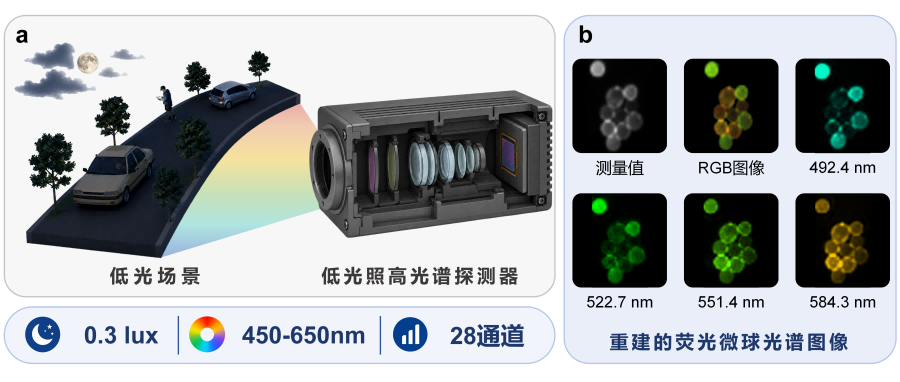
Low-light hyperspectral imaging can simultaneously acquire both spatial structure and spectral information of a scene under constrained illumination conditions, making it highly valuable for applications such as night‑vision perception, dim‑target detection, and biological fluorescence imaging. However, in low‑light environments, the number of available photons is extremely limited, and conventional hyperspectral imaging techniques struggle with insufficient light throughput, low signal‑to‑noise ratios, and the difficulty of balancing spatial and spectral resolution. The research team led by Professor Bian Liheng at Beijing Institute of Technology has proposed a low-light hyperspectral imaging method that combines broadband Fabry–Perot modulation with single-photon detection. Under an illumination level of 0.3 lux, the method achieves high-fidelity reconstruction across 28 spectral channels in the 450–650 nm range, attaining average PSNR and SSIM values of 33.53 dB and 0.953, respectively, in test scenarios. This study has overcome the limitations imposed by photon flux in hyperspectral imaging under low-light conditions, providing crucial technical support for acquiring hyperspectral information in light‑constrained environments.
Thesis Title : Ultralow-light hyperspectral imaging via broadband Fabry–Perot resonance and single-photon detection
LATEST NEWS
Thank you for visiting the official website of Chongfan Technology. If you have cooperation intentions or suggestions, please contact us through the following methods, and we will reply as soon as possible, thank you!
Address: Room 403, Building 6, Phase III of R&D, No. 36 Xiyong Avenue, High tech Zone, Chongqing, China.
Telephone: +86-13658337211
E-mail: Sales@cfkeji.net
Website: www.cfkeji.net
Mobile Version