
Chongfan Technology
News
06
2026
-
07
Progress has been made in research on optical scattering metrology.
Author:
In advanced optical manufacturing, rapid, non‑destructive, high‑precision measurement of grating nano‑scale microstructural parameters remains a significant challenge. Traditional physical inversion methods entail substantial computational overhead, while microscopic measurement techniques suffer from low throughput, high costs, and difficulties in enabling online inspection. Integrating stable optical measurement systems with deep‑learning‑based analysis engines represents a key approach to enhancing the speed and robustness of grating metrology.
Recently, teams including the Shanghai Institute of Optics and Fine Mechanics of the Chinese Academy of Sciences have made progress in deep-learning–based optical scattering metrology. The researchers have developed a dual-beam optical scattering metrology system and proposed an adaptive, self-calibrating convolutional neural network with physical constraints.
The system leverages a reference optical path to suppress source‑light fluctuations, while its model extracts multi‑scale spectral features via an adaptive receptive‑field fusion module and a self‑calibrating residual attention module, and incorporates a physics‑based loss term to enhance prediction reliability. Experimental results demonstrate that the system achieves sub‑nanometer measurement accuracy, with a coefficient of determination (R²) exceeding 0.99, and a single‑sample inference time of 9.07 ms, thereby providing robust support for high‑speed, nondestructive characterization of grating microstructural parameters.
The relevant research findings were published in Optics Express.
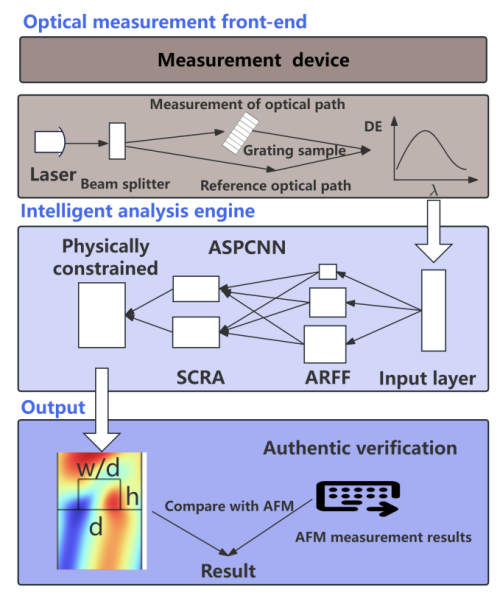
Schematic diagram of a dual-beam optical scattering measurement system and an intelligent analysis engine.
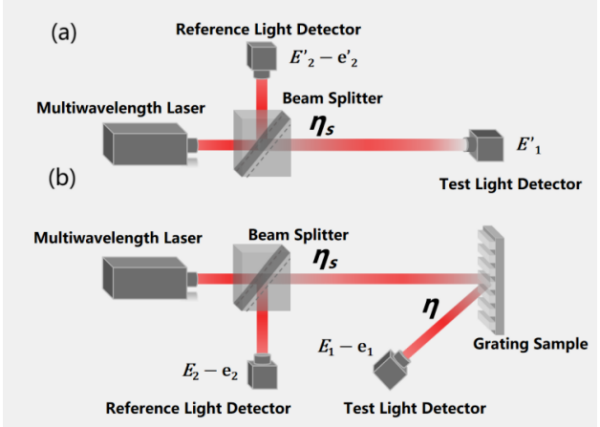
Schematic diagram of a double-beam measurement system
Source: Shanghai Institute of Optics and Fine Mechanics
LATEST NEWS
Thank you for visiting the official website of Chongfan Technology. If you have cooperation intentions or suggestions, please contact us through the following methods, and we will reply as soon as possible, thank you!
Address: Room 403, Building 6, Phase III of R&D, No. 36 Xiyong Avenue, High tech Zone, Chongqing, China.
Telephone: +86-13658337211
E-mail: Sales@cfkeji.net
Website: www.cfkeji.net
Mobile Version