
Chongfan Technology
News
24
2026
-
07
Thermally Tunable Dual-Function Terahertz Metamaterial Based on Non-Volatile Phase-Change Materials
Author:
The teams led by Quanzhong Zhao and Guofeng Yang at Jiangnan University, Lin Wu at the Singapore University of Technology and Design, Ming-Ming Chen at the Macau University of Science and Technology, and Fang-Zhou Shu at China Metrology University have proposed a thermally tunable dual‑function terahertz (THz) metamaterial based on a nonvolatile phase‑change material (Ge–Sb–Te, GST). This metamaterial comprises two aluminum sector rings, a polyimide interlayer, and a continuous GST thin film. At room temperature, it exhibits a metal–dielectric bilayer configuration that strongly interacts with incident THz radiation, inducing bright–bright mode coupling and giving rise to an electromagnetically induced transparency (EIT) effect. Upon applying high‑temperature stimulation, the GST undergoes crystallization, transforming the structure into a metal–dielectric–metal trilayer. This configuration, leveraging magnetic resonance, achieves near‑perfect dual‑frequency absorption (NPA). The design demonstrates customizable functionality, enabling EIT intensity variations exceeding 41.8% and absorption‑peak shifts of 46.0% and 57.0% for the two NPA resonances—performance markedly superior to that of existing single‑function metamaterial devices. This breakthrough could inspire further research into high‑performance, compact, and integrated terahertz components.
The research findings were published on July 20, 2026, in Laser & Photonics Reviews under the title “Thermally Tunable Dual-Functional Terahertz Metamaterials via Nonvolatile Phase Change Material.”
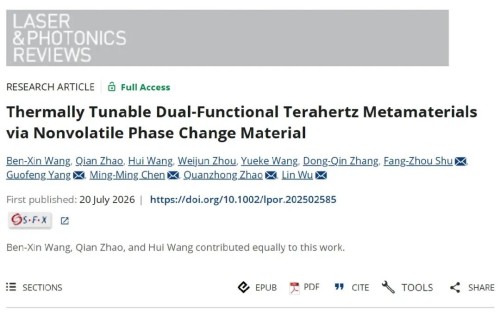
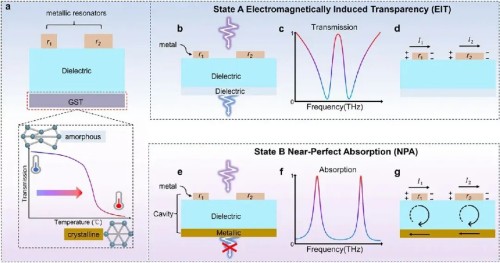
Figure 1: Principle of a thermally tunable dual-function terahertz metamaterial based on non-volatile phase-change materials.
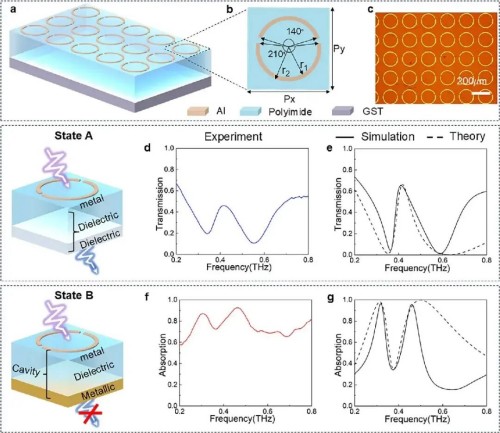
Figure 2: Experimental demonstration of a thermally tunable dual-function terahertz metamaterial.
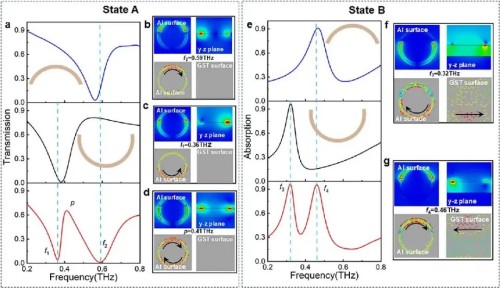
Figure 3: Numerical Simulation Analysis of the Physical Mechanisms of State A and State B
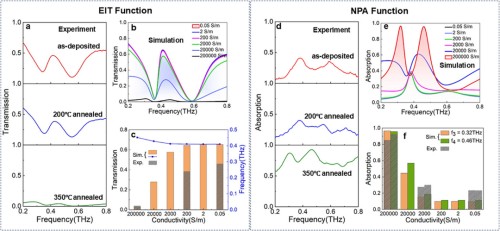
Figure 4: Continuously Adjustable
Source: Optics World
LATEST NEWS
Thank you for visiting the official website of Chongfan Technology. If you have cooperation intentions or suggestions, please contact us through the following methods, and we will reply as soon as possible, thank you!
Address: Room 403, Building 6, Phase III of R&D, No. 36 Xiyong Avenue, High tech Zone, Chongqing, China.
Telephone: +86-13658337211
E-mail: Sales@cfkeji.net
Website: www.cfkeji.net
Mobile Version