
Chongfan Technology
News
02
2026
-
07
Research on the Construction of a Photothermal–Joule Heating–Coupled Pervaporation System for Ethanol Dehydration
Author:
Currently, industrial ethanol dehydration faces several challenges, including the difficulty of azeotrope separation, high energy consumption associated with conventional heating, and susceptibility of membranes to thermal degradation. Although pervaporation membrane technology offers distinct advantages, its performance is highly temperature‑dependent, and traditional bulk‑heating approaches are inefficient and prone to compromising membrane integrity.
Recently, a team from the Xinjiang Institute of Physics and Chemistry, Chinese Academy of Sciences, has innovatively integrated photothermal and Joule‑heating mechanisms to develop a pervaporation system for ethanol dehydration that achieves precise, localized heating at the membrane interface, thereby overcoming the technical limitations of conventional bulk‑heating approaches. At the heart of this ethanol dehydration system is an MWCNTs/SA‑PAN@BF composite pervaporation membrane paired with a dual‑heat‑source synergistic device. The membrane layer uses basalt fiber fabric (BF) as its substrate; after modification with polyacrylonitrile (PAN), it is loaded with a carboxylated multi‑walled carbon nanotube (MWCNTs)/sodium alginate (SA) photothermal separation layer, which exhibits excellent hydrophilicity, high photothermal conversion efficiency, and robust structural stability, enabling targeted temperature control at the membrane interface.
Under the synergistic action of one standard solar irradiance and a voltage of 2.9 V, the optimized 2 wt% MWCNT‑loaded membrane achieves a permeate flux of 1124.67 g·m⁻²·h⁻¹ for the dehydration of 90 wt% ethanol, with a separation factor as high as 1313.64. Compared with conventional bulk oil‑bath heating, the overall energy consumption of the system is reduced by more than 80%, and when powered solely by natural light, the energy savings can reach 90%. Furthermore, during 120 hours of continuous operation, the membrane exhibits no significant decline in flux or separation factor; its Ca²⁺‑crosslinked structure remains stable without leaching, and its microstructure retains its integrity, demonstrating excellent long-term stability. The system demonstrates outstanding water/ethanol selectivity, with a separation mechanism driven by the cooperative interplay of “selective dissolution–directed diffusion–vacuum desorption.”
This study achieves the efficient utilization of materials such as carbon nanotubes and basalt fibers, offering a green, low‑carbon, energy‑saving, and highly efficient new pathway for pervaporation membrane separation technology, while also providing an innovative solution for the large‑scale application of industrial ethanol dehydration.
The relevant research findings were published in Separation and Purification Technology. This work was supported by the Xinjiang Talent Development Fund, the Chinese Academy of Sciences’ “Light of the West” Talent Cultivation Program, and other funding sources.
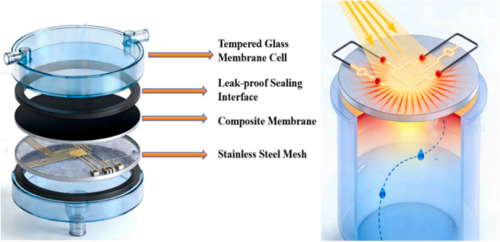
Research on the Construction of a Photothermal–Joule-Heating Synergistic Coupled Pervaporation System for Ethanol Dehydration
Source: Xinjiang Institute of Physics and Chemistry, Chinese Academy of Sciences
Previous
Previous
LATEST NEWS
Thank you for visiting the official website of Chongfan Technology. If you have cooperation intentions or suggestions, please contact us through the following methods, and we will reply as soon as possible, thank you!
Address: Room 403, Building 6, Phase III of R&D, No. 36 Xiyong Avenue, High tech Zone, Chongqing, China.
Telephone: +86-13658337211
E-mail: Sales@cfkeji.net
Website: www.cfkeji.net
Mobile Version