
Chongfan Technology
News
02
2026
-
07
A research team from East China Normal University has achieved significant progress in the field of ultrafast spectroscopy.
Author:
Introduction
Recently, Professor Zeng Heping and Researcher Yan Ming’s team at the Chongqing Research Institute of East China Normal University have made significant advances in the field of ultrafast spectroscopy. The research group has demonstrated time‑resolved dispersive Fourier‑transform spectroscopy based on an optical storage cavity, thereby addressing the spectral aliasing problem that has long plagued conventional time‑stretch spectroscopy in ultrafast measurements. This breakthrough enables real‑time characterization of non‑repetitive ultrafast spectral events separated by only a few picoseconds.
The research findings, titled “Temporally super-resolved dispersive Fourier transformations spectroscopy,” were published in Nature Photonics on June 29, 2026.
Research Background
Ultrafast spectroscopy is an essential tool for investigating transient processes such as laser dynamics, material phase transitions, chemical reactions, and biomolecular dynamics. Many critical processes occur on picosecond timescales or even faster, and they are often stochastic and irreproducible. Conventional pump–probe methods typically rely on repeated measurements, making it difficult to capture a single event in its entirety; meanwhile, spectral techniques based on spatiotemporal encoding or streak cameras suffer from limitations in storage depth and real-time performance. Time-domain dispersive Fourier transform spectroscopy—also known as “time‑stretch” spectroscopy—enables continuous, real-time spectral acquisition, but its spectral acquisition speed and temporal resolution are constrained by the pulse repetition period. When the time interval between successive events is too short, spectral aliasing arises, thereby limiting its utility in ultrafast optical research.
To address this challenge, the research team developed a time‑resolved dispersion‑based Fourier‑transform spectroscopy technique leveraging optical storage cavities. This method stores ultrashort pulses, each carrying distinct transient spectral information, within an optical cavity and then reads out the pulses sequentially via temporal “gates,” thereby preventing overlap between adjacent spectral signals. The team successfully advanced time‑domain spectroscopic measurement to the picosecond timescale, offering a new approach for real‑time observation of non‑repetitive ultrafast processes.
Research Innovation Highlights
1. Developing a novel mechanism for optical time-resolved super-resolution measurement
The research team integrated an optical storage cavity into time‑stretch spectroscopy, enabling ultrashort pulses carrying distinct spectral information to undergo controlled replication and temporal delay within the cavity. Subsequently, spectral events are read out one by one using asynchronous sampling. This approach effectively stores an ultrafast “spectral movie” before playing it back frame by frame, thereby circumventing the overlap of adjacent spectral signals during the time‑stretch process at the measurement level.
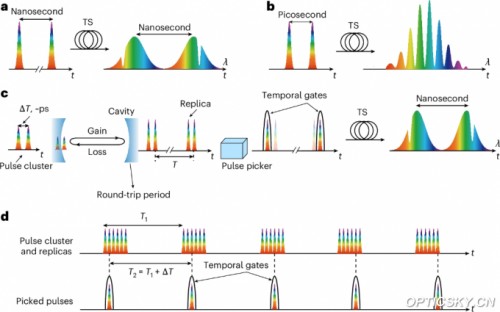
Schematic diagram of the principle of time-resolved dispersive Fourier-transform spectroscopy.
2. Extending continuous single-shot spectroscopic measurements to the picosecond timescale
Traditional time‑stretch spectroscopy is limited by temporal aliasing, with the time resolution of continuous measurements typically confined to the nanosecond regime. By employing a time‑super‑resolution readout scheme, the research team has advanced single‑shot spectral acquisition to the picosecond timescale. In experiments, they successfully resolved the spectral evolution of 25‑GHz electro‑optic frequency‑comb pulses and further distinguished transient spectral features separated by as little as 3 ps, thereby enhancing the time resolution of time‑stretch spectroscopy by three orders of magnitude.
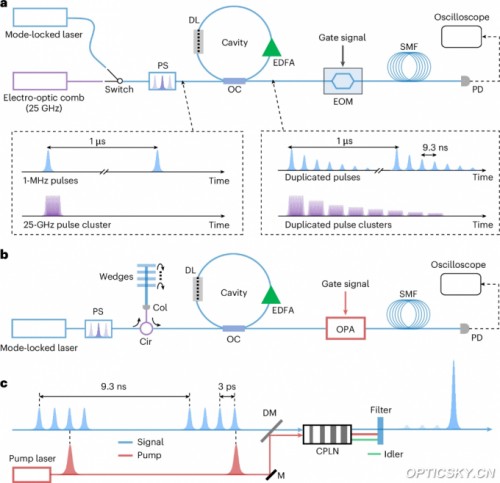
Experimental setup for time-resolved dispersive Fourier-transform spectroscopy
3. Expanding the capability for real-time observation of non-repetitive ultrafast processes
This method does not rely on multiple repetitions of the process under investigation, enabling it to preserve the continuous spectral evolution of random, transient, and non-reproducible events. Compared with conventional pump–probe techniques, it is better suited for probing non-repetitive ultrafast processes such as optical rogue waves, mode-locking laser dynamics, microcavity dynamics, laser‑induced plasmas, material phase transitions, and chemical reactions, thereby offering a new technological pathway for ultrafast spectroscopy and real-time precision measurements.
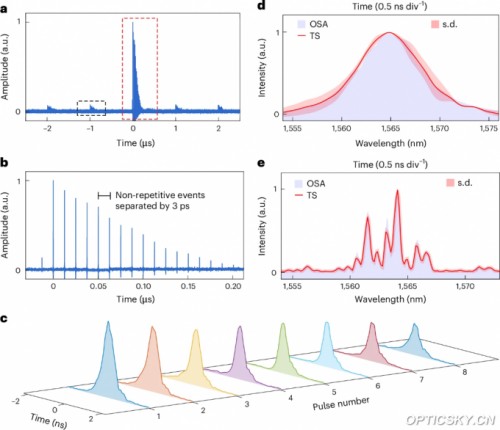
Time-resolved super-resolution measurement results of spectral events separated by 3 ps
Summary and Outlook
This study offers a novel technical approach for ultrafast spectroscopic measurements, enabling the observation of non-repetitive, uncontrolled transient spectra and stochastic dynamical processes. By integrating frequency up-conversion techniques, this method can be extended into the mid-infrared molecular fingerprint region, providing an ultrafast spectroscopic tool for applications in chemical analysis, biological sensing, and materials science.
Professor Zeng Heping and Researcher Yan Ming’s team have long been dedicated to research on molecular fingerprint spectroscopy and precision measurement technologies based on optical frequency combs. They have successively developed innovative methods and technologies, including cavity optomechanical-enhanced dual-comb spectroscopy [Nature Communications 14, 5037 (2023)], infrared time‑stretch spectroscopy [Laser Photonics Reviews 18, 2300630 (2024)], time‑domain binocular vision 3D imaging [Nature Communications 16, 6839 (2025)], and quantum‑correlation‑enhanced dual-comb spectroscopy [Light: Science & Applications 14, 257 (2025)]. These efforts have been supported by major national science and technology programs, as well as funding from Chongqing Municipality, Hainan Province, and Shanghai Municipality.
Source: Chongqing Research Institute of East China Normal University
LATEST NEWS
Thank you for visiting the official website of Chongfan Technology. If you have cooperation intentions or suggestions, please contact us through the following methods, and we will reply as soon as possible, thank you!
Address: Room 403, Building 6, Phase III of R&D, No. 36 Xiyong Avenue, High tech Zone, Chongqing, China.
Telephone: +86-13658337211
E-mail: Sales@cfkeji.net
Website: www.cfkeji.net
Mobile Version