
Chongfan Technology
News
02
2026
-
07
Ultrafast Magneto-Optical Fingerprint Features in the Interleaved Magnet MnTe
Author:
Interleaved magnets are an unconventional class of magnetic systems that have attracted considerable attention in recent years within the fields of condensed matter physics and spintronics. Their defining feature lies in the unique coexistence of two distinct properties: in real space, they resemble conventional antiferromagnets, with macroscopic magnetic moments nearly fully canceled; in momentum space, however, they exhibit a spin-split band structure akin to that of ferromagnets. This peculiar combination—“antiferromagnetic in real space, ferromagnetic‑like in momentum space”—endows them with advantages such as low stray fields, ultrafast response times, and strong spin‑dependent responses, thereby opening up promising avenues for practical applications. Nevertheless, how to experimentally probe both of these properties simultaneously using efficient methods remains a critical challenge that urgently needs to be addressed in this field.
Magneto‑optical effects are widely employed to probe spin‑related physical properties and electronic structures of materials. Depending on how time-reversal symmetry is violated, two principal magneto‑optical effects can be distinguished: the time-reversal‑odd Magneto‑Optical Kerr Effect (MOKE) and the time-reversal‑even Magneto‑Optical Voigt Effect (MOVE). Traditionally, MOKE has served as a highly sensitive probe for characterizing ferromagnets, with its signal scaling linearly with magnetization (M). However, in fully compensated antiferromagnets, the opposing sublattices exhibit antiparallel alignment, resulting in a net magnetization of zero. Consequently, any magneto‑optical effect that depends linearly (as an odd function) on M is suppressed by destructive interference arising from signals originating from the opposite sublattice. In contrast, the time-reversal‑even Magneto‑Optical Voigt Effect is highly sensitive to antiferromagnetic Néel order and is often used as its primary diagnostic tool. Given that the Magneto‑Optical Kerr Effect is exquisitely sensitive to ferromagnetism, while the Magneto‑Optical Voigt Effect responds strongly to antiferromagnetism, both effects are expected to coexist in interfacial magnetic heterostructures, thereby providing potential fingerprint signatures for this emerging class of magnetic systems.
Recently, the research group led by Researcher Cheng Zhaohua at the Laboratory of Magnetism, Institute of Physics, Chinese Academy of Sciences / Beijing National Laboratory for Condensed Matter Physics, in collaboration with the Hong Kong University of Science and Technology and the Songshan Lake Materials Laboratory, among other institutions, has achieved a significant breakthrough in the study of the intercalated magnetic material MnTe. For the first time, the team observed the coexistence of pronounced magneto‑optical Kerr and Voigt effects in this material, systematically demonstrating that these effects originate, respectively, from Berry curvature in momentum space and Néel antiferromagnetic order in real space, thereby providing clear magneto‑optical fingerprints for intercalated magnets. Using time‑resolved magneto‑optical techniques, the researchers conducted a systematic investigation of the magneto‑optical response of 30‑nm‑thick MnTe thin films. By precisely tuning the polarization state of the probe light and the direction of the applied magnetic field, they successfully disentangled the contributions of the Kerr and Voigt effects. Combined with symmetry analysis and first‑principles calculations, the study further revealed that the Kerr signal exhibits magnetic‑field antisymmetry and is predominantly governed by the distribution of Berry curvature in momentum space within the intercalated magnetic structure, whereas the Voigt signal displays magnetic‑field symmetry and arises from anisotropic dielectric responses induced by the in‑plane Néel vector, reflecting antiferromagnetic order in real space. Particularly noteworthy is the distinct temporal evolution of the two magneto‑optical responses: the Kerr signal relaxes on a timescale of approximately 445 fs, while the Voigt response undergoes a two‑step relaxation process, with time constants of about 642 fs and 1.42 ps, respectively. This indicates that the electronic‑structure response underlying the Kerr effect is faster, whereas the spin‑ordering dynamics associated with the Voigt effect are comparatively slower, thus shedding further light, from a dynamical perspective, on the dual nature of intercalated magnets.
The study demonstrates that the coexistence of the magneto‑optical Kerr effect and the Voigt effect, along with their distinct ultrafast dynamical behaviors, can serve as an effective magneto‑optical fingerprint for identifying altermagnetism. This finding not only deepens our understanding of unconventional magneto‑optical responses in compensation‑type magnets but also opens up new avenues for achieving synergistic control over light, spin, and electronic degrees of freedom using altermagnetic materials. The relevant results, titled “Ultrafast Magneto-Optical Fingerprints of Altermagnetism in MnTe,” have been published in Physical Review Letters.
Associate Researcher Yang Xu of the Institute of Physics, Chinese Academy of Sciences, and Cheng Xingkai of the Hong Kong University of Science and Technology are the co-first authors of the paper, while Researcher Cheng Zhaohua and Associate Professor Liu Junwei of the Hong Kong University of Science and Technology serve as the co-corresponding authors. Key contributors to this work also include Senior Engineer Feng Hongmei from the Attosecond Center at the Songshan Lake Materials Laboratory, Deputy Chief Engineer Zhang Xiangqun and Associate Researcher He Wei of the Magnetism Laboratory at the Institute of Physics, Chinese Academy of Sciences. This research was supported by projects under the National Key R&D Program, the Hong Kong Research Grants Council, and the National Natural Science Foundation of China, among others.
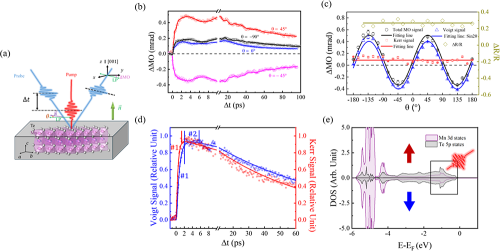
Figure (a) shows the experimental configuration for ultrafast magneto-optical response measurements of MnTe; (b) illustrates the polarization-dependent magneto-optical response of the probe beam; (c) presents the angle‑dependent magneto-optical signal at Δt = 3.0 ps; (d) depicts the time-resolved evolution of the magneto‑optical Kerr and Voigt effects; and (e) provides a schematic of the spin‑resolved density of states in MnTe.
Source: Institute of Physics
LATEST NEWS
Thank you for visiting the official website of Chongfan Technology. If you have cooperation intentions or suggestions, please contact us through the following methods, and we will reply as soon as possible, thank you!
Address: Room 403, Building 6, Phase III of R&D, No. 36 Xiyong Avenue, High tech Zone, Chongqing, China.
Telephone: +86-13658337211
E-mail: Sales@cfkeji.net
Website: www.cfkeji.net
Mobile Version